Tricks to Teach Your Dog: 8 Easy Tricks With Step-by-Step Plans
The best tricks to teach your dog are the ones that look fun, take minutes to start, and build focus, confidence, and body control while you train them.
Trick training is not just showing off. Short learning games tire a dog’s mind, and a dog who learns how to learn becomes easier to teach in everyday life.
This guide gives you eight easy tricks in a sensible order. Each one has clear steps, plus help for common sticking points and safety notes.
Tricks to Teach Your Dog: The Direct Answer
To learn tricks to teach your dog, start with touch, keep sessions short, and reward the exact moment your dog gets it right.
Teach one trick at a time until it works in a quiet room. Then add a little distance or a mild distraction, and only then move to a busier place.
Key Takeaways
- Start with touch and shake, because both are quick wins for most dogs.
- Keep sessions to five to ten minutes, and stop while your dog still wants more.
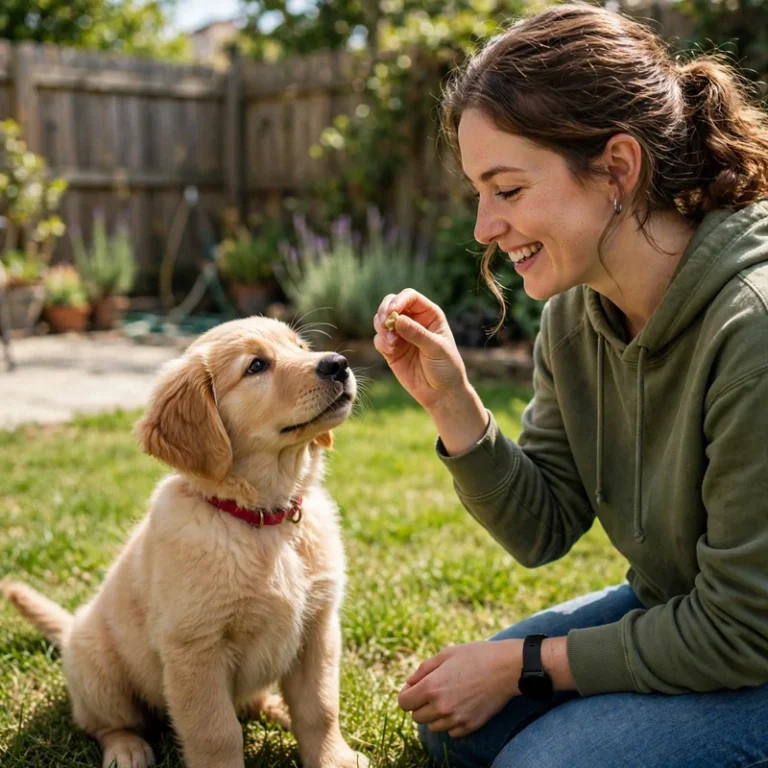
- Mark the right moment with a clear word or click, then pay with a treat at once.
- Build one small step at a time, and go back a step when your dog struggles.
- Choose tricks to teach your dog that fit your dog’s body, and skip any move that causes pain or limping.
- Use rewards only, and get help early for pain, sudden change, or aggression.
How Dogs Learn Tricks
Dogs learn by repeating actions that pay off. When a behavior earns a treat, a toy, or a game, your dog is more likely to offer it again.
Timing matters more than speed. Mark the instant your dog does the right thing, then deliver the reward where you want the next try to happen.
Short sessions work best, because focus fades fast. Two or three short sessions a day usually beat one long session that ends in frustration.
Teach one trick at a time, so your dog can link one word to one action. Mixing two new tricks in one session often slows both of them down.
- Keep sessions short, and train in a quiet room first.
- Use tiny, soft treats that are fast to swallow.
- Mark, then pay, every time at first.
- Get the behavior first, and add the word second.
- End on a win, not on a failure.
A strong touch also helps recall, because your dog learns to move toward you for a reward. For a staged recall plan, read the Beagle recall guide.
The 8 Tricks at a Glance
| Trick | Start with | Move on when |
|---|---|---|
| Touch | Nose to palm | Your dog drives to your hand |
| Shake | Paw lift from a sit | Your dog offers a paw on sight of your hand |
| Spin | A slow treat lure in a circle | Your dog turns smoothly for a quarter turn |
| Roll Over | A lure from a down | Your dog flops to his side calmly |
| Play Dead | A lure to a side flop | Your dog holds still for a second |
| Sit Pretty | A lure up from a sit | Your dog lifts his paws with control |
| Wave | A high paw from shake | Your dog lifts a paw without touching your hand |
| Find It | A treat under one cup | Your dog searches with confidence |
Trick 1: Touch
Touch teaches your dog to press his nose to your palm. It sounds simple, and it is a useful foundation for recall, guiding, and many later tricks.
- Hold your flat palm a few inches from your dog’s nose.
- Mark and treat the instant his nose touches your palm.
- Remove your hand, present it again, and repeat.
- Add the word touch once your dog drives to your hand.
- Move your hand higher, lower, and to each side.
Keep your hand still and let your dog come to you. If he sniffs without touching, wait a moment, then present your hand again.
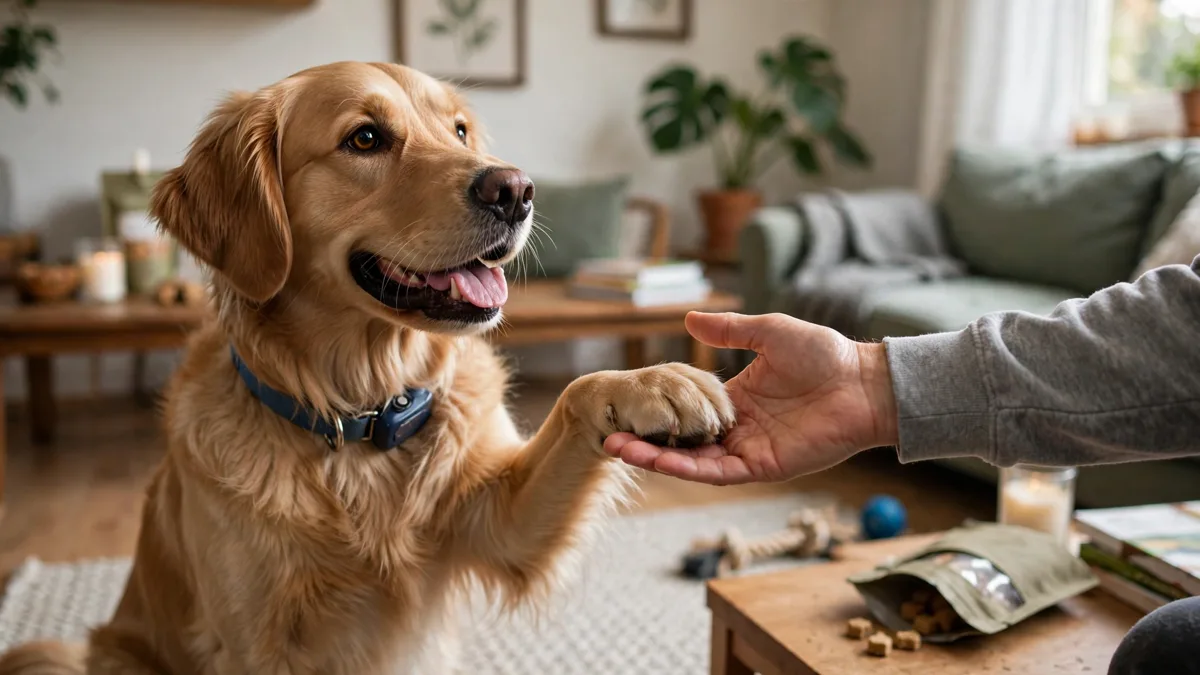
Trick 2: Shake
Shake teaches your dog to offer a paw on cue. It builds on touch, because your dog already knows that offering a behavior earns a reward.
- Ask for a sit, and hold a treat in your closed fist at chest height.
- Mark and treat any paw lift, even a small one.
- Open your hand to pay, then close it again for the next try.
- Add the word shake once your dog offers a paw on sight of your hand.
- Practice the other paw, and keep sessions short.
Reward the paw your dog offers, and do not grab a paw he did not offer. If teeth land on your hand during paw work, pause the game and offer a toy instead. For a full mouthing plan, read the Golden Retriever puppy nipping guide.
Trick 3: Spin
Spin teaches your dog to turn in a circle on cue. It is a fun warm-up, and it teaches your dog to follow a lure without rushing.
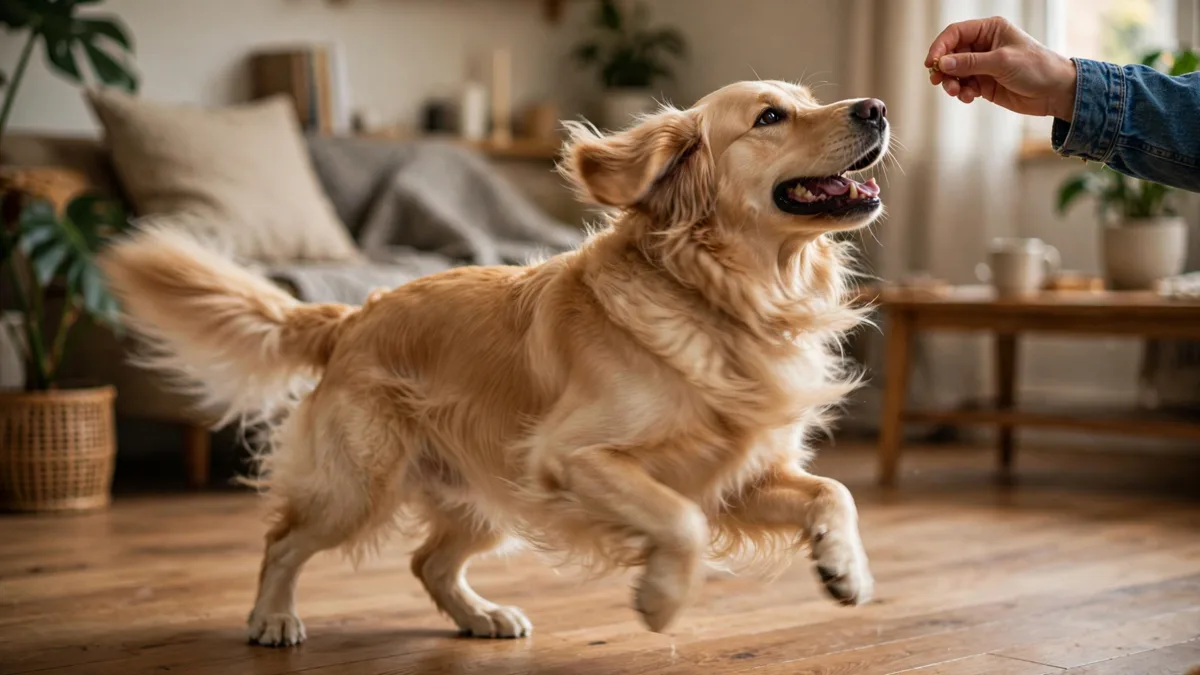
- Hold a treat at your dog’s nose, and draw a big, slow circle.
- Reward a quarter turn, then a half turn, then a full turn.
- Add the word spin once the full turn is smooth.
- Make the lure smaller over several sessions.
- Teach the other direction, using the word twirl.
Go slowly at first, because a fast lure makes many dogs lose the turn. If your dog looks wobbly or dizzy, stop and try a slower, wider circle later.
Trick 4: Roll Over
Roll over teaches your dog to roll from a down to his side and around. It needs patience, because most dogs learn it in stages, not in one session.
- Start from a down, on carpet or grass.
- Bring a treat to his nose, then arc it slowly back over his shoulder.
- Reward the head turn, then the flop onto his side.
- Reward the full roll, in small stages, over several sessions.
- Add the words roll over only when the full roll is smooth.
- Fade the lure by making the same hand motion smaller.
Work on a soft, non-slip surface, and skip this trick if your dog is stiff or sore. Ask your vet first if you are unsure whether rolling suits your dog.
Trick 5: Play Dead
Play dead teaches your dog to flop to his side and hold still. It pairs well with roll over, because both start from the same side flop.
- Start from a down, and lure his head toward his shoulder.
- Stop at the flopped-on-side position, and reward at once.
- Build stillness in seconds: one second, then three seconds.
- Add your word and hand signal, such as bang, once stillness is steady.
- Release him with a cheerful word and a game.
Keep stillness short at first, so your dog can succeed often. The contrast between statue-still and released-and-playing is what makes this trick fun.
Trick 6: Sit Pretty
Sit pretty teaches your dog to sit up with his front paws raised. It is a core workout, so keep reps few and build the hold very slowly.
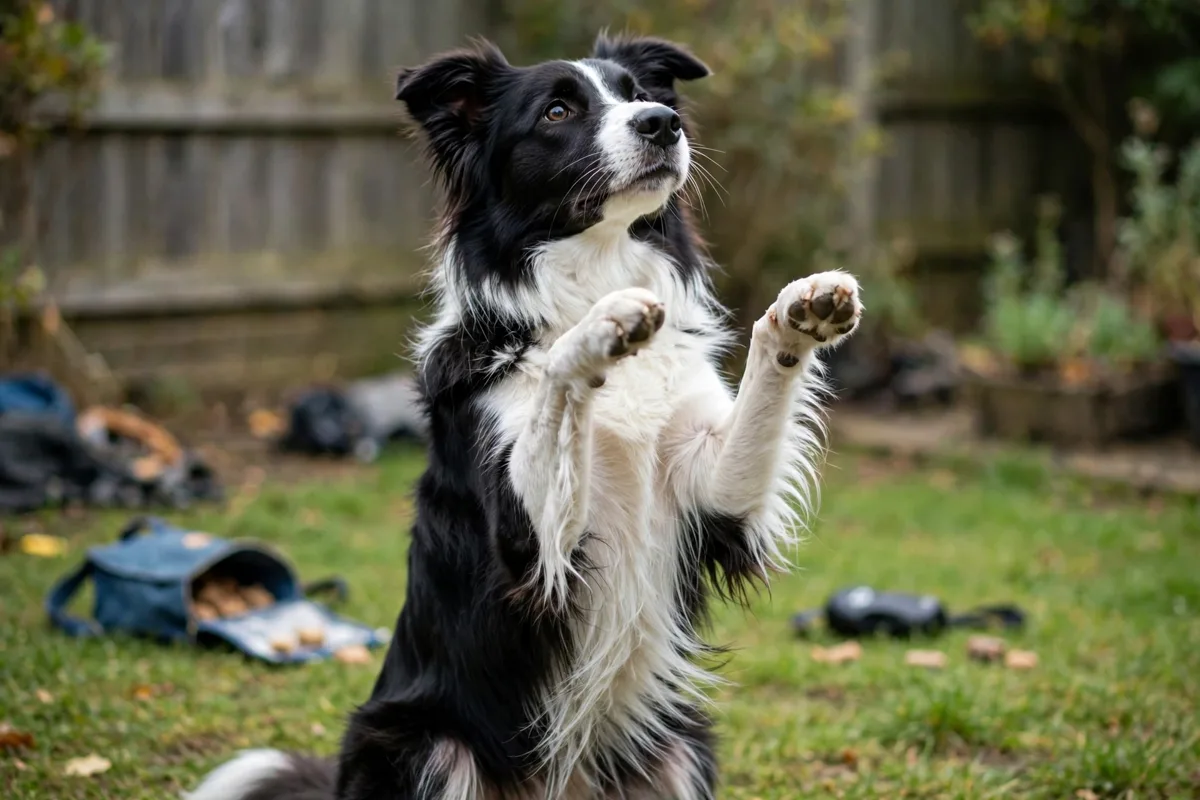
- Ask for a sit, then hold a treat just above and slightly behind his nose.
- Reward any lift of the front paws, even a small one.
- Let him lean a paw on your forearm in the early stages.
- Build to a three-second hold, one second at a time.
- Add the words sit pretty once the hold is steady.
- Lengthen the hold slowly, and keep reps few.
Skip or change this trick if your dog has back, hip, or balance problems. Ask your vet or a qualified trainer for a safer version for your dog.
Trick 7: Wave
Wave teaches your dog to raise a paw in the air without touching your hand. A high five is simply a shake with a higher palm, so use it as a step toward wave.
- Start from shake, and present your palm upright and a little higher.
- Reward a paw lift that reaches up, even before it touches your hand.
- Raise your palm a little more over several sessions.
- Step back a little, and reward any raised paw at that distance.
- Add the word wave once the raised paw is reliable.
Keep these sessions silly and short, because paw tricks excite many dogs. If your dog starts jumping, pause, reset with a sit, and try again calmly.
Trick 8: Find It
Find it teaches your dog to search for a hidden treat on cue. It is a great rainy-day game, because searching uses both mind and nose.
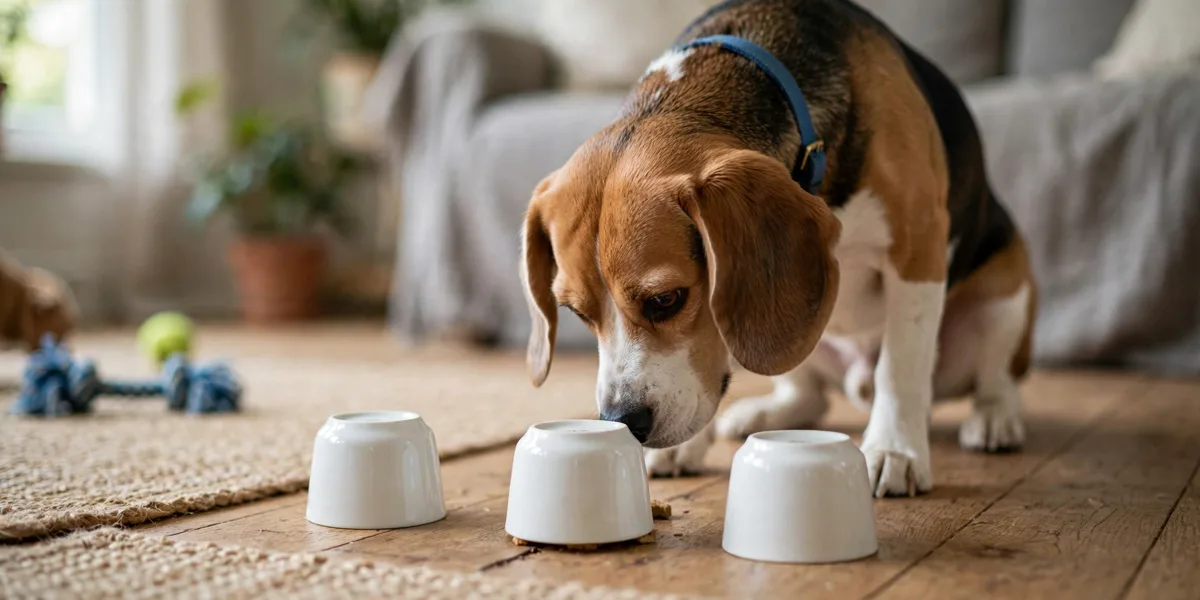
- Let your dog watch you place a treat under one of three cups.
- Ask him to find it, and reward the correct cup at once.
- Add more cups, and hide the treat while he watches less.
- Hide treats around one room while he waits in another spot.
- Add the words find it once searching is confident.
- Build to harder hides, one step at a time.
Start embarrassingly easy, so your dog wins often and wants to play again. A dog who can find it can also find a toy, which makes the game useful every day.
Troubleshooting: When a Trick Stalls
If your dog fails twice in a row, the step was too big. Go back to the last version he could do, reward that, and try the harder step later.
| Problem | What it usually means | Try this |
|---|---|---|
| Walks away or lies down | Tired, or the reward is too low | End cheerfully and try later with a better reward |
| Gets frantic or grabs | Excitement is too high | Slow down and reward calmer tries only |
| Works at home, not outside | The new place is harder | Restart easy in the new place |
| Stuck after several days | The trick needs a smaller step | Park it, teach another trick, and return later |
Distractions need their own staged plan, because a skill in one place does not transfer by itself. The German Shepherd recall guide shows how to rebuild a skill place by place.
What NOT to Do
- Do not repeat the cue many times, or your dog will learn to wait for the third or fourth call.
- Do not scold, push, or force your dog’s body into a position.
- Do not use shock or prong collars in trick training.
- Do not train through pain, limping, fear, or tiredness.
- Do not make every recall or trick the end of fun.
Keep training kind and clear. If your dog looks stressed, with a tucked tail, yawning, lip licking, or turning away, stop and try an easier step later.
When to Get Professional Help
Most stalls are training stalls, and a smaller step fixes them. Get help sooner when safety, health, or welfare is in doubt.
- Pain, limping, stiffness, or a sudden change in behavior.
- Aggression, such as growling, snapping, or guarding.
- Fear that does not ease with easier steps and distance.
- A skill that was solid and then falls apart suddenly.
See your vet first for pain, sudden changes, or medical causes. Then talk to a qualified, reward-based trainer or behavior professional for a plan.
Frequently Asked Questions
What are the easiest tricks to teach your dog first?
Touch or shake. Both take minutes for most dogs, pay off at once, and teach your dog how training works.
How long does it take to teach a trick?
Simple tricks like spin and shake often land within a few short sessions spread over a few days. Harder tricks, like roll over, need more stages and more patience.
Can a puppy and an older dog learn the same way?
Yes, with shorter, gentler sessions for puppies and for older dogs. Keep it playful, watch for tiredness, and ask your vet if your older dog is stiff or sore.
My dog is not food motivated. Can he still learn tricks?
Yes. Use whatever he loves as pay: a favorite toy, a game of tug, or enthusiastic play, delivered right after the right behavior.
How do I stop using treats for every trick?
Once a trick is fluent, reward every second success, then reward at random, while always praising the effort. Keep a treat handy for hard places, so the trick stays strong.
The Bottom Line
The tricks to teach your dog in this guide work best in order, from touch to find it, with short sessions and kind rewards.
Start with touch this week, add shake when touch is solid, and build one trick at a time. Keep it short, keep it fun, and end while your dog still wants more.
Reference
American Kennel Club, Why Trick Training Is Good for Dogs and Their People: https://www.akc.org/products-services/training-programs/canine-good-citizen/articles/why-trick-training-is-good-for-dogs/
Still stuck? Get a plan built for your dog.
Answer a few quick questions and get a personalized, force-free training plan in minutes.
Try the Free Dog Tools