How to Stop Your Golden Retriever Puppy Nipping: 4-Week Plan
Golden Retriever puppies are affectionately known as baby land sharks, and anyone who’s dealt with golden retriever puppy nipping knows exactly why. Those needle teeth find hands, sleeves, ankles, and anything else within reach.
If you’re wondering how to stop golden retriever puppy nipping, start here: this is normal, it’s temporary, and there’s a plan that works. It just needs consistency from every human in the house.
Goldens nip more than many breeds because they were bred to use their mouths. A retrieving breed explores the world orally, plays orally, and shows affection orally. You’re not fixing a broken puppy; you’re teaching a mouthy breed where the mouth belongs.
Key Takeaways
- Nipping is normal puppy behavior, amplified in Goldens by the retrieving instinct and teething. It is not aggression.
- The core method is simple: redirect to a toy, reward gentle behavior, and briefly remove your attention when teeth hit skin.
- Never use scruff grabs, alpha rolls, or physical punishment: they increase fear and can make mouthiness worse.
- Expect real improvement in 2–4 weeks of consistent work from the whole family, with full resolution as teething ends around 6 months.
Why Golden Retriever Puppies Nip So Much
The retrieving mouth. Goldens were developed to carry game gently in their mouths. That breeding left them unusually oral: they mouth when playing, when greeting, when excited, when exploring.
A Labrador or Golden puppy will always be mouthier than, say, a Greyhound puppy. It’s genetics, not attitude.
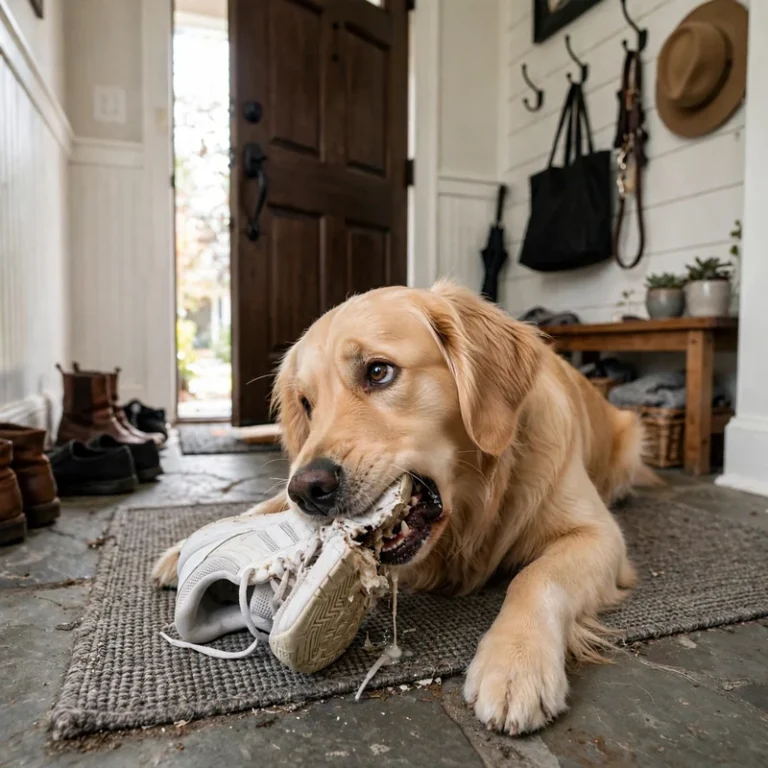
Teething. Puppy teeth erupt, then adult teeth push through between roughly 4 and 6 months. Sore gums drive chewing and mouthing. Frozen chew toys help more than any correction ever will.
Play. Puppies play with their mouths the way human toddlers grab with their hands. Your puppy nips you for the same reason they wrestle their littermates: it’s how puppies play.
Overtiredness. An overtired puppy nips harder and more frantically. Many owners don’t realize their puppy’s worst biting happens when the puppy desperately needs a nap, not more play.
Puppies need a lot of sleep, and a cranky, bitey evening puppy is often just an exhausted one.
Under-exercise and boredom. A puppy with unspent energy and nothing to chew will invent both an activity and a target. Usually your hands.
The Ground Rules Before Week 1
Everyone follows the same plan. If one family member allows nipping (“oh, he’s just playing”) while another corrects it, the puppy learns nothing except confusion. Get agreement first.
Set up management. Keep your puppy on a light indoor leash or in a pen when not actively supervised. Management prevents rehearsal: every unaddressed nip is practice. Have chew toys in every room.
Never punish the mouth. No scruff grabs, no muzzle holding, no alpha rolls, no yelling in the puppy’s face. These are still recommended in some corners of the internet, but they work through fear, damage trust, and can escalate mouthiness into genuinely fearful behavior.
This breed is sensitive and eager to please: punishment is both unnecessary and counterproductive.
Meet the needs first. A puppy who is tired, well-fed, exercised appropriately for their age, and napped enough nips far less. Training works on top of met needs, never instead of them.

How to Stop Golden Retriever Puppy Nipping: Your 4-Week Plan
Week 1: Redirect and Reward
The foundation. Every time teeth touch skin or clothes, immediately offer a toy instead.
When the puppy takes the toy, praise warmly. You’re teaching a simple equation: toys are for biting, people are not.
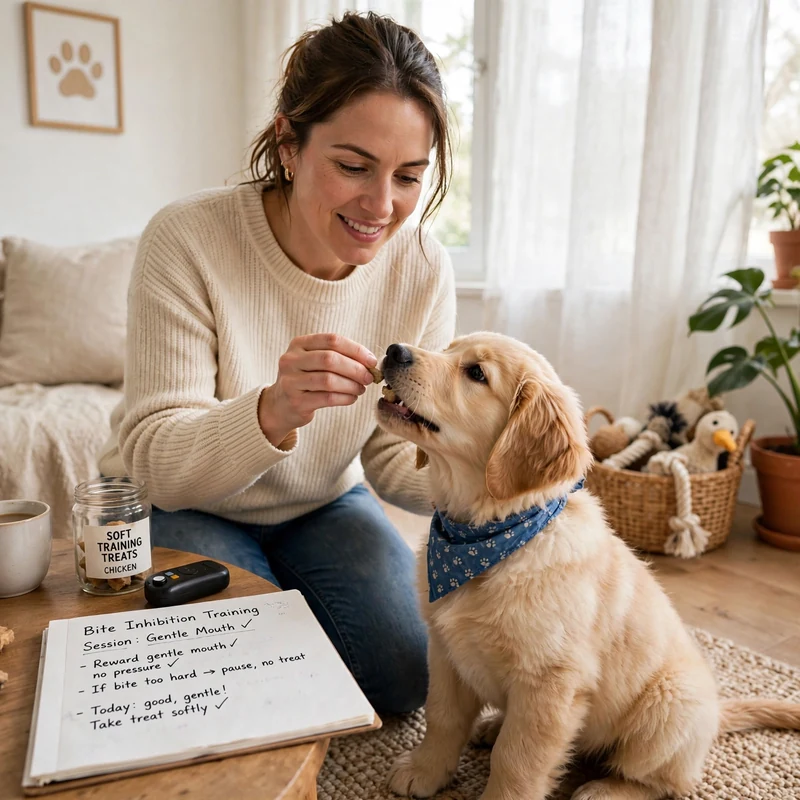
Also start rewarding calm, gentle behavior proactively: treat the puppy for lying quietly, for licking instead of nipping, for playing gently. You’re making gentleness pay better than nipping does.
Success looks like: the puppy sometimes chooses the toy on their own.
Week 2: Bite Inhibition (Teach a Soft Mouth)
Now teach the puppy that human skin is delicate.
When the puppy nips too hard during play, give a calm, brief marker (a short “ouch” or “too bad” in a neutral tone), stop play immediately, and withdraw attention for 20–30 seconds: turn away, arms folded. Then resume.
Note: a high-pitched yelp excites some puppies more. If “ouch” winds your puppy up, skip the sound and go straight to the play-stop. The consequence that matters is the loss of play, not the noise.
Success looks like: nips getting softer, puppy pausing after the marker.
Week 3: Impulse Control Games
Add short training games that teach the puppy to think before acting: “sit” for everything they want, “leave it” with treats, “drop it” with toy trades, and brief settle-on-a-mat practice. Keep sessions to a few minutes; puppies learn fast but tire faster.
This is also the week to generalize: practice the redirect-and-pause routine with every family member, including kids (supervised). The puppy must learn the rules apply to all humans.
Success looks like: the puppy offering sits instead of jumping and mouthing, faster recovery after excitement.
Week 4: Proofing and Calmness
Take the skills on the road: practice around mild distractions, on walks, when visitors arrive. Keep rewarding calm behavior heavily. By now the pattern should be established: mouth on toy, gentle with people, play stops when teeth get rowdy.
Shift emphasis toward capturing calmness throughout the day. The long-term goal isn’t just “no nipping” but a puppy who defaults to settled behavior.

Success looks like: nipping rare and soft, puppy self-directing to toys, family consistent without thinking about it.
How to Stop Golden Retriever Puppy Nipping in the Moment: The Script
When teeth hit skin, run this exact sequence:
1. Mark calmly. A neutral “too bad” or brief “ouch.”
2. Stop everything. Freeze, withdraw hands, turn slightly away. Play ends.
3. Wait 20–30 seconds. Boring. No eye contact, no talking.
4. Redirect. Offer a toy. Praise taking it.
5. If it escalates, leave. Calmly step out of the pen or behind a baby gate for 30–60 seconds. Return neutrally.
Repeat every single time. Consistency is the entire method for stopping golden retriever puppy nipping.
Troubleshooting: When Golden Retriever Puppy Nipping Isn’t Improving
“We’ve done this for two weeks and nothing changed.” Check consistency first: is every family member doing it? Is the puppy getting enough sleep?
Are training sessions happening, or just reactions? Most stalls trace back to inconsistency or unmet needs, not a broken method.
“The nipping is worse in the evenings.” That’s the overtired witching hour. Enforce a nap schedule.
A puppy who naps properly in the day is a different animal in the evening.
“My puppy nips the kids hardest.” Kids move fast, squeal, and flail: prime puppy triggers.
Supervise all interactions, teach kids to “be a tree” (stand still, arms folded) when the puppy gets mouthy, and give the puppy and kids structured, toy-based play instead of free-for-all wrestling.
“Nothing works and I’m worried.” If nipping is intense, escalating, or accompanied by growling over resources, stiffness, or snapping, talk to your vet and a qualified positive-reinforcement trainer.
True aggression in Golden puppies is rare, but pain or fear can drive behavior that looks like it, and those need professional eyes.
Frequently Asked Questions
How long does Golden Retriever puppy nipping last?
With consistent training, most owners see major improvement within 2–4 weeks. The behavior naturally fades as teething finishes around 6 months and the puppy matures. Without training, mouthy habits can persist well into adolescence.
Is my puppy’s nipping aggression?
Almost certainly not. Puppy nipping is bouncy, playful, and directed at hands, sleeves, and ankles during play or excitement.
Aggression involves stiff body language, hard stares, growling over valued items, or intent to harm. If you’re unsure, one session with a qualified trainer will settle it.
The “ouch” method just makes my puppy bite harder. What now?
Drop the “ouch” and go straight to ending play. Some puppies find the sound exciting. The effective part was never the noise: it’s the 20–30 seconds of lost attention afterward.
Should I use a taste deterrent spray?
Bitter sprays can help protect specific targets (furniture legs, leashes) as a management aid, but they don’t teach the puppy anything. Use them alongside the redirect-and-reward plan, not instead of it. Our leash-biting guide covers this for walks specifically.
My 7-month-old still nips. Is that normal?
Adolescent mouthiness can linger, especially in under-trained or under-exercised young dogs. Revisit the plan: tighten consistency, increase appropriate exercise and mental work, and keep rewarding calm. If it’s escalating rather than fading, get a trainer involved.
Can I let the puppy mouth gently but not hard?
That’s actually the goal of bite inhibition: a dog who learned as a puppy to control jaw pressure. But for most families, the clearer rule (“teeth on people ends the fun”) is easier to apply consistently, and consistency beats nuance with puppies.
—
Golden retriever puppy nipping is the tax you pay for a retrieving breed’s wonderful mouth, and it’s temporary. Work the plan, keep everyone consistent, and you’ll come out the other side with a gentle-mouthed adult.
For the chewing side of mouthiness, see puppy chewing everything, read the complete Golden Retriever behavior guide, and explore all Golden Retriever guides.