Dachshund Crate Training: The Complete Guide
The crate arrives in a flat box. You assemble it, add a soft blanket, and present it proudly. Your Dachshund looks at it the way you’d look at a parking ticket. For dachshund crate training to work, forget “tough love” and locked doors: the crate has to become the burrow, the small, warm den they’d choose themselves. Get that right and most Dachshunds don’t just tolerate the crate. They claim it.
This guide covers choosing the crate, setup, the gradual introduction, nights, whining, adult dogs, and the mistakes that turn a simple project into a month-long standoff.
Key Takeaways
- Dachshunds take to crates well because they’re natural burrowers. A covered, cozy crate feels like a den, not a cage.
- Never rush the introduction. A few days of voluntary exploring beats a week of forced confinement every time.
- The crate is for management and rest, never punishment. One bad association can undo weeks of progress.
- Whining is communication, not defiance. Learn to tell “I need the toilet” from “I’m testing the boundaries” and respond accordingly.

Why Dachshund Crate Training Works So Well
Dachshunds were bred to go underground into badger burrows: tight, dark, enclosed spaces. That heritage is still in the wiring. Watch one in a living room: they burrow under blankets, wedge behind cushions, and pick the smallest sleeping spot available. A crate plugs straight into that instinct.
That gives you three wins: easier house training (most dogs avoid soiling their sleeping den), safe management (an unsupervised puppy goes in the crate instead of rehearsing bad habits), and a portable safe space for travel and vet stays.
None of it works if the dog fears the crate. So everything below follows one rule: the crate predicts good things, always.
Choosing the Right Crate for a Dachshund
Size. Your Dachshund should stand, turn around, and stretch out lying down, with a little room to spare and no more. Too big and a puppy sleeps at one end and toilets at the other. For a growing puppy, buy the adult size with a divider panel.
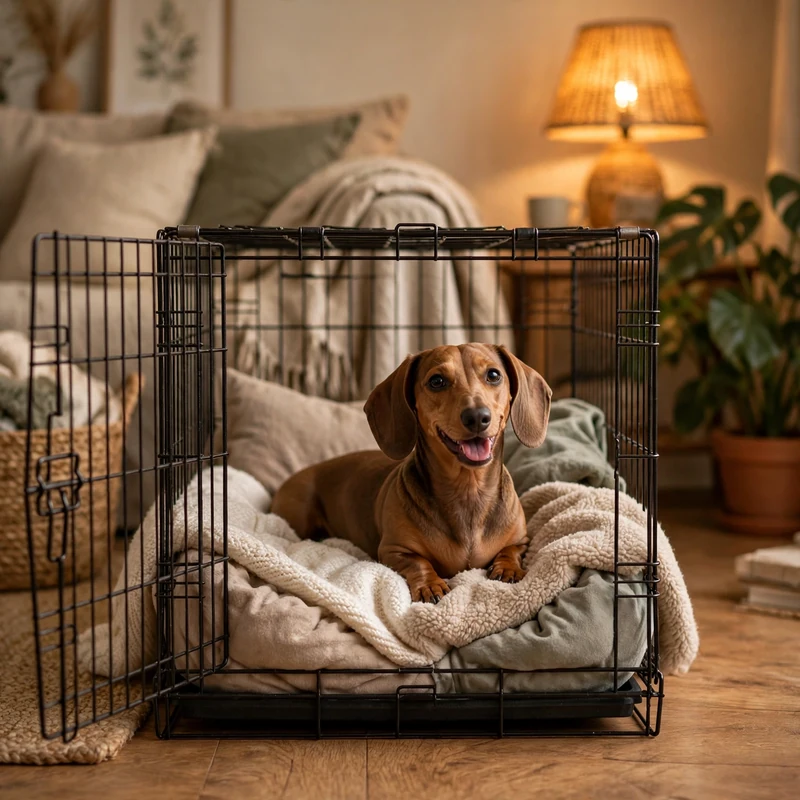
Type. Wire crates are the most popular: good airflow, visibility, and they fold flat. A blanket draped over the top and sides (door end open) turns one into the dark den Dachshunds love. Plastic crates are cozier out of the box and double as car crates. Skip soft-sided crates for puppies and chewers.
Door and locks. Get a secure, dog-proof latch: Dachshunds are problem-solvers with dexterous noses, and a determined adolescent can learn a flimsy latch fast.
What goes inside. A washable crate mat, one safe chew, and that’s plenty. Skip squeaky plush toys for unsupervised time. For water, use a clip-on bowl rather than a loose dish.
Safety first: always remove your Dachshund’s collar before crating. Collars can catch on bars or latches, and a tangled collar in an unsupervised crate is genuinely dangerous.
Setting Up the Crate
For the first week or two, put the crate where the family spends time: the living room, not a lonely utility room. A crate that means isolation from day one teaches the wrong lesson.
Make it inviting before training starts: door fixed open, bedding in, treats scattered inside. Let the puppy discover it; most investigate within the hour.
Once the dog goes in happily, cover the top and three sides with a light blanket, leaving the door end open. The dim, enclosed den is exactly what this breed finds reassuring.
The Dachshund Crate Training Plan, Step by Step
Don’t skip phases. Each one is short, and rushing is what creates the horror stories.
Phase 1: Exploration (days 1–3). The crate is furniture with snacks in it. Toss treats inside whenever you pass and feed one meal a day just inside the door, moving it further back over successive meals. Praise voluntary entries calmly. Door stays open. Goal: the puppy walks in and out like it’s nothing.
Phase 2: Door closed, briefly (days 3–5). Once the puppy eats happily inside, close the door during the meal, then open it when they finish. Build to a few minutes with the door closed while you sit nearby, treating calm behavior through the bars. If there’s panic rather than mild complaint, drop back to Phase 1 for a day.
Phase 3: Alone in the room (days 5–10). Give a stuffed food toy, close the door, and leave the room for a few minutes. Return before the puppy gets distressed. Stretch absences gradually (five minutes, fifteen, thirty), varying durations so returns stay unpredictable. Pair crate time with your routine: while you shower, cook, or answer the door.
Phase 4: Real life. Use the crate as intended: naps, bedtime, absences. Keep arrivals and departures boring: a calm “in your crate,” a treat, no farewell speech. The drama-free exit teaches the puppy your leaving is a non-event. In the early weeks, every crate entry should earn something good.

Crate Training at Night
Nights are usually the easiest part, because you’re right there. For the first week or two, put the crate in your bedroom, close enough that the puppy can hear you breathe. That proximity prevents most lonely crying and lets you hear a genuine toilet whine.
Final toilet trip right before bed: boring, on leash, no play. Young puppies still need a middle-of-the-night break, so set an alarm rather than waiting for desperate crying. Our night barking guide covers the full settling protocol.
Once the puppy sleeps through for a couple of weeks, move the crate to its permanent spot gradually, a few feet every couple of nights.
When Your Dachshund Whines in the Crate
Whining is information. Your job is to decode it.
Toilet whine: restless and escalating, often with circling. Always honor it, especially with puppies: out on leash, boring trip, straight back in. Ignoring genuine needs teaches the puppy the crate is a toilet.
Protest whine: intermittent, stops and starts. This is the “are you sure?” test. Wait for a pause, then calmly reward the quiet. Never open the door mid-whine: that teaches whining opens doors, and Dachshunds learn that lesson permanently.
Distress: continuous and escalating, with panting, drooling, or clawing. Let them out calmly and drop back a phase. Distress crating builds crate hatred, not crate love.
Some crying in the first nights is normal. The line is between complaining (annoying, temporary) and panic (escalating, desperate). When in doubt, assume the kinder interpretation.
Crate Training an Adult or Rescue Dachshund
Everything above works for adults too; it just may take longer if the dog has crate baggage. Many rescues have never seen a crate, and some have bad associations from being confined too long.
Go slower than you think necessary; an adult new to crates might need a full week of Phase 1. For real crate fear, start further back: treats near the crate, then on the lip, then inside, over many sessions.
Never try to “fix” separation distress by locking the dog in longer. A distressed dog can injure themselves escaping, and long-backed Dachshunds risk real harm throwing themselves against the door. If your adult panics when left, read our destructive-when-alone guide and get professional help before pushing crate time.
Common Crate Training Mistakes
- Using the crate as punishment. “Bad dog, in the crate!” poisons the association instantly. The crate must never be the consequence of anything.
- Too much, too soon. Eight hours on day one because you have work. Build up gradually or arrange midday breaks; flooding creates fear, not acceptance.
- Forcing the dog in. Pushing, dragging, or shutting the door on a panicking puppy. Every forced entry is a withdrawal from the trust account.
- Inconsistent rules. Crate for naps but free roam at night, or crate only when you’re angry. Dogs learn patterns; make the pattern simple and consistent.
- Leaving the collar on. Covered above, worth repeating: collars off in the crate, always.
- Only crating for departures. If the crate only appears when you leave, it becomes the leaving cue. Use it for naps and quiet time while you’re home too.
When to Ask for Help
Get professional input if your dog shows genuine panic (drooling, self-injury, escape attempts), if distress doesn’t improve after two weeks of patient work, or if confinement triggers aggression. A qualified behavior professional spots problems faster than trial and error. And if crating coincides with any sudden behavior change, see your vet first: pain and crate distress look alike.

Frequently Asked Questions
How long can a Dachshund stay in a crate?
Build up gradually. Young puppies need toilet breaks every couple of hours and shouldn’t be crated for a full workday; arrange a midday break. A trained adult typically manages a few hours comfortably, longer overnight. For full workdays, a puppy-proofed room or pen with the crate inside (door open) is kinder than eight hours locked in.
My Dachshund hates the crate. What now?
Go back to the beginning, slower. Most “crate hatred” is really “rushed introduction.” Spend a week with the door open and high-value treats in the crate; don’t close the door until the dog naps in there voluntarily. Genuine panic needs a behavior professional.
Should I cover the crate?
Usually yes, once the dog is comfortable entering. A cover over the top and sides makes it den-like, which suits this breed. Leave the door end open for airflow and visibility, and watch that the dog doesn’t pull the cover through the bars and chew it.
Is it cruel to crate a Dachshund?
A crate the dog loves is a bedroom, not a prison. Cruelty is in the misuse: too long, forced, or as punishment. Used as described here, most Dachshunds choose the crate over the sofa.
Can I use the crate to stop chewing?
As management, yes: an unsupervised puppy goes in the crate instead of rehearsing chewing. But the crate alone teaches nothing, so pair it with training: see our puppy chewing and furniture chewing guides.
Should the crate be near my bed permanently?
Not necessarily. Bedroom placement is a training tool for the early weeks; once the dog is confident, the crate can live wherever suits your home. Many owners keep it there permanently because the dog sleeps better, which is fine too.
—
A crate-trained Dachshund is a dog with a safe den for life: easier house training, safer unsupervised time, calmer travel, and simpler vet stays. For the full breed picture, read the complete Dachshund behavior guide, learn how to calm an overexcited Dachshund, and browse all Dachshund guides.