Golden Retriever Potty Training Problems: Fixes That Work
Golden Retrievers are bright and eager to please, which makes it extra maddening when housetraining stalls. You take the puppy out, stand around for twenty minutes, come back inside, and there it is on the rug.
If that cycle sounds familiar, you are dealing with one of the most common golden retriever potty training problems, and nearly all of them have a specific, fixable cause.
This guide is built around diagnosis first. Do not overhaul your whole approach until you know which of the five usual suspects is behind the accidents.
Key Takeaways
- Golden retriever potty training problems almost always trace to a schedule gap, intervals that are too long, adolescent regression, or a medical issue.
- Puppies can generally hold it about one hour per month of age. If accidents cluster, the schedule is usually failing the puppy, not the other way around.
- Clean every accident with an enzymatic cleaner. Regular soap leaves scent that invites repeat performances.
- Never punish accidents, during or after. Punishment teaches your puppy to hide it from you, not to hold it.
- Sudden accidents in a previously reliable dog warrant a vet visit to rule out urinary tract infections and other medical causes.
Step 1: Diagnose Your Golden Retriever Potty Training Problems
Work through this table before adjusting your method. Most owners find their answer in row one or two.
| Cause | What it looks like | The fix |
|—|—|—|
| Schedule gap | Accidents happen at predictable times, like mid-afternoon or overnight | Shorten intervals; add a trip at the gap time |
| Intervals too long for the age | Young puppy left 2-3 hours between outings | Match outings to bladder capacity: roughly one hour per month of age |
| Adolescent regression | Reliable at 5 months, accidents again at 7-10 months | Temporarily tighten the schedule for 1-2 weeks, then ease back |
| Medical issue | Sudden accidents with urgency, frequent small pees, straining | Vet visit first; rule out UTI before assuming behavior |
| Marking or excitement urination | Small amounts on vertical surfaces, or dribbling during greetings | Management and maturity; different problem, different plan |
Step 2: Fix Golden Retriever Potty Training Problems With a Better Schedule
Prevention beats correction every time. The goal is to make accidents nearly impossible by getting your puppy outside before they need to go, then rewarding the right choice heavily.
Match frequency to age. The widely used guideline, supported by the AKC, is about one hour of bladder control per month of age, up to around six months. An eight-week-old needs a trip roughly every hour while awake; a three-month-old about every three hours.
These are maximums, not targets. After meals, naps, play, and drinks, go out immediately regardless of the clock.
Anchor trips to transitions. Puppies almost always need to go: right after waking (including naps), within ten to fifteen minutes after eating or drinking, after play, and last thing at night, plus at least once overnight for very young puppies.
Set phone alarms if you need to.
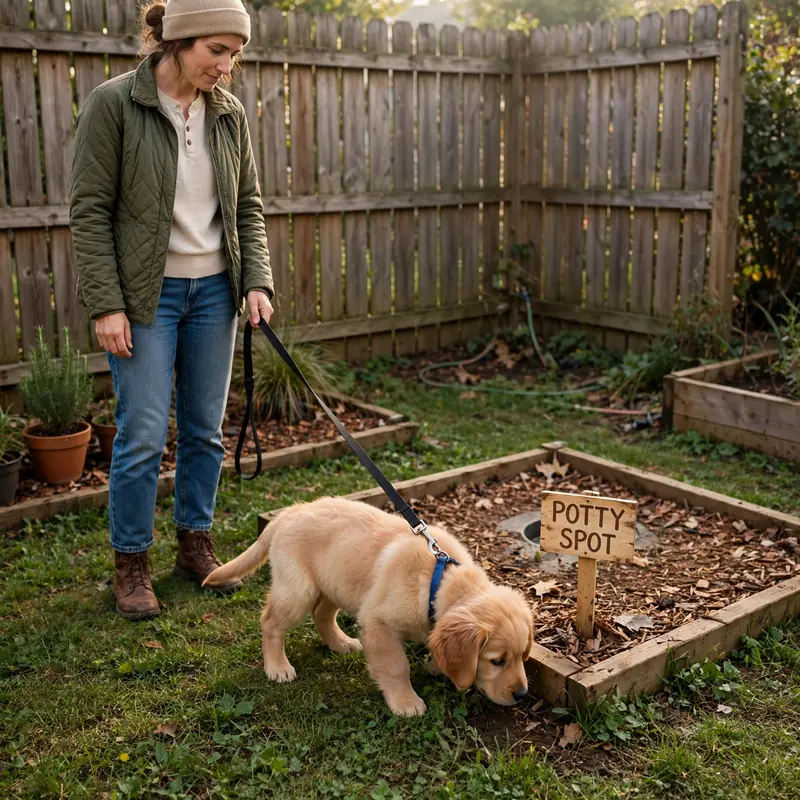
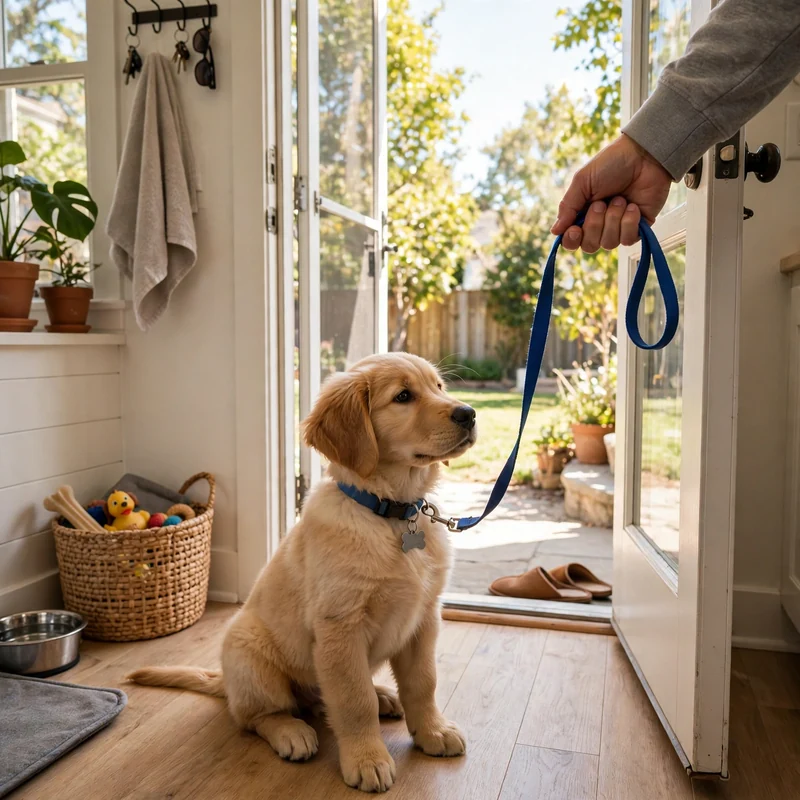
Use one boring potty spot. Take your Golden to the same spot on leash, stand still, and wait. Wandering the whole yard is playtime; the designated corner is business.
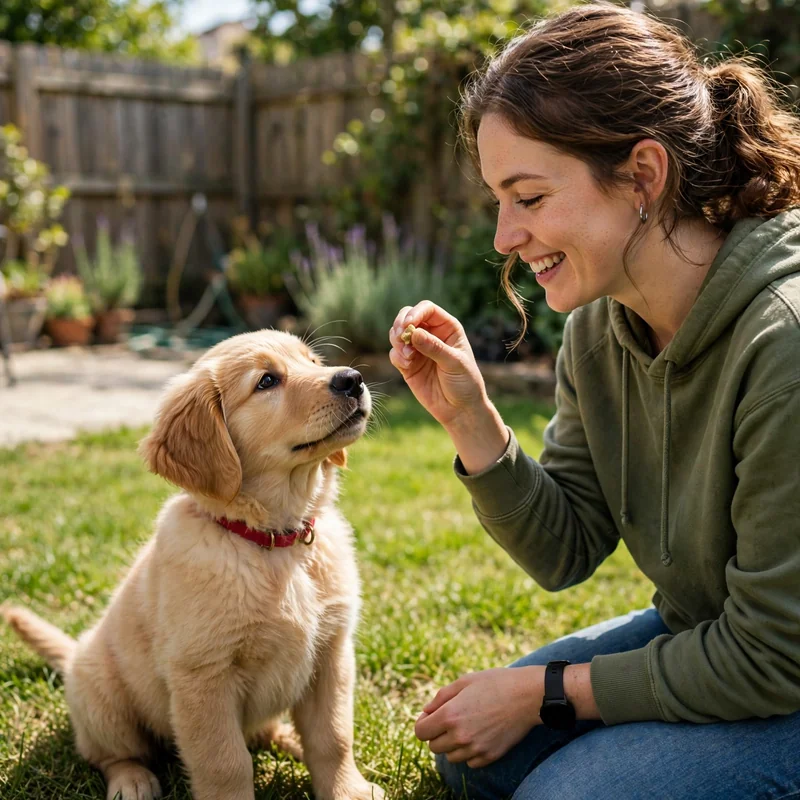
When they go, reward within seconds with a genuinely good treat and calm praise. You are building a strong habit: this spot, this surface, good things happen.
Stay out a few extra minutes. Rushing straight back inside teaches some puppies that going potty ends the fun, so they hold it to extend outdoor time. Give a couple of minutes of sniffing or play after the deed.
Supervise or confine. When you cannot watch your puppy directly, use the crate (correctly sized, for fair durations) or a small puppy-proofed area.
Most accidents happen during unsupervised wandering. If crate training is part of your plan, our crate training troubleshooting guide pairs with this one.
Step 3: Respond to Accidents Correctly
Even with a perfect schedule, accidents happen. Your response in that moment determines whether training progresses or stalls.
If you catch them mid-accident: interrupt gently with a calm sound, not a shout. Scoop or lead your puppy outside immediately and let them finish there, then reward. No scolding, no drama.
If you find it after the fact: say nothing and clean it up. Your puppy cannot connect your frustration with something that happened minutes ago. Reacting teaches them only that you are scary around puddles, which leads to sneakier accidents behind furniture.
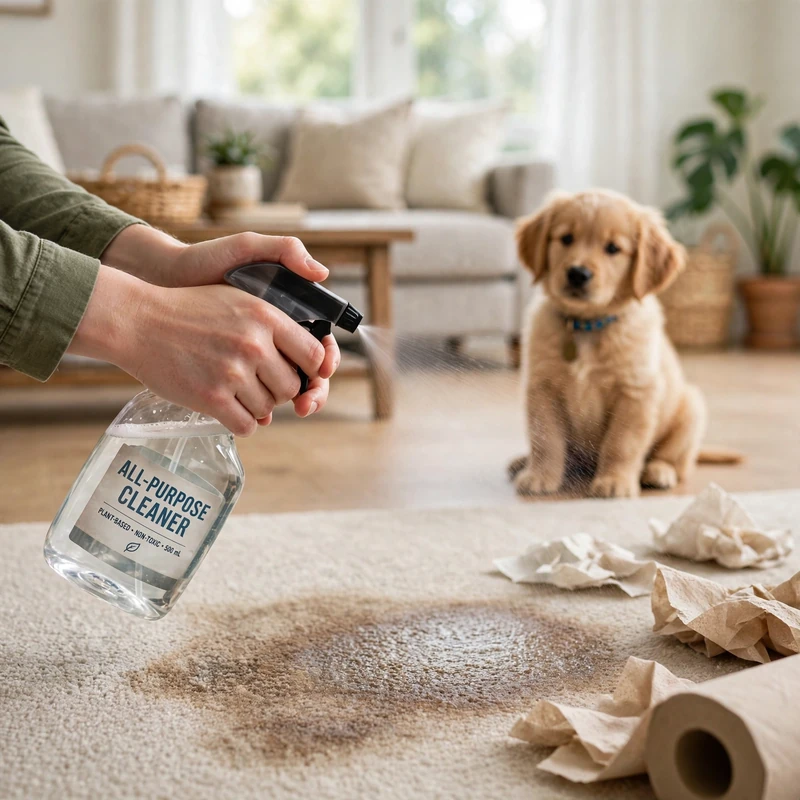
Clean it like a professional. Blot up as much as possible, then saturate the spot with an enzymatic cleaner and let it work for the time the label specifies. Regular household cleaners and even vinegar leave behind proteins your dog’s nose can still detect, and that scent marks the spot as an approved bathroom.
For carpet, you may need two treatments.
Step 4: Handle the Tricky Scenarios
Nighttime accidents. Young puppies need a middle-of-the-night trip. Take water up an hour or two before bed, do a final outing as late as you can manage, and set an alarm for a night break in the early weeks.
Keep the crate close enough that you hear the restlessness that precedes an accident.
The “goes right after coming inside” puppy. This usually means the outdoor trip was too short or too exciting. Next time, stay out longer, keep it boring until business is done, and consider that the puppy may need to go twice.
Some puppies empty only partially, then finish ten minutes later.
Bad weather refusal. Goldens generally love water but some puppies hate rain. A covered potty area, a large umbrella, or simply cheerful persistence helps.
Do not let a rain strike become an indoor accident; the habit you allow is the habit you build.
Adolescent regression. Between roughly six and eighteen months, previously reliable dogs often backslide. Hormonal changes, testing boundaries, and busier lives all play a role. This is normal and temporary.
Go back to a tighter schedule for one to two weeks as if the dog were younger, reward successes generously, and do not punish the backslide. It passes.
Step 5: Know When It Is Medical, Not Training
This is the step owners skip, and it matters. See your vet promptly if you notice:
- A sudden onset of accidents in a previously reliable puppy or adult
- Frequent small urinations, straining, or signs of pain while peeing
- Cloudy or bloody urine, or excessive licking of the genital area
- Excessive thirst paired with accidents
- Any accident pattern that does not improve after a week of a tightened schedule
Urinary tract infections are one of the most common medical causes of housetraining regression, and no amount of schedule tightening fixes an infection. Puppies, especially females, are prone to them.
A simple urinalysis at the vet gives you a clear answer, and antibiotics resolve most UTIs quickly.
A Note on Bell Training
Potty bells, where the dog rings a bell to ask to go out, work well for many Goldens because they are smart and food-motivated. The risk is a dog who rings the bell fifty times a day just to go sniff around.
If you use bells, hang them by the door, ring them yourself every time you go out for a potty trip, and reward only genuine business, not bell concerts.
If your Golden turns into a compulsive bell-ringer, go back to a schedule-based system for a while.
How long does it take to potty train a Golden Retriever?
Most Golden puppies grasp the basics within a few weeks of a consistent schedule, and many are largely reliable by four to six months. Full reliability, including through adolescence and without constant supervision, often takes until six to twelve months.
Breeders and trainers consistently note that Goldens are among the easier breeds to housetrain because they are eager to please, but “easier” still requires your consistency.
My Golden Retriever puppy pees every 20 minutes. Is that normal?
For a very young puppy, frequent urination can be normal, especially after drinking, playing, or waking. But urinating every twenty minutes around the clock, straining, or producing only tiny amounts each time is worth a vet check for a urinary tract infection.
When in doubt, a urinalysis is cheap and definitive, and it is better to rule out a medical cause early than to spend weeks fighting a training battle that is actually an infection.
Should I use puppy pads for my Golden Retriever?
Pads can be useful for very young puppies, high-rise apartments, or owners who cannot get outside frequently. But they teach the puppy that going indoors on a soft surface is acceptable, which can slow the transition to outdoor-only habits.
If your long-term goal is outdoor pottying, most trainers recommend skipping pads and investing the effort in frequent outdoor trips from the start. If you do use pads, place them in one consistent spot near the door.
Why does my potty trained Golden Retriever suddenly have accidents?
The most common reasons golden retriever potty training problems resurface, in order: a schedule that quietly loosened, adolescent regression, stress or routine changes (moving house, new pet, new baby), and medical issues like UTIs.
Tighten the schedule first and watch for a week. If accidents persist or come with urgency, straining, or increased frequency, see your vet.
Sudden changes always deserve a medical rule-out before a training overhaul.
Is it okay to punish my Golden for potty accidents?
No. Punishing during or after an accident does not teach bladder control, because the puppy cannot connect your anger to the act.
What it does teach is to avoid going in front of you, which leads to hiding behind furniture, refusing to go on walks, and a generally anxious dog.
Every major humane training authority agrees on this: reward the outdoor successes heavily and manage the indoors so accidents cannot happen.
My Golden pees when greeting people. How do I fix submissive or excitement urination?
This is different from a housetraining failure. Keep greetings calm: ask visitors to ignore the puppy for the first minute, crouch sideways instead of looming, and take the puppy out to pee before guests arrive.
Most puppies outgrow excitement urination by one to two years of age. Never scold for it; the puppy is overwhelmed, not disobedient.
For the complete behavior picture behind golden retriever potty training problems, see our Golden Retriever behavior problems pillar and the Golden Retriever category.
Housetraining and crate training work as a pair, so keep our crate training troubleshooting guide handy, and if chewing is filling the unsupervised gaps in your schedule, our guide on puppy chewing everything will help.