
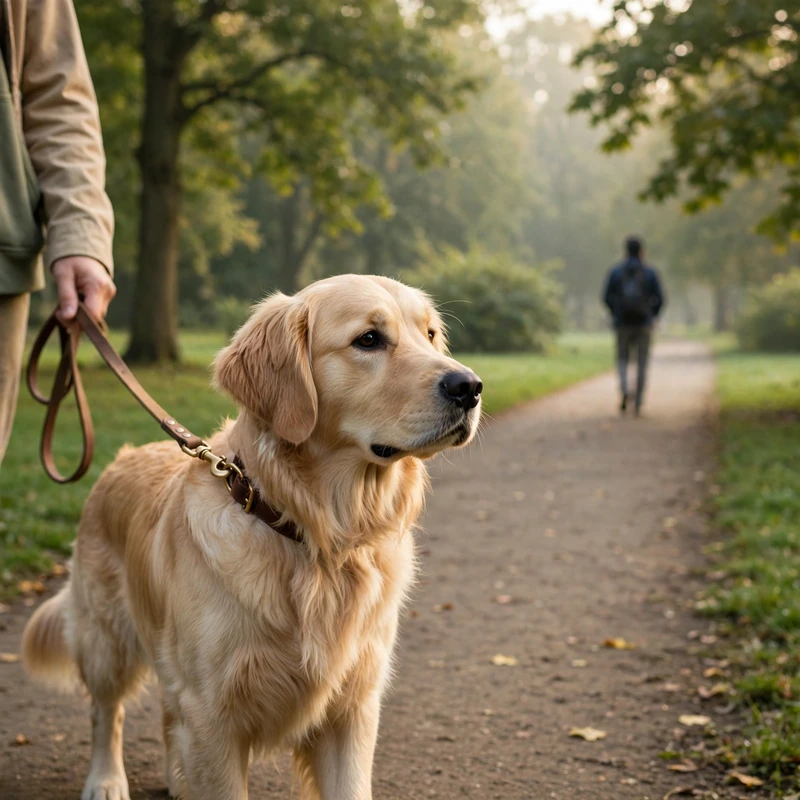
Golden Retriever Barking at Strangers on Walks: What to Do
Golden Retrievers have a reputation as the friendliest dogs on the planet, so when yours erupts into barking at every stranger on the walk, it can feel embarrassing and confusing. You are not alone. A Golden retriever barking at strangers on walks is a common complaint trainers hear, and it is very trainable once you understand what is driving it.
Most of the time, this barking is not aggression. It is usually fear, frustration, or overexcitement wearing a loud costume. This guide walks you through telling those apart, then gives you a practical, positive on-walk plan that actually fits real life.
Key Takeaways
- Golden retriever barking at strangers is usually fear, leash frustration, or excitement, not true aggression.
- Find your dog’s threshold distance first: where they notice strangers but can still think and take treats.
- The core training tools are distance management, an emergency U-turn, and rewarding calm noticing of strangers.
- Never punish the barking with yelling, leash jerks, or prong, choke, or shock collars. Punishment never fixes the feeling behind it.
- A sudden onset of barking at people warrants a vet check for pain or medical causes.
Why Your Golden Retriever Is Barking at Strangers on Walks
Before you can fix the barking, you need to know which kind you are dealing with. The most common causes:
Fear or nervousness. Many Goldens did not meet enough different-looking people early on, or had one scary experience that stuck. Cornell University’s Riney Canine Health Center notes that a reactive dog is usually a fearful dog, most often from limited socialization, prior bad experiences, or lack of training. A fearful dog barks to make the scary thing go away.
Leash frustration. Your Golden wants to rush up and greet everyone, but the leash stops them. That frustration boils over into barking and lunging. This looks dramatic but is often the friendliest version of the problem.
Barrier frustration plus arousal. Walks are exciting, and the restraint of the leash collides with that excitement until it boils over into barking. Adolescent Goldens between six and eighteen months are especially prone to this.
Learned habit. If barking has worked in the past, the stranger moves away or your dog gets attention, the behavior gets stronger. Dogs repeat what works.
Pain or a medical cause. If your previously calm Golden suddenly starts barking at strangers, rule out pain, vision or hearing changes, and other medical issues with your vet before assuming it is behavioral.
Fear or Excitement? How to Tell What Is Behind Golden Retriever Barking at Strangers
The training approach shifts with the emotion, so spend a walk or two just observing. Watch the body, not just the noise:
- Fearful barking: body low or leaning away, tail tucked or low, ears pinned back, barking paired with retreating or a tense freeze. The dog wants more distance.
- Excited or frustrated barking: body forward, tail wagging high and fast, bouncing, whining mixed with barks, pulling toward the person. The dog wants less distance.
- Mixed: many dogs bounce between the two in seconds. That is normal, and the plan below handles both.
If you are unsure, err on the side of treating it as fear. Giving a fearful dog more space never makes things worse, while forcing a fearful dog closer can.
The On-Walk Training Plan for Golden Retriever Barking at Strangers
This is a desensitization and counter-conditioning plan: you gradually change how your dog feels about strangers at a distance where they can stay calm, and you pair the sight of strangers with good things. Work through it in order.
Step 1: Find the threshold distance. On your next walk, notice the distance at which your Golden spots a stranger but can still look at you and take a treat. If they are calm at 40 feet but lose it at 20, train at 45 feet. Progress lives where your dog can still think.
Step 2: Teach an emergency U-turn. In a quiet spot with no strangers around, say “let’s go!” in a cheerful voice, turn 180 degrees, and reward your Golden for coming with you. Practice until it is automatic. This is your escape hatch for surprise encounters.
Step 3: Mark and reward calm noticing. At threshold distance, when your Golden notices a stranger, wait for a glance, then the moment they look back at you (even briefly), say “yes!” and deliver a high-value treat like real chicken or cheese. Over repetitions, strangers start predicting treats instead of conflict. Keep sessions short, five to ten minutes of set-ups is plenty.
Step 4: Add the “find it” scatter game. Toss a few treats into the grass and say “find it!” This gives your dog a nose-based job to do while a stranger passes at a distance. Sniffing lowers arousal, and it is much easier than asking for a perfect sit-stay in an exciting moment.
Step 5: Shrink the distance gradually. Only when your dog is relaxed at the current distance across several sessions, move five to ten feet closer. If barking returns, you moved too fast. Go back to the last distance where they succeeded.
Step 6: Set up practice on purpose. Ask a friend to walk past at a planned distance. Real walks are unpredictable; short planned set-ups are where the real learning happens.
Management: Make Walks Livable While You Train
Training takes weeks. Management keeps everyone sane in the meantime, and every barking rehearsal you prevent is progress protected. Consistent management alone can noticeably reduce golden retriever barking at strangers while the training takes effect.
- Walk at off-peak times and choose wide routes. Parks with big open fields beat narrow sidewalks. Distance is your best training tool, so give yourself room to use it.
- Cross the street or arc around. You are keeping your dog under threshold so learning can happen.
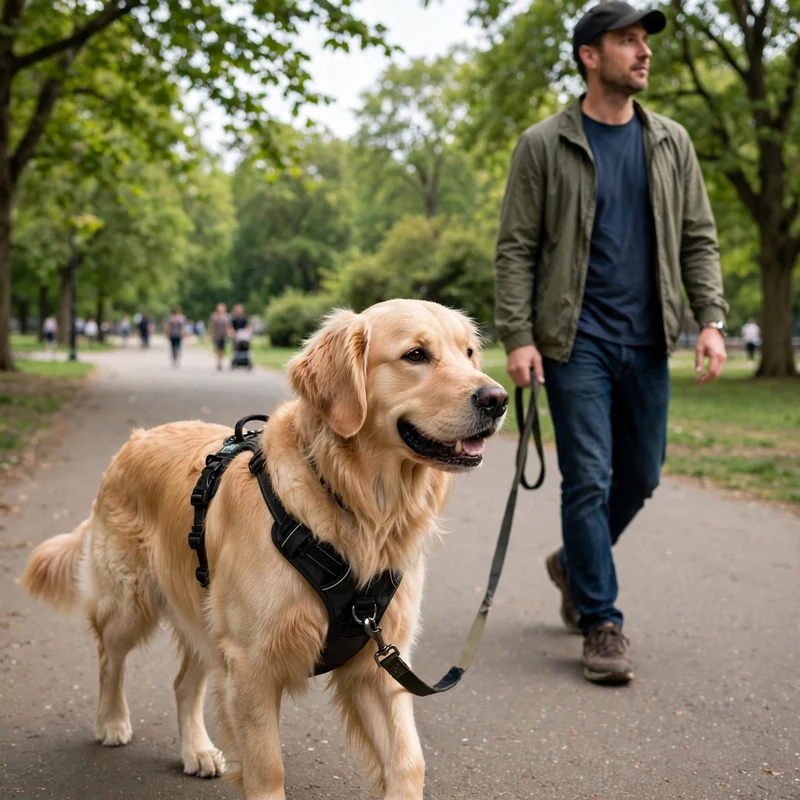
- Use a front-clip harness. It gives you steering without pain. Never use prong, choke, or shock collars; they add pain to an already stressed dog and can turn fear into genuine aggression.
- Carry excellent treats every walk. Kibble rarely cuts it against stranger excitement; tiny pieces of chicken, cheese, or freeze-dried liver do.
- Meet exercise and enrichment needs. A Golden who has had fetch or a swim is far less explosive on walks. If barking also happens at home, see our night barking guide.
- Practice the door and window too. Dogs that rehearse barking at passersby from the window all day arrive at the walk already primed.
What Never to Do About the Barking
This matters as much as the training itself, because these mistakes can set back your progress against golden retriever barking at strangers:
- Do not yell “no” or “quiet” at a barking dog. You sound like you are barking along. Veterinary behaviorist guidance is explicit: no yelling, scolding, or leash corrections during a reaction.
- Do not use prong, choke, or shock collars. These tools suppress barking through pain or fear. They do not change the underlying emotion and frequently make reactivity worse.
- Do not flood your dog. Forcing close approaches to strangers to “get them used to it” usually sensitizes them further. Distance first, always.
- Do not let strangers feed or pet your dog as a fix unless your dog is genuinely relaxed and choosing to approach. Tossing treats from a distance during set-ups is fine; forced greetings are not.
When to Get Professional Help
Bring in a certified, force-free trainer or a veterinary behaviorist if the barking is escalating, your dog has snapped or bitten, the fear is spreading, or you feel unsafe on walks.
Any sudden behavior change deserves a vet visit first: pain, thyroid issues, and sensory decline can all masquerade as new reactivity. A professional can also tailor the plan when golden retriever barking at strangers persists despite consistent training.
Why does my Golden Retriever bark at strangers on walks but is friendly at home?
Context changes behavior. At home your dog feels safe; on walks, the leash restricts movement, strangers approach head-on, and arousal is already high. Many dogs bark from leash frustration, the urge to greet colliding with restraint. Others are fine with familiar visitors but nervous about unfamiliar people outdoors.

Should I let strangers give my Golden treats to stop the barking?
Only in planned set-ups, and only if your dog is already calm enough to take treats. Having a stranger toss treats on the ground from a comfortable distance can build positive associations. But letting strangers hand-feed or pet a dog that is actively barking and lunging usually backfires: the forced closeness spikes fear, and the dog learns that scary people keep getting closer.
Is barking at strangers a sign my Golden Retriever is aggressive?
Usually not. Cornell University’s Riney Canine Health Center distinguishes the two clearly: a reactive dog is usually a fearful dog, while an aggressive dog is determined to cause harm. Barking and lunging on leash are most often over-arousal or fear, and reactivity is a trainable condition, not a character flaw. That said, any reactive dog should be taken seriously and managed responsibly, because fear-based reactions can escalate if mishandled.
How long does it take to stop golden retriever barking at strangers?
Expect weeks to a few months of consistent practice, not days. Mild leash-frustration cases often improve within a few weeks of good threshold work. Deeper fear-based reactivity takes longer, and progress is rarely a straight line. Preventing rehearsals through management and never training over threshold speeds things up.
My Golden only barks at certain types of people, like men with hats or kids. Why?
Dogs generalize poorly, especially if socialization was narrow. A Golden raised mostly around women may find bearded men, people in hats or hoodies, or fast-moving children genuinely startling because those silhouettes are unfamiliar. Treat each category as its own mini-project: find the threshold distance for that specific trigger and work the same desensitization plan. Do not assume progress with one type of stranger transfers automatically to another.
Will a shock collar or prong collar stop the barking faster?
It may suppress the noise, but at a real cost. Aversive collars work through pain and fear, which teaches your dog that strangers predict pain. That is exactly the wrong lesson for a fearful dog, and it is how reactivity escalates into genuine aggression. Force-free threshold training takes longer but changes the emotion behind the barking, which is the only fix that lasts.
If your Golden’s barking is part of a bigger pattern, start with our Golden Retriever behavior problems pillar and browse the Golden Retriever category. Leash manners pair naturally with this work: see Golden Retrievers biting the leash, and the German Shepherd version at barking at strangers on walks.