How to Stop Your Golden Retriever Jumping on Guests
The doorbell rings and your Golden Retriever transforms. One second they're a model citizen, the next they're a 30-kilo missile of joy launching at your mother-in-law's chest.
You apologize, you grab the collar, the guest says "oh, I don't mind!" while being climbed like a tree, and nothing changes.
If this is your house, you are dealing with the classic case of Golden Retriever jumping on guests, and the good news is that it's one of the most fixable problems in the breed.
It's also one of the most misunderstood. Jumping isn't dominance or stubbornness. It's a greeting strategy that worked once and kept working.
Your job is to make it stop working, and to give your Golden a better strategy instead.
Key Takeaways
- Golden Retriever jumping on guests is attention-seeking greeting behavior, not dominance: jumping worked once, so it keeps happening.
- The core rule: jumping gets absolutely nothing (no eye contact, no words, no pushing). Four paws on the floor gets everything.
- "Just ignore it" only works below the excitement threshold. Over-the-top greeters need arousal management plus a rehearsed guest-arrival protocol.
- Brief every guest with the same short script. One person who rewards jumping can undo a week of training.
- Never use kneeing, leash pops, or aversive collars for jumping. They don't teach the alternative and can raise arousal or fear.
Why Golden Retrievers Jump on Guests
Goldens are bred to be close to people; the breed standard calls them friendly, reliable, and trustworthy, and most treat every visitor as a long-lost best friend. Jumping is simply how an enthusiastic dog tries to reach the interesting part of a person: the face.
The habit usually starts in puppyhood, when a tiny Golden jumping up earned exactly what it wanted: eye contact, laughter, and petting.
As the dog grows, the same behavior that was cute at 8 kilos becomes a problem at 30. The dog doesn't know it outgrew the privilege. It only knows jumping has always produced human attention.
One thing most quick tips skip: "just ignore it" works at low excitement but fails when your dog is over threshold.
When a visitor walks in and arousal spikes, the dog is flooded with excitement and genuinely can't process the lesson. Below threshold, removing attention teaches fast. Above threshold, manage the arousal first, then train the greeting.
The Core Rule: Four on the Floor
Every method that fixes Golden Retriever jumping on guests shares one principle: jumping gets nothing, four paws on the floor gets everything.
When your Golden jumps, remove all attention instantly: fold your arms, turn away, no eye contact, no talking, no pushing them down.
Pushing feels like correction to you, but to an excited Golden it feels like interaction, and interaction is the reward. The instant all four paws hit the floor, turn back and reward calmly with quiet praise or a treat.
This works because Goldens are attention-driven, and removing attention needs no equipment or force.
But it must be consistent: if three people ignore the jumping and one person laughs and ruffles the dog's ears, the dog learns jumping works one time in four, the exact schedule that makes a behavior hardest to extinguish.
A Greeting Protocol That Stops Golden Retriever Jumping on Guests
Random training at random doorbells won't cut it. Rehearse this protocol when no guests are coming, then use it at every real arrival.
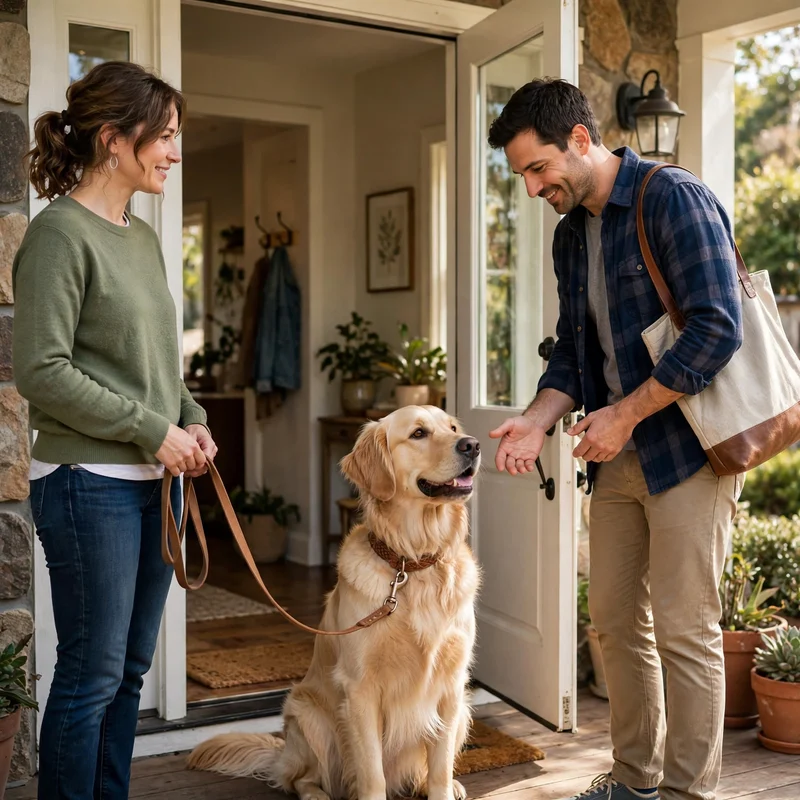
Step 1: Set up before the doorbell. Keep a treat pouch and a 2-meter indoor leash near the front door.
When guests are expected, exercise your Golden first: a 15-minute walk or a few minutes of fetch takes the edge off. An under-exercised Golden greets at full volume; an exercised one can think.
Step 2: Control the first 30 seconds. The door opening is the most chaotic moment.
Put your Golden on the indoor leash before you open the door, or park them behind a baby gate where they can see the guest but can't launch. Ask for a sit while the guest is still at a distance. It's far easier to hold a sit at 3 meters than at 30 centimeters.
Step 3: Let the guest approach the sit. With your dog sitting, invite the guest in.
If your Golden breaks and surges forward, the guest pauses or steps back, you reset the sit, and you try again. The guest approaching is the reward for the sit. If the dog jumps, the guest turns away and the approach stops.
Step 4: Reward four on the floor immediately. The moment your dog is sitting or standing with all paws down, the guest crouches and offers calm praise or a treat you've provided.
Keep your own energy low: human excitement raises the dog's arousal right back up.
Step 5: Give them a job. For chronic jumpers, "go to your mat" is the most reliable tool.
Train a solid mat stay separately, then deploy it at the door: guest arrives, dog goes to mat, guest greets the dog on the mat. A dog lying on a mat cannot be jumping on a guest.
What to Tell Your Guests: The 20-Second Script
Guests undo training because nobody tells them what to do. Text this before they arrive:
"We're training [dog's name] not to jump. When you come in, please turn away and ignore him if he jumps: no eye contact, no talking, no petting.
The second all four paws are on the floor, crouch down and say hello calmly. There's a treat bowl by the door if you'd like to reward his sit. Thank you!"
For the "oh, I love it, let him jump" guest, be firmer: "He's 30 kilos and he knocks kids over, so we need everyone on the same page."

When Excitement Runs Too Hot
Some Goldens don't just jump; they vibrate. For these dogs, train the arousal down before training the greeting. It's the missing step in most Golden Retriever jumping on guests advice.
The treat scatter. Before opening the door, toss treats across the floor and say "find it."
Sniffing is naturally calming, and the scatter redirects the brain from the door to the nose.
The name game. Say your dog's name and reward the head turn, dozens of times daily in boring moments.
A dog that whips around at their name is a dog you can reach mid-greeting.
Pre-guest exercise. Ten minutes of fetch or flirt-pole play before guests arrive burns energy while teaching impulse control.
A dog that has run, thought, and earned rewards is a different animal at the doorbell.
Mat training as an off-switch. Teach "place" separately over weeks: reward stepping onto the bed, then sitting, then lying down, then duration.
Then deploy it at the door.
Mistakes That Keep Golden Retriever Jumping on Guests Alive
| Mistake | Why it backfires | Do this instead |
|—|—|—|
| Pushing the dog down or kneeing them | Feels like physical play; raises arousal | Turn away, remove attention, reward four on the floor |
| Yelling "no!" mid-jump | Loud attention is still attention | Stay quiet, reset, ask for the trained sit |
| Letting some people allow it | Intermittent rewards make behavior hardest to stop | Same rule for every human, every time |
| Training only at real arrivals | Real doorbells spike arousal past the learning threshold | Rehearse with helpers in calm setups first |
| Skipping exercise before guests | An under-exercised Golden cannot offer calm | Walk or play before expected visitors |
On equipment: some owners reach for prong collars, choke chains, or leash "corrections" to punish jumping.
The American Veterinary Society of Animal Behavior's position statement on humane dog training recommends reward-based methods for all dog training and states that aversive methods, including prong collars, choke chains, and leash corrections, should not be used.
Corrections suppress the jump in the moment but don't teach what to do instead, and they can increase fear around guests.
When to Get Professional Help
Most jumping resolves within a few weeks of consistent practice. Get help sooner if the jumping started suddenly in an adult dog (pain or health changes can alter behavior: vet first).
If your dog guards the doorway or the "excitement" includes snapping, ask your vet for a certified behavior professional. If a month of consistency brings no improvement, a trainer can spot the timing error you can't see yourself.
Jumping that includes mouthing hands and clothes is common in young Goldens and usually part of the same excitement package. Our guide on stopping Golden Retriever puppy nipping covers the mouthing side.
Golden Retriever Jumping on Guests: FAQs
Why does my Golden Retriever jump on guests but not on me?
Because you've probably stopped rewarding it. Guests are novel and inconsistent: they laugh, pet, and talk in high voices. Your dog learned family members are boring and guests pay out. Make guests boring too.
How long does it take to stop a Golden Retriever jumping on guests?
With daily practice and consistent guests, most owners see clear improvement in 2 to 4 weeks and a reliable polite greeting in 2 to 3 months.
Puppies learn faster; adults with years of rehearsed jumping take longer. The biggest variable is whether every human follows the plan.
Should I teach "off" or train a "sit" for greetings?
Train the sit (or a down, or a mat stay). "Off" says what to stop, not what to do instead, and it's usually shouted mid-jump when the dog can't learn. A sit physically prevents jumping and gives the dog a way to earn the greeting.
My guests encourage the jumping. What do I do?
Manage the environment: leash your dog before the door opens, use the baby gate, keep greetings short. Tell enthusiastic guests plainly that he's strong enough to knock kids over and training is non-negotiable.
Will neutering stop my Golden Retriever jumping on guests?
No. Jumping is a learned, attention-driven greeting behavior, not a hormonal one. Neutering doesn't teach a sit for greetings. There is no shortcut around training the replacement behavior.
Is it too late to train my 3-year-old Golden Retriever?
Not at all. Adults learn fast because they're calmer and more food-motivated than puppies.
You'll need more repetitions to overwrite years of habit, and management (leash, gate, mat) matters more early on, but the same protocol works at any age.
The Polite Greeter Is Already in There
Your Golden doesn't jump because they're bad. They jump because they're a friendly, people-loving dog using the only greeting strategy that's ever worked. Teach them a better one, make it pay better, and get every human on the same page.