Golden Retriever Pulling on Leash: How to Get Loose-Leash Walks
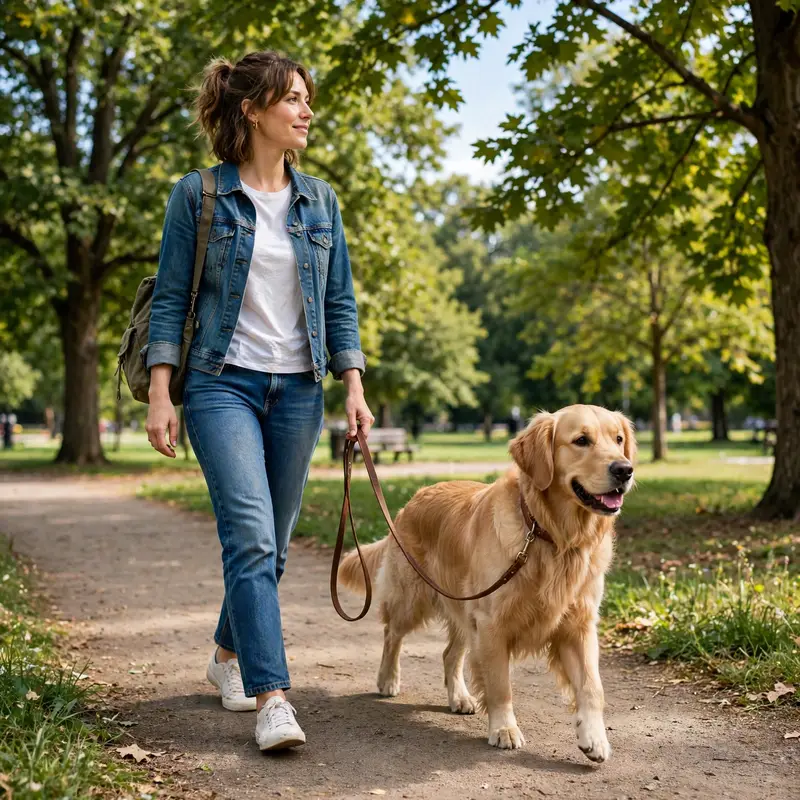
There’s a special kind of arm ache known only to owners of a Golden Retriever pulling on leash. You’re being towed down the street by 30 kilos of enthusiasm while your dog treats the leash as a tow rope and you as the water-skier.
Every walk becomes a battle of shoulders, and “enjoyable stroll” feels like a fantasy other people have.
Here’s what makes this fixable: your Golden isn’t pulling from dominance or stubbornness. They’re pulling because it works.
Every step forward on a tight leash teaches them pulling gets them where they want to go. Change that equation, and the pulling stops.
Key Takeaways
- A Golden Retriever pulling on leash is doing what works: tight leash = forward movement. Training reverses it: tight leash = we stop.
- Three techniques do the heavy lifting: stop-and-wait, direction changes, and engagement walking (rewarding check-ins).
- Gear helps but doesn’t replace training: a front-clip harness and a standard 4-6 ft leash; skip retractable leashes, prong, and choke collars.
- Start in low-distraction places, keep sessions to 10-15 minutes, and make sure every walker enforces the same rule.
- Sudden pulling changes, or pulling driven by fear or lunging at triggers, needs a vet check or a certified professional, not just leash drills.
Why Golden Retrievers Pull on Leash
Goldens were bred to work actively alongside people all day: ranging out, retrieving, and coming back. That working heritage is part of the Golden Retriever breed story.
It gives you a strong, energetic, curious dog who finds the whole world interesting and wants to reach it at speed. Pulling is self-rewarding in the purest sense: the dog pulls, the walk continues, the interesting smell gets closer.
Opposition reflex plays a role too. When you pull back against a pulling dog, many dogs instinctively pull harder into the pressure.
That’s why hauling your Golden back or giving leash “corrections” tends to build a stronger puller, not a calmer walker. And every walk where pulling succeeds, even a little, is a training session in the wrong direction.
The Gear: What Helps and What to Skip
Gear won’t train your dog, but the wrong gear makes training much harder.
| Equipment | Verdict | Notes |
|—|—|—|
| Front-clip harness | Best starting point for pullers | Chest attachment turns the dog back toward you when they pull. Good management while you train. |
| Back-clip harness | Fine for trained dogs | Comfortable, but gives a strong puller full sled-dog leverage. Not a training tool. |
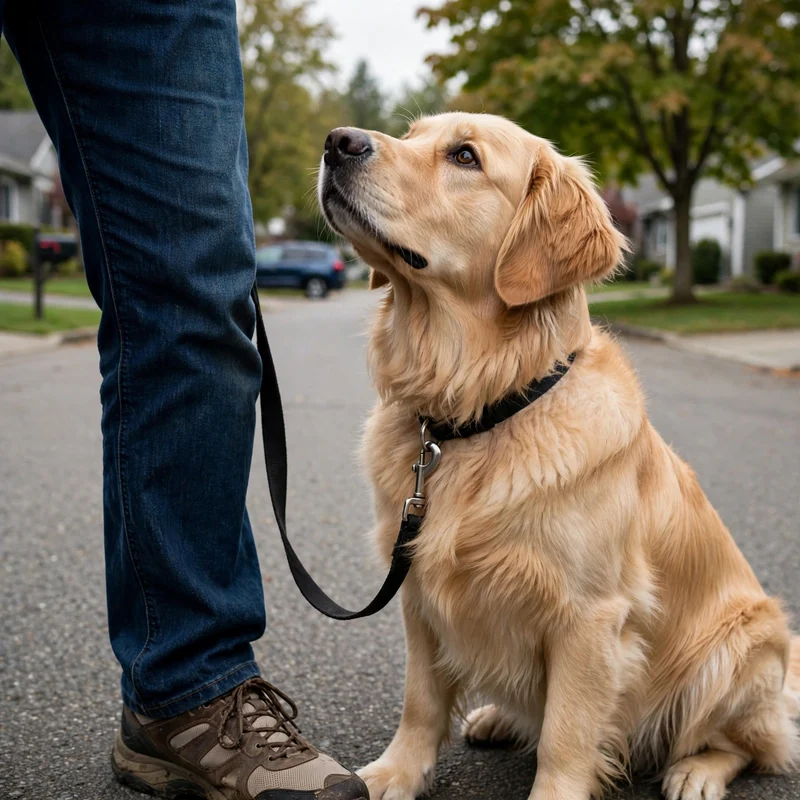
| Flat collar | Fine for ID and light training | OK once pulling improves. Avoid for hard pullers: repeated throat pressure can cause injury. |
| Head halter | Useful for very strong dogs | Great control, but most dogs need gradual, treat-heavy conditioning to accept it. |
| Retractable leash | Skip for training | Teaches the dog that pulling extends their range: the opposite of what you want. |
| Prong / choke collars | Skip entirely | The American Veterinary Society of Animal Behavior’s position statement on humane dog training recommends reward-based methods and states aversive tools like prong collars, choke chains, and leash corrections should not be used. |
Use a standard 4-6 ft fixed leash. It gives consistent feedback about leash tension and keeps your dog at a predictable distance.
Stop Golden Retriever Pulling on Leash: The Core Method
The foundation is stop-and-wait, sometimes called “be a tree.” Simple, boring, extremely effective.
1. Walk forward with your Golden on a loose leash.
2. The instant the leash goes tight, stop. Don’t yank, don’t say anything, just become a tree.
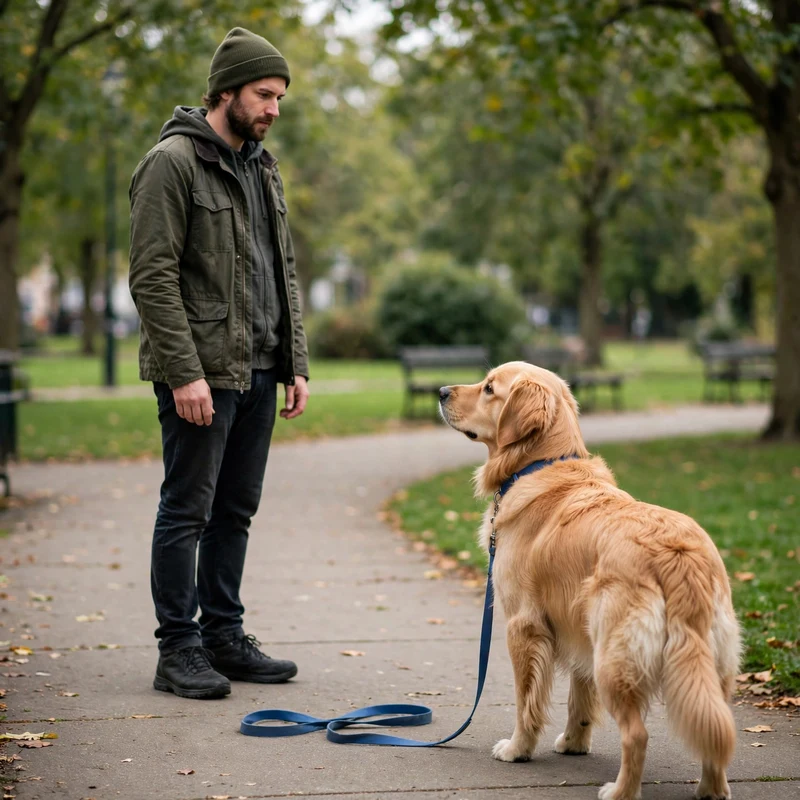
3. Wait until your dog turns back, steps toward you, or otherwise creates slack.
4. The moment the leash loosens, even slightly, praise and move forward. A treat for checking in makes the lesson stick faster.
5. Repeat. Every single time.
Your dog learns a clean equation: tight leash = we go nowhere; loose leash = the walk continues. Expect to stop constantly on the first few walks — that’s the training working.
Within a couple of weeks of consistent practice, most Goldens figure out that staying close keeps the walk moving. This patient routine is what turns a golden retriever pulling on leash into a relaxed walking partner.
Two rules make or break this method. First, every person who walks the dog must enforce it: one family member who lets the dog pull teaches the dog that pulling sometimes works.
And sometimes-rewarded behavior is the hardest kind to stop. Second, never pull back when your dog pulls. Be the tree instead.
Technique 2: Direction Changes
If stop-and-wait feels too passive, or your Golden has learned to lean into the stop and wait you out, add direction changes. When your dog pulls ahead, turn and walk the opposite direction without warning.
Don’t drag them around; just change course so the pulling dog suddenly finds themselves behind you. When they catch up on a loose leash, praise and keep walking. Be unpredictable: left turns, right turns, U-turns.
This teaches your Golden to pay attention to where you’re going instead of locking onto a destination and towing you there. Many owners combine both techniques to end golden retriever pulling on leash for good: stop for mild pulling, change direction for committed surging ahead.
Technique 3: Engagement Walking
This takes the most effort and produces the best long-term results. Instead of only reacting to pulling, actively reward your dog for choosing to stay connected.
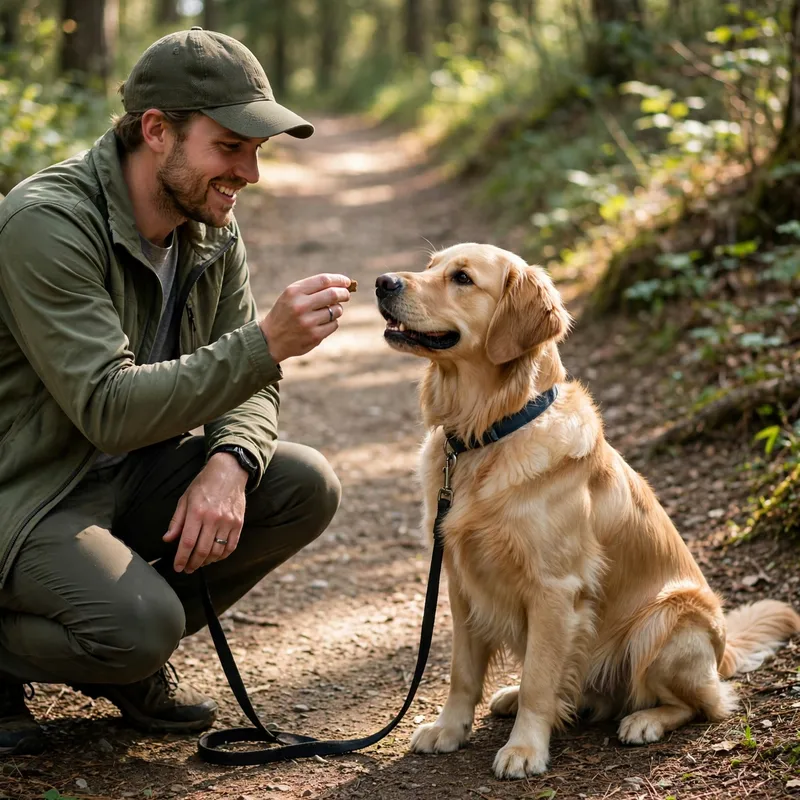
Carry high-value treats reserved for walks (not everyday kibble). Reward every voluntary check-in: a glance your way, eye contact, walking close unasked.
You’re making yourself more interesting than the environment — the real antidote to golden retriever pulling on leash.
Start indoors or in the garden: walk a few steps, reward a loose leash, repeat. Then a quiet street, then busier areas.
Each new environment is a new classroom; expect regression when you level up and drop back when it happens.
Your First Two Weeks: A Realistic Plan
Days 1-3: Practice indoors and in the garden only, 5-10 minute sessions. Teach the stop-and-wait game where it’s easy, and get your dog comfortable in the front-clip harness with treats.
Days 4-7: Move to a quiet street at a quiet time. Keep training walks to 10-15 minutes, then let the dog sniff. Expect lots of stopping and reward every check-in generously.
Days 8-14: Add direction changes and extend walk length. Try slightly busier spots, retreating if pulling spikes. Everyone in the household should be using the same method by now to keep golden retriever pulling on leash from creeping back.
A note on puppies: keep sessions short and positive, and ask your vet about safe walking areas before vaccinations are complete.
Many vets advise keeping unvaccinated puppies out of high-traffic dog areas; your own garden or a friend’s fenced yard is ideal for early practice.
Common Mistakes
- Letting the dog “just pull this once” because you’re in a hurry. Every successful pull is a deposit in the pulling bank. If you can’t train on a walk, manage instead: drive to a field or use a long line.
- Yanking or “popping” the leash. It risks neck and throat injury, and opposition reflex means the dog often pulls harder. It teaches nothing about what to do instead.
- Training only on the exciting route. If every walk starts at the park gate, the dog starts every session over threshold. Train on boring streets first.
- Too-long sessions. A frustrated 40-minute drill teaches less than a crisp 10-minute one. End while you’re both still happy.
- Forgetting sniff breaks. A walk that’s all drilling and no sniffing is miserable for the dog. Sniffing is mentally tiring and calming; build it into every walk.
When Pulling Isn’t Just Pulling
Leash training fixes pulling from enthusiasm and habit. Get professional help if your Golden lunges, barks, or growls at dogs, people, or traffic — that’s leash reactivity, needing desensitization work with a certified trainer.
Also see a professional if pulling started suddenly in a previously good walker (pain can change how a dog moves on leash: see your vet), or if your dog panics on leash by cowering, bolting, or shutting down (fear needs a careful behavior plan, not more drills).
If your Golden’s leash frustration includes grabbing the leash itself, that’s a separate and very Golden habit: our guide to Golden Retrievers biting the leash on walks covers it.
Golden Retriever Pulling on Leash: FAQs
How long does it take to stop a Golden Retriever pulling on leash?
Puppies started early often walk nicely within weeks. Adults with a long pulling history typically need 4 to 8 weeks of consistent daily practice. The timeline depends almost entirely on consistency: every walker, every walk, same rules.
Are front-clip harnesses bad for a Golden Retriever’s shoulders?
Front-clip harnesses are widely recommended by trainers for pullers, and most dogs use them without issue. Fit matters: straps should sit without rubbing or restricting leg movement.
If your dog has a known shoulder or gait problem, check with your vet about the best option.
Should I use a head halter for my pulling Golden?
It can suit very strong dogs or smaller handlers. Condition it gradually with several short, treat-heavy sessions. It’s a management tool, not a replacement for training.
Why does my Golden only pull on the way out, not the way home?
The outbound leg is full of novelty and anticipation; the return is familiar and the dog is tireder. It’s normal.
Train on the way out when motivation is highest, and don’t assume the calm walk home means the problem is solved.
Is it OK to let my Golden pull when we’re just going to the park?
No, if you want the training to work. Dogs don’t understand “pulling is fine on Tuesdays.” Inconsistent rules teach the dog that pulling sometimes pays, which makes the behavior more persistent.
On non-training days, manage the walk (drive to the park, use a long line) rather than letting them rehearse pulling.
My Golden pulls toward other dogs. Is that the same training?
Not quite. Excitement pulling is fixed with the methods above. Pulling with barking, lunging, or fixating is leash reactivity and needs desensitization and counterconditioning, ideally with a certified trainer.
Ask your vet for a referral if you’re unsure which you’re seeing.
Walks Can Be the Best Part of the Day
A golden retriever pulling on leash isn’t giving you a hard time; they’re having a hard time containing their joy about the walk.
Channel that joy into a skill: tight leash stops the fun, loose leash keeps it going. Be boring when they pull, be a treat dispenser when they check in, and get the whole household on board.
For the bigger picture, see the Golden Retriever behavior problems pillar and the Golden Retriever category. Excitement at the door often goes with excitement on the street, so pair this with our guide on Golden Retriever jumping on guests.