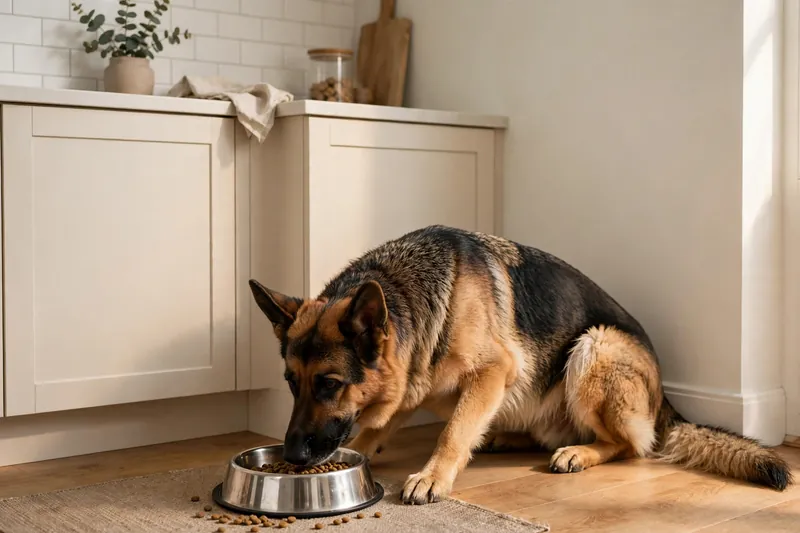
German Shepherd Resource Guarding Food: What to Do
That first low growl over the food bowl can rattle even a confident owner. One minute your German Shepherd is happily crunching kibble, and the next he stiffens over the bowl.
If that has happened in your kitchen, you are dealing with German Shepherd resource guarding food. Guarding is normal canine behavior, but in a strong, fast breed it is a safety issue to handle with care.
German Shepherd Resource Guarding Food: The Direct Answer
German Shepherd resource guarding food means your dog warns people or other pets away from food because he fears losing it. The warning may be stiffening, a hard stare, a growl, or a snap.
Start with safety and management, not training exercises. Feed him alone, leave him alone while he eats, and never punish the growl. For mild cases only, gentle trade-up work can then change how he feels about people near food.
If he has bitten, snapped, or lunged, or if children are involved, stop home training. See your vet and a qualified behavior professional instead.
Key Takeaways
- Guarding comes from fear of losing something valuable. Punishing it makes it worse.
- Management comes first: a quiet private feeding spot, away from other pets and children, bowl down then walk away.
- Never take the bowl away mid-meal, reach into it, or test your dog. That is how guarding starts and escalates.
- Mild cases only, with no snapping and no children involved, may suit trade-up games and pass-by exercises.
- Never punish the growl. It is a warning, not disobedience.
- Snapping, lunging, biting, guarding aimed at children, or sudden guarding means vet first, then a qualified behavior professional.
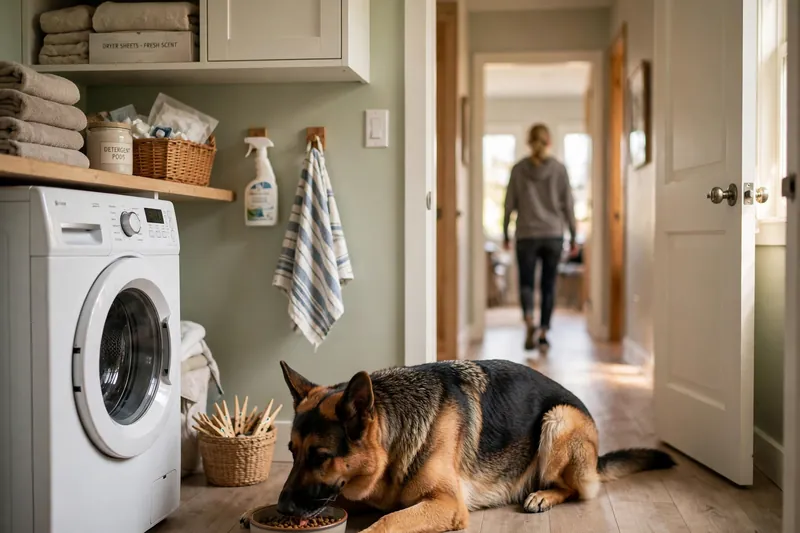
The Safety Rules Come First
Set these rules up before any training. Every guarding episode teaches your dog that guarding works, so prevention is not optional.
- Feed in a private, predictable spot. Use a separate room with the door closed, or a space behind a baby gate.
- Put the bowl down, then walk away. Hovering adds pressure, and pressure adds worry.
- When he has finished and walked away on his own, pick the bowl up. Do not leave bowls out all day.
- Everyone in the household must follow the same rules. One person testing the dog can undo the plan.
Children and Safety
No child should approach, pet, or feed a dog that guards food. Children should never be part of guarding exercises.
Children move quickly, and they are close to a large dog’s mouth. They also miss early warning signs that an adult might spot.
Feed behind a closed door or gate when children are home. If your dog guards from children, treat that as a professional case at once.
What Never to Do
- Never punish the growl. Punishing a warning can remove the warning without removing the fear.
- Never take the bowl away mid-meal to show control. That confirms the dog’s fear that food disappears near people.
- Never reach into the bowl, pry food from his mouth, or tease him around food.
- Never test how far guarding goes. Do not push him until he snaps to see what happens.
- Never use yelling, physical corrections, shock collars, or prong collars. Use rewards and calm management instead.
- Never let a child hand-feed, trade with, or train a dog that already guards food.
Why German Shepherds Guard Food
Guarding is an old survival behavior. In nature, an animal that gives up food easily may not eat, so holding on can feel like the safe choice.
German Shepherd resource guarding food is usually driven by worry, not spite. Your Shepherd guards because he fears the food might disappear.
German Shepherds were bred as herding and guarding dogs, bred to watch, decide, and act. That watchful temperament does not switch off at dinnertime.
Scarcity, competition with littermates, shelter life, or food and toys often being taken away can also teach a dog to hold on tight.
Household stress can add to the problem. A new pet, a move, or a new schedule can make a worried dog guard more strongly.
Pain and illness can also drive a sudden change. Dental pain, ear pain, and digestive trouble can make a dog newly defensive around food.
Book a vet check before training if guarding is new, sudden, or worse than before. Rule out pain and medical causes first.
The Warning Ladder: Read It Before It Escalates
Dogs rarely go from calm to biting with no steps in between. Dogs whose early warnings are ignored or punished tend to escalate to louder ones.
| Level | What you may see | What to do |
|---|---|---|
| Early and quiet | Eating faster, hunching over the bowl, freezing, turning to block access | Give space at once and use management |
| Clear warning | Hard stare, flattened ears, tense mouth, lip lift, low growl | Back away calmly and do not punish the warning |
| Urgent | Air snap, lunge, chase away, or bite | Stop home training and get professional help |
The growl is communication, not rudeness. It tells you your dog is uncomfortable and needs more distance.
Never punish the growl. A dog that learns warnings bring punishment may stop warning and snap without warning instead.
Where your dog sits on this ladder tells you how serious things are. The higher the warning, the sooner you need professional help.
Management While You Train
In German Shepherd resource guarding food, management keeps everyone safe while you work on the feeling behind the behavior. Management alone does not change the emotion, but it stops rehearsal and bites.
- Feed each dog separately, in a closed room, at the same times each day.
- Keep high-value items, such as bones and long-lasting chews, out of reach except in the safe feeding spot.
- Clear the area before guests eat. Confine your dog in another room until food is cleared away.
- Teach visitors the rule: when the dog is eating, we leave the dog alone.
- Keep a simple written list of the rules where every family member can see it.
Other breeds can guard food, too. The same safety-first approach is used in our Dachshund food aggression guide and our Golden Retriever food aggression guide.
For Mild Cases Only: The Trade-Up and Pass-By Plan
German Shepherd resource guarding food at the mild level means stiffening, eating faster, turning away, or an occasional low growl. There must be no snapping, lunging, or biting, and no children in the picture.
If your dog is above the growl on the warning ladder, skip this plan. Go to the professional referral section instead.
The goal is to change how your dog feels about people near his food, from threat to something wonderful arriving. Use only rewards, and work slowly.
Step 1: Find your starting distance. Notice how close someone can be before the first subtle sign appears, then start well outside that distance.
That starting point may be across the room, from the doorway, or from behind a baby gate. Comfort matters more than speed.
Step 2: Pass by and toss something better. While he eats, walk past at your starting distance and toss a high-value treat, such as cooked chicken or cheese, in his general direction.
Keep moving. Do not stop, reach toward the bowl, or stare. Do a few repetitions per meal, in short sessions.
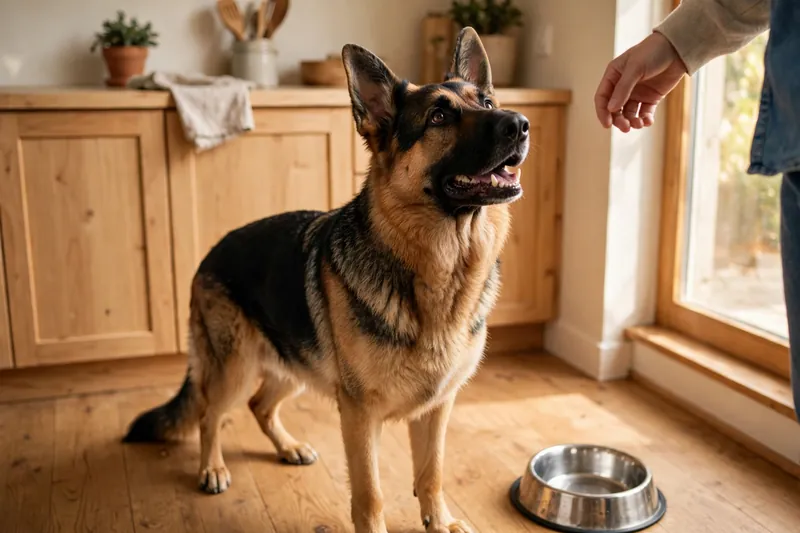
Step 3: Watch for the happy look-up. After enough repetitions you may see a shift: he lifts his head when you approach, looking bright and expectant instead of tense.
Only then move a little closer, one small step at a time, over days. If you see stiffening, a hard stare, or a lip lift, you moved too fast.
Return to the last comfortable distance. A setback is information, not failure.
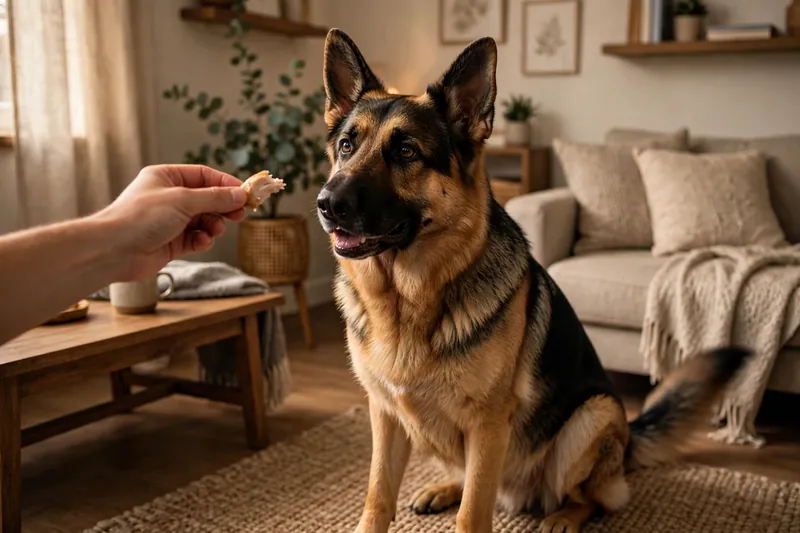
Step 4: Play the trade-up game away from meals. With a low-value item he does not guard, show a high-value treat and offer a trade.
When he drops the item, give him the treat and then give the item back. Giving it back teaches him that letting go does not mean losing.
Start with boring items and work up gradually. Never practice with something he actively guards.
Step 5: Try the empty-bowl game. Once he is comfortable with you approaching, place his bowl down empty, walk over, drop in food, and walk straight away.
When he finishes, return and drop in another handful. He learns your arrival at the bowl means food appears, not disappears.
Expect weeks, sometimes a couple of months. Progress is rarely a straight line, and a bad day means you drop back a step.
If guarding escalates instead of softening, stop and get professional help. A slow-feeder bowl can help if he eats too fast for pass-by exercises.
When to Get Professional Help
Some situations are beyond what home exercises can safely address. Call your vet first, then ask for a referral to a board-certified veterinary behaviorist or a certified applied animal behaviorist.
- Your dog has snapped, lunged, air-snapped, or bitten over food, or tried to.
- Your dog guards food from children, or children live in the home and any guarding is present.
- Your dog guards multiple things, such as beds, resting spots, doorways, stolen items, or people, not just food.
- Guarding appeared suddenly in an adult dog that never guarded before. See your vet urgently to rule out pain or illness.
- Intensity is escalating, with louder warnings, a growing trigger distance, or guarding from people he used to trust.
- Guarding goes beyond mild food-bowl tension, or you feel unsafe at any point. Your gut counts as data.
A qualified professional will assess your individual dog, design a plan matched to his threshold, and advise honestly on next steps.
This article alone is not enough for those cases. Do not keep trying home exercises when the risk is rising.
Frequently Asked Questions
Should I take my German Shepherd’s food bowl away while he eats?
No. Taking food away teaches a dog that people near his food are a threat. That can cause guarding, and it can intensify guarding that already exists.
My puppy growled over his bowl once. Should I worry?
Take it seriously, but do not panic and do not punish him. Start the management rules at once, and practice trade-up games with low-value items only.
Watch whether it fades or grows. If it escalates or spreads to toys or resting spots, get professional help early.
Can I train my dog to be fine with my kids near his food?
No, and please do not try. Children should never be part of guarding training. Any guarding in a home with children is a professional case.
Manage it with strict separation at mealtimes until a qualified behavior professional designs the plan.
How long does the training take?
Plan on weeks to a couple of months of consistent, patient work. You are changing an emotional response, not teaching a trick.
Short daily sessions beat occasional long ones, and progress happens on the dog’s timeline.
Will my dog grow out of it on his own?
Unlikely. Guarding that works tends to stick around and often intensifies, because every successful episode reinforces the strategy.
Should I punish my dog for growling?
Never. The growl is a warning system working exactly as designed. Punishing it removes the warning without removing the fear.
Calmly increase distance, then address the underlying worry with management, gentle trade-up work for mild cases, or professional help.
German Shepherd resource guarding food can get better with patience, safety, and the right help. Set the safety rules, manage the environment so guarding never gets rehearsed, and use gentle trade-up work for mild cases only.
Start with safety, keep meals calm, and get help early, and for the wider breed picture see our complete German Shepherd behavior problems guide and our German Shepherd separation anxiety when left alone guide.
Reference
ASPCA, “Food Guarding”: ASPCA Food Guarding
Still stuck? Get a plan built for your dog.
Answer a few quick questions and get a personalized, force-free training plan in minutes.
Try the Free Dog Tools