How to Stop a Dachshund Barking at Guests
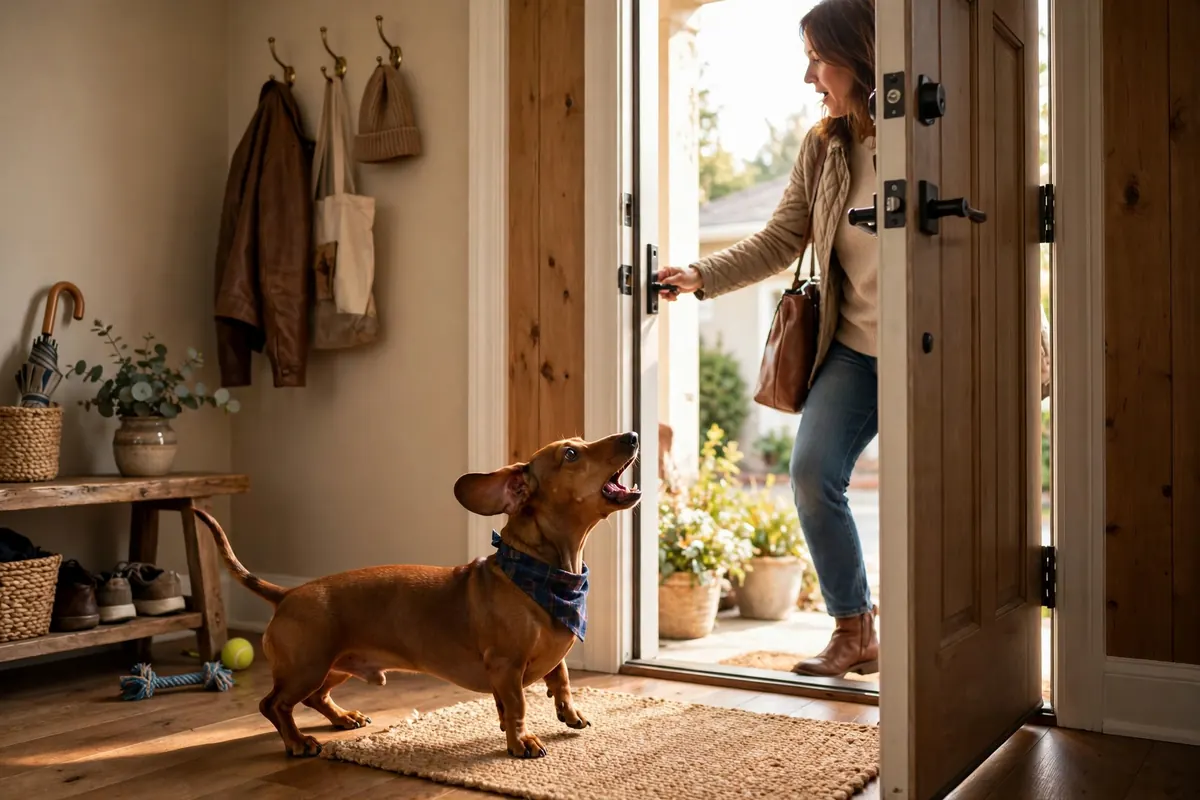
The doorbell rings. Before you’ve even stood up, your Dachshund has launched into a full-volume alarm that suggests armed intruders rather than your mother-in-law with a casserole.
Ten minutes later the guest is on the sofa, the dog is on the guest’s lap, and everyone’s pretending the deafening welcome didn’t happen.
If you’re wondering how to stop Dachshund barking at guests, it helps to know what’s actually happening in that little head:
Your dog is running ancient software (announce the intruder, loudly) on thoroughly modern hardware: your front door.
The goal isn’t a dog who ignores visitors. It’s a dog who alerts, then trusts you to handle the greeting, and who has a trained job to do instead of barking.
Key Takeaways
- Guest barking is usually territorial alerting, excitement, or fear, sometimes all three at once. The fix differs slightly for each, so watch your dog’s body language.
- Dachshunds were bred to announce findings loudly; you won’t train out the alert, but you can train a fast off-switch and a calmer greeting ritual.
- Management (baby gates, distance, a pre-guest routine) prevents rehearsal while training catches up. Every un-managed doorbell is practice for the dog.
- Guests must follow the rules too: no looming, no grabbing, and treats come from visitors only for calm behavior.
Why Your Dachshund Barks at Guests
Territorial instinct.
To your Dachshund, the house is the burrow and visitors are uninvited badgers. The doorbell is the starting gun.
This is the most common driver: the dog barks at the arrival, then often settles once the guest is “processed.”
Which is why so many Dachshunds bark furiously for five minutes and then demand lap time.
Excitement. Some Dachshunds love people and bark from pure arousal, the human equivalent of screaming when your favorite band takes the stage. Excited barkers are bouncy, wiggly, and often vocalize in a higher pitch. They usually want to reach the guest, not repel them.
Fear or uncertainty.
Less confident dogs bark to create distance: “stay back!” from behind your legs.
Fear barkers may show tucked tails, flattened ears, or a retreat-and-approach pattern.
This matters because flooding a fearful dog with forced greetings makes things worse. Their protocol needs distance and choice, not just obedience.
It works.
Here’s the quiet truth behind most persistent guest barking: from the dog’s perspective, barking is wildly successful.
The scary/exciting person eventually sits down, stops looming, and the crisis passes, which the dog credits to the barking.
Every repetition cements the habit, which is why Dachshund barking at guests becomes so entrenched.
How to Stop Dachshund Barking at Guests: Start with Management
Training takes weeks. Management works tonight. Every guest visit your dog spends practicing frantic barking is a deposit in the wrong account, so set up the environment before you train the behavior. For Dachshund barking at guests, management is what breaks the rehearsal cycle.
1. Control the doorway.
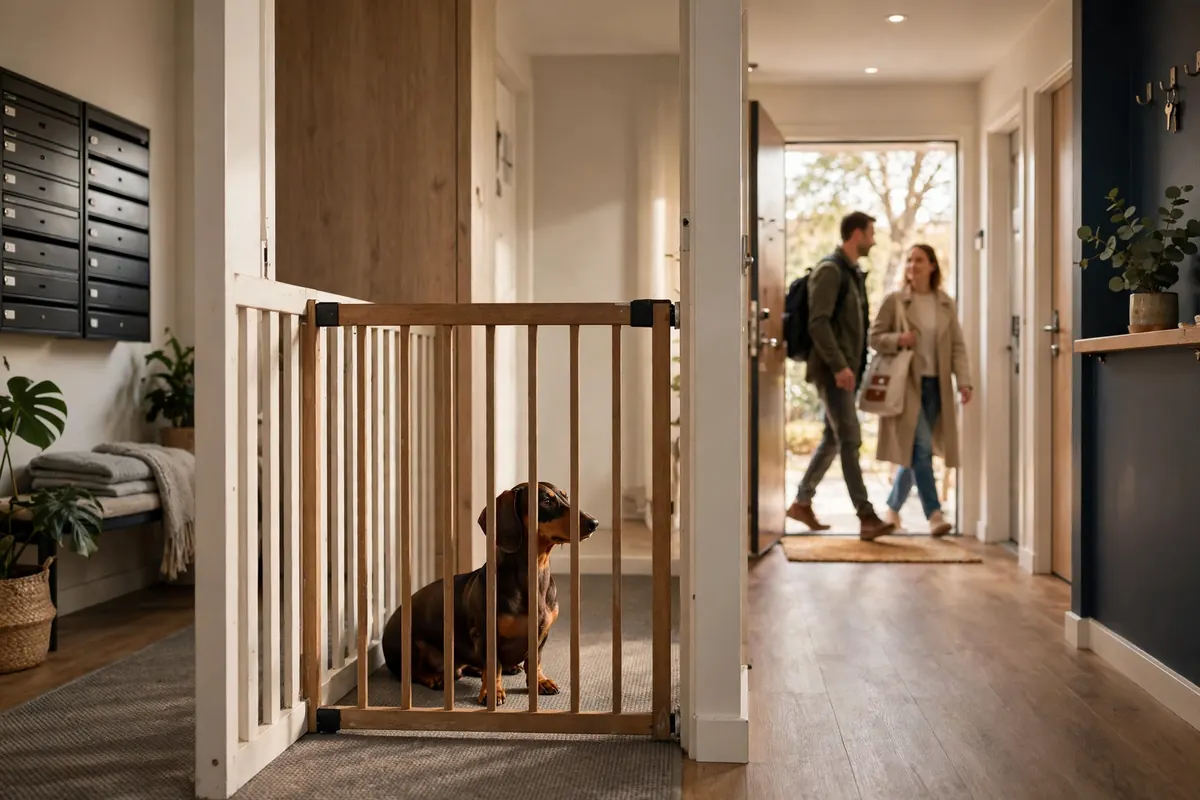
A baby gate across the hall or a leash on the dog during arrivals prevents the full-throttle door charge.
Distance alone takes enormous pressure off: a dog greeting from six feet behind a gate is a different animal from one with their nose in the visitor’s shoes.
2. Create a guest routine.
Ten minutes before visitors arrive: toilet break, a short play or training burst to take the edge off, then settle the dog in their spot (bed, crate, behind the gate) with a stuffed Kong or long-lasting chew.
A dog with a job and a full mouth barks less.
3. Muffle the trigger. If the doorbell is the starting gun, change the starting gun: switch to a phone text (“we’re here”) instead of ringing, or desensitize the bell sound separately with treats at low volume. Fewer explosive triggers, fewer explosive responses.
4. Give fearful dogs an exit. If your Dachshund is genuinely worried about visitors (not just loud), let them choose distance. A safe room with a chew, visited on their own terms, beats forced greetings. Confidence builds through choice, not confrontation.
The Greeting Protocol: Teach a Better Hello
The long-term fix is replacing the barking ritual with a calmer one. Here’s a protocol that works for most Dachshunds, and it’s the core of fixing Dachshund barking at guests:
Step 1: Park the dog before the guest enters.
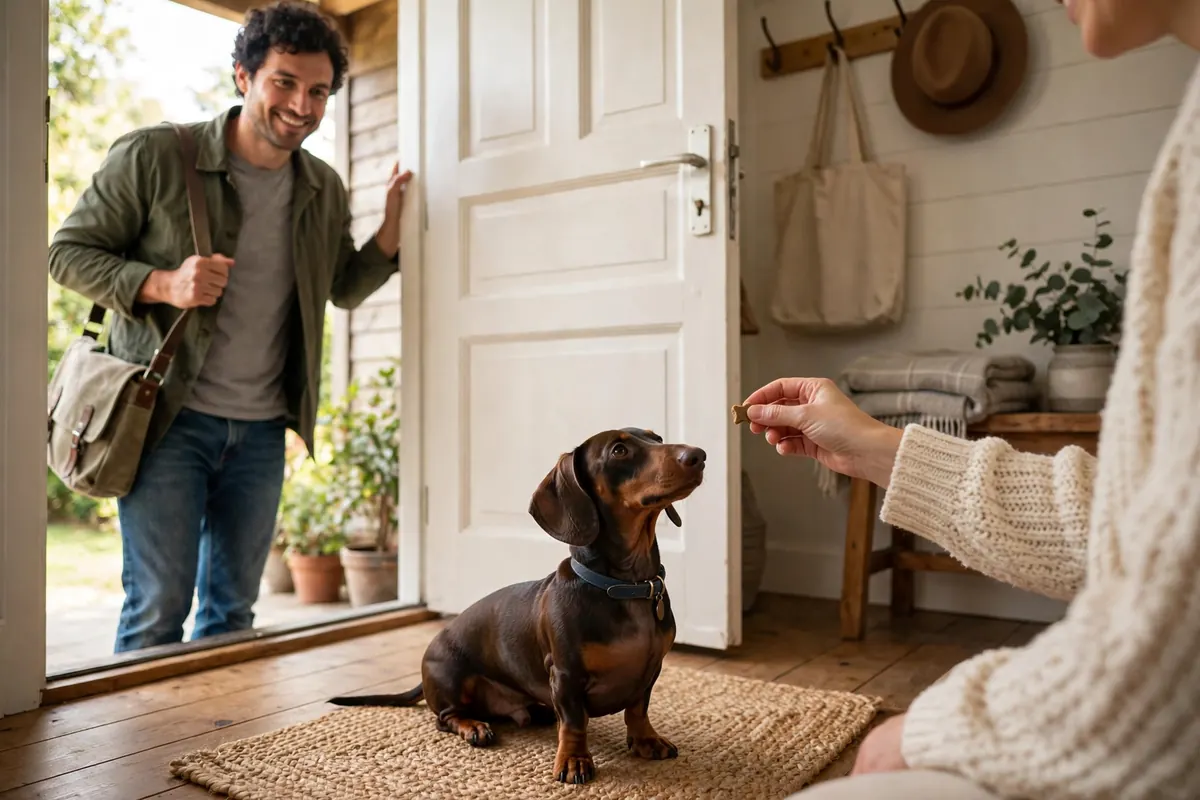
Guest texts on arrival. Dog goes to their bed/spot on cue (train this separately first: “go to your bed” is one of the highest-value cues a dog can learn).
Guest enters while the dog is settled at a distance.
Step 2: Treat scatter for calm.
As the guest walks in, scatter a handful of small treats on the dog’s bed or the floor around it.
This does two things: it gives the mouth something to do besides bark, and it changes the emotional math: guest arrival predicts raining treats.
Step 3: Structured introduction.
Once the initial excitement passes (usually a few minutes), allow a brief greeting on your terms: dog on leash or behind the gate, guest crouching sideways, letting the dog approach.
Treats for calm sniffing. Then the guest sits down.
Seated humans are far less threatening and exciting than standing ones, and normal life resumes.
Step 4: Guest rules, non-negotiable.
Brief every visitor, kindly but firmly: don’t loom over the dog, don’t reach for their head, don’t pick them up uninvited, don’t stare.
Toss treats (don’t hand-feed at first) for calm behavior.
Guests who follow the rules get a calm dog; guests who wrestle the “cute sausage” get the barking they paid for.
Dachshund barking at guests thrives on inconsistent rules, so brief every visitor.
For fearful dogs: skip straight to distance. The guest ignores the dog completely: no eye contact, no reaching, while treats rain near the dog’s safe spot. Let the dog decide when curiosity beats caution. This can take multiple visits, and that’s fine.
Keep Greetings Safe for a Long-Backed Breed
Excited arrivals mean jumping, twisting, and launching off the sofa, and for a Dachshund that physical chaos carries a real spinal risk on top of the noise. Build back protection into your guest plan from the start.
Keep the dog’s settle spot low and easy to reach: a bed or mat on the floor, not the sofa arm where they’ll launch themselves off mid-greeting.
Ask guests not to encourage jumping up; greetings happen at floor level, with the guest crouching, only once the dog is calm.
If you need to guide your dog away from the doorway mid-excitement, use a harness or a calm body block rather than yanking the collar while they’re pulling and twisting.
And brief visiting children the same way you brief adults: let the dog come to them, quiet voices, and no picking the dog up.
A long-backed dog grabbed mid-wiggle by an excited child is a back injury waiting to happen.
How to Stop Dachshund Barking at Guests: The Training Foundations
The protocol works because of trained foundations. Build these in short daily sessions, away from real guests first. These foundations are what finally resolve Dachshund barking at guests.
1. A rock-solid “go to bed.” Train it like a trick: lure to the bed, reward, add the cue, add distance, add duration. Practice with fake doorbells and knocks before the real thing. This single cue transforms guest arrivals.
2. The “quiet” cue.
Let the dog bark two or three times at a knock (the alert is fine), then cue “quiet,” mark and reward the pause.
Dachshunds are extremely food-motivated, so pay generously for silence.
Practice daily until the cue works at 80% reliability indoors before testing it on guests.
3. Desensitize the doorbell.
Play doorbell recordings at low volume while feeding treats, gradually increasing volume over sessions.
The golden rule: always work below the point where your dog erupts.
If they’re already barking flat-out, the exercise is too hard, so increase distance, lower the volume, or drop back a stage.
Separately, practice calm greetings with a cooperative friend playing “guest.” Real setups beat real chaos.
4. Reward the boring.
The most underused tool in dog training: quietly treating calm behavior whenever you catch it.
Dog lying on their bed while you move around? Treat. Dog watching a guest from a distance without comment? Treat.
You’re building a dog who defaults to settled, which is the end goal for Dachshund barking at guests.
Our guide to calming a Dachshund down has more settle-building exercises.
Common Mistakes
- Yelling over the barking. To your Dachshund, you’re joining the alarm chorus, which confirms this is indeed an emergency. Calm, low voices only.
- Letting guests “win through.” Every unmanaged visit where the dog barks for ten minutes and the guest eventually sits down teaches the dog that persistence works. Management isn’t optional while you train.
- Forcing greetings on a fearful dog. Picking up a scared Dachshund and handing them to a guest, or letting visitors chase and corner them, deepens fear. Distance and choice build confidence; flooding destroys it.
- Punishing the bark. Spray bottles, shouting, leash jerks, and especially aversive collars suppress the noise without changing the feeling, and a punished territorial dog often becomes a tenser, less predictable one. Train the alternative instead.
- Inconsistent rules between household members. If one person enforces the greeting protocol and another lets the dog charge the door “because it’s funny,” the dog learns the rules are optional. Everyone follows the same script.
When Guest Barking Needs Professional Help
Most guest barking is a training project. Get professional help if:
- The barking escalates to lunging, snapping, or biting at guests
- Your dog is genuinely fearful: cowering, trembling, hiding, or unable to eat treats around visitors
- There’s been any bite, however minor: consult your vet and a qualified force-free behavior professional
- The behavior appeared suddenly in an adult dog alongside other changes (vet check first; pain and medical issues can drive new reactivity)
A good professional doesn’t just suppress the barking; they read why it’s happening and build a plan around your specific dog.

Frequently Asked Questions
Should I put my Dachshund in another room when guests come?
As a management step while training, absolutely.
It’s far better than letting them rehearse frantic barking.
But don’t make it the permanent solution without training too; the goal is a dog who can be present and calm, even if that takes months.
Combine separation with the greeting protocol and desensitization work.
Why is my Dachshund fine with guests after 10 minutes but terrible at the door?
Because the trigger is the arrival, not the person.
The doorbell, the doorway, the looming stranger: that’s the explosive cocktail.
Once the guest sits and becomes furniture, the threat/excitement evaporates.
This is actually good news: it means you mainly need to fix the first five minutes, which is exactly what the greeting protocol targets.
My Dachshund barks at some guests but not others: why?
Dogs read details we miss: hats, deep voices, strong perfume, sudden movements, nervous energy. Men with beards and tall looming strangers are classic triggers for small dogs. It’s not personal; it’s pattern-matching. Note the pattern and give those guests extra distance and extra treats.
Can I just give guests treats to feed my dog?
Yes, with structure: guests toss (not hand) treats for calm behavior only: four paws on the floor, quiet mouth.
Treats for jumping or barking pay for the wrong behavior.
And for fearful dogs, let the guest ignore the dog entirely at first; tossed treats near the safe spot, no social pressure.
How long before my Dachshund greets guests calmly?
With consistent management plus training, many owners notice real improvement within a few weeks.
Full reliability (calm greetings with novel visitors, not just familiar ones) typically takes a few months.
Fear-based cases take longer and shouldn’t be rushed.
Dachshund barking at guests is highly fixable with this approach.
—
Dachshund barking at guests is one of the most fixable behavior problems because the trigger is predictable and the protocol is clear.
For related challenges, see barking at night and barking at strangers.
If handling is part of the issue, read why Dachshunds bite when picked up, and for families, nipping at kids.
For the full breed picture, see the complete Dachshund behavior guide, and browse the barking archive and every Dachshund guide.