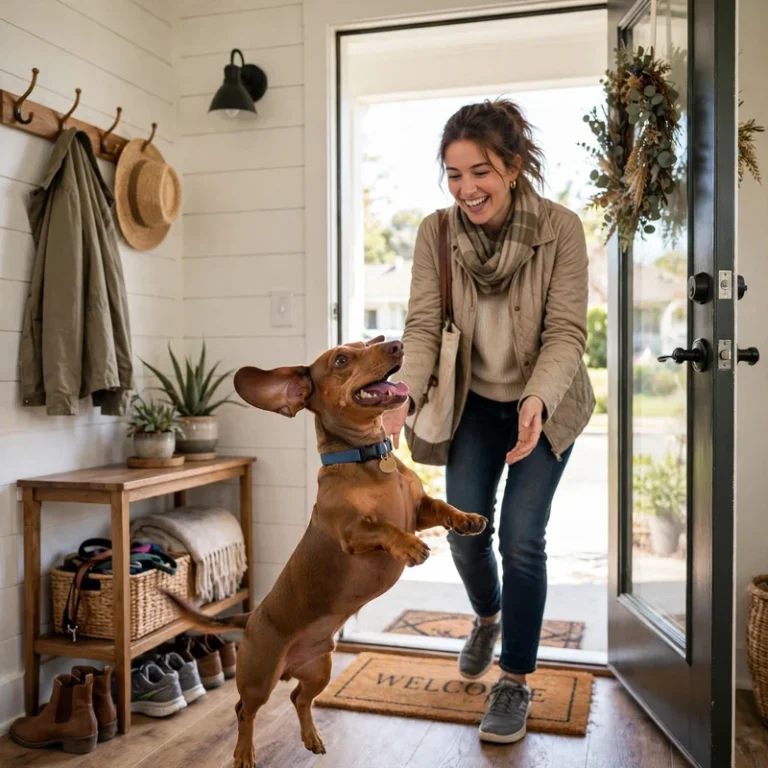
How to Stop a Dachshund Barking at Strangers
You’re halfway down the street when it happens. A jogger appears around the corner, and your ten-pound Dachshund transforms into a furry air-raid siren — lunging, spinning, and barking at the end of the leash. Back home it’s no better: the doorbell rings and your Dachshund delivers a full operatic performance at the window. This is dachshund barking at strangers in its most classic form.
If you’re wondering how to stop Dachshund barking at strangers, here’s the first thing to know: your dog isn’t being “bad” or “dominant.” They’re doing what Dachshunds were bred to do — loudly. Dachshunds were developed as badger hunters who worked underground, and barking was part of the job: a Dachshund in a burrow had to bark so the hunter above ground knew where they were. That big voice in a small body is still factory-installed centuries later. They just need help learning when the alarm is unnecessary.
Key Takeaways
- Dachshunds bark at strangers because of breeding (they’re vocal by design), alert instinct, fear, or barrier frustration — not stubbornness or dominance.
- On walks, distance is your best tool: the farther your Dachshund is from a stranger, the more brain they have left for learning.
- Counter-conditioning, pairing strangers with treats, changes how your dog feels about strangers, which changes the barking.
- At home, manage the triggers (curtains, white noise) while you train a doorbell routine.
- Never punish the barking with yelling, leash yanks, or aversive collars — it increases the underlying fear or arousal.

Why Dachshunds Bark at Strangers
Bred to announce. Most barking breeds were bred to notice things, but Dachshunds were specifically bred to vocalize about them. A silent Dachshund in a badger burrow was a useless Dachshund. Your dog’s brain treats unfamiliar people as announcement-worthy events. You’re not fighting a bad habit so much as channeling an instinct. This breeding history is why dachshund barking at strangers is so persistent — and why the American Kennel Club describes them as vocal by nature.
Alert instinct at home. The doorbell, a knock, footsteps on the path — to your Dachshund, these are security alerts. Strangers approaching the house trigger the same guarding response you’d see in much larger breeds, just delivered at higher pitch and from closer to the ground.
Fear, not confidence. Here’s what surprises many owners: a lot of stranger-barking is fear-based, not bold. The Dachshund barks, the stranger passes by (because that’s what strangers do), and the dog concludes the barking worked — the scary thing left. That relief reinforces the behavior. Dogs who bark from fear often show it in their body language: weight shifted back, ears pinned, tail tucked, barking while retreating. For fear-based dachshund barking at strangers, patience matters more than correction.
Barrier frustration. On leash or behind a fence or window, your Dachshund can’t do the normal dog thing of approaching, sniffing, and moving on. The restraint itself builds frustration, which pours out as barking. This is why many Dachshunds who are polite off-leash turn into lunatics on-leash — the leash adds arousal, not the stranger.
Small-dog syndrome is a training gap, not a trait. People laugh off barking from small dogs in a way they never would from a German Shepherd. But the Dachshund experiences the same fear or frustration — they just get fewer people taking it seriously enough to train. Your dog deserves the same training plan a big dog would get.
How to Stop Dachshund Barking at Strangers on Walks
Training happens in your dog’s thinking brain, and a Dachshund in full meltdown has no thinking brain available. Management keeps them under threshold so learning can happen. The right approach to dachshund barking at strangers starts well below your dog’s reaction threshold.
Distance is your superpower. Figure out your dog’s “barking radius”: the distance at which they notice a stranger but can still take a treat and respond to you. For many Dachshunds it’s surprisingly large: 15, 20, even 30 meters. Work at or beyond that distance. Every calm pass at a safe distance is a rep that builds the new pattern.
Master the U-turn. Teach a cheerful U-turn at home first: say your dog’s name or a cue like “this way!”, lure the turn with a treat, reward generously. On walks, the moment you spot a stranger inside your dog’s radius, U-turn before the explosion. You’re not “avoiding the problem”; you’re preventing rehearsal of the barking while the training kicks in.
Cross the street. Simple, unglamorous, effective. There’s no prize for walking past every stranger at close range while your dog loses their mind. Give space freely.
Keep the leash loose. A tight leash telegraphs your tension straight down the line and adds to barrier frustration. Practice loose-leash walking separately (short sessions, reward for slack), so the leash isn’t part of the problem.
Skip on-leash greetings for now. Forcing a reactive Dachshund to “say hello” to strangers is like exposure therapy without the therapy. Politely decline greetings while you’re training: “We’re in training, thanks!” Most people understand.
Bring the good treats. Kibble won’t cut it when a stranger is approaching. Use small pieces of chicken, cheese, or whatever makes your Dachshund’s eyes go wide. You’re competing with adrenaline, so bring something worth competing with.
Work the body and the nose first. A Dachshund who has had a sniffy walk, a short training session, or a simple scent game (treats scattered in grass to find) starts every stranger encounter with a lower arousal baseline. Exercise alone won’t fix reactivity, but an under-exercised, bored dog has far less patience for triggers. Five minutes of nose work before a walk often does more than a longer, tenser walk.
Counter-Conditioning: Change How Strangers Feel
Management prevents the barking; counter-conditioning fixes the feeling underneath it. The goal: stranger appears → Dachshund feels “treats are coming” instead of “alarm!” Done well, it transforms dachshund barking at strangers from an emotional explosion into a calm glance.
The “look at that” game. At a safe distance, when your Dachshund notices a stranger, mark the moment (“yes!”) and deliver a treat — before any barking starts. You’re rewarding the noticing, not the reacting. Over sessions, your dog starts glancing at strangers and then whipping their head back to you expectantly. That’s the new pattern forming.
Timing is everything. The treat must come within a second or two of noticing the stranger. Late treats reward whatever the dog is doing now, and if you’re late, that’s barking. Watch your dog’s body: ears prick, body stills, stare locks. That’s your window. Mark and treat there.
Stay under threshold. If your Dachshund can’t take the treat, snapping at it, ignoring it, too fixated to chew, you’re too close. Increase distance. A dog who won’t eat is a dog who can’t learn right now. This isn’t failure; it’s information.
Short sessions, many reps. Five minutes of calm stranger-noticing beats a 45-minute forced march past a busy high street. Set up sessions deliberately: park at a distance from a walking path, treat for calm noticing, leave while you’re ahead.
Build a positive stranger history. If your Dachshund missed out on good stranger experiences as a puppy, you can still build them in on purpose: calm pass-bys paired with treats, plus occasional set-ups where a calm friend tosses a treat without approaching. You’re not just training behavior; you’re building the social history the dog never got. Keep every interaction voluntary and under threshold, because one bad experience undoes many good ones.
What about the alert itself? You don’t need to eliminate every bark. A single alert bark followed by settling on cue is a perfectly reasonable goal for a breed built to announce. Train a “quiet” or “enough” cue separately (rewarding pauses in barking at home), and use it after the initial alert.

How to Stop Dachshund Barking at Strangers at Home
Home barking has different triggers, the doorbell, knocks, people visible through windows, and it needs its own plan. The indoor plan for dachshund barking at strangers leans heavily on management while training catches up.
Block the rehearsal. Close curtains or blinds on street-facing windows, or apply removable window film that lets light in but blurs the view. Every stranger your Dachshund barks at through the window is a practice rep for the habit. Fewer reps, weaker habit.
Mask the sounds. A fan, white noise machine, or quiet radio near the front of the house blurs the footsteps and voices that set off alert barking. This is one of the highest-impact, lowest-effort changes you can make.
Desensitize the doorbell. Record your doorbell (or find the sound online). Play it at very low volume while feeding treats. Over multiple sessions, gradually raise the volume. You’re rewiring the association: doorbell predicts chicken, not intruders. Practice when no one’s actually at the door — you want training reps, not real-life ambushes.
Train a door routine. Decide what you want your Dachshund to do when the doorbell rings: go to a mat in another room is the gold standard. Train it separately first (mat → treat, mat → treat, until the mat is the best place in the house), then add the doorbell as the cue. A dog with a job can’t simultaneously be at the window screaming.
Acknowledge, then redirect. When the barking happens anyway: calmly acknowledge (“thank you, I see them”), then cue the trained behavior (mat, “quiet”), and reward the settle. Boring and consistent beats dramatic and occasional.
Desensitize stranger sounds generally. Beyond the doorbell, many dogs react to voices on the path, knocks, or footsteps. If these set your dog off, the same low-volume-and-treats approach works: play recordings of those sounds very quietly while feeding treats, and only raise the volume as your dog stays relaxed.
Common Mistakes
- Yelling “QUIET!” at the dog. From your Dachshund’s perspective, you’re barking too — which confirms this is indeed a bark-worthy emergency. Stay calm and low-voiced.
- Leash yanks and collar corrections. Jerking a barking dog adds pain and fear to an already aroused moment. For fear-barkers, it confirms strangers predict bad things. For frustrated barkers, it adds conflict. Either way, the barking gets worse.
- Flooding. Dragging your Dachshund into a crowd of strangers “to get them used to it” usually sensitizes rather than desensitizes — the dog just learns crowds are overwhelming. Gradual beats sudden.
- Punishment collars. Shock, citronella, and ultrasonic collars suppress barking through fear or discomfort without changing the underlying emotion, and they risk increasing anxiety and fallout behaviors.
- Inconsistent rules. If barking at the window is sometimes ignored and sometimes gets a dramatic reaction, you’ve built a slot machine — the most addictive reward schedule there is. Pick the protocol and stick to it.
When to Get Professional Help
Most stranger-barking improves with the plan above, but get help if:
- The barking is escalating, more intense, closer triggers, harder to interrupt, despite consistent training
- There’s any snapping, lunging with intent, or bite history toward strangers
- Your Dachshund is generally fearful or anxious beyond just strangers (hiding, trembling, refusing walks)
- The behavior started suddenly in an adult dog — see your vet first, since pain and medical issues can drive sudden reactivity
Look for a qualified force-free behavior professional (credentials like IAABC or equivalent in your country). Avoid anyone promising quick fixes through punishment or “dominance” methods. A good behaviorist can tailor the plan for dachshund barking at strangers to your dog’s specific triggers — and PetMD‘s resources explain when professional help is warranted.

Frequently Asked Questions
Will my Dachshund ever stop barking at strangers completely?
Maybe not entirely — and that’s okay. The breed was built to announce. A realistic goal is dramatic reduction: a single alert bark, then settling on cue, and calm passes on walks. Chasing total silence usually leads to frustration for both of you. Consistency is what finally quiets dachshund barking at strangers for most families.
Is it okay to let them “bark it out”?
No. Barking is self-rewarding, because every bark feels productive to the dog, so “barking it out” usually means a long session that strengthens the habit. It teaches nothing and rehearses everything.
My Dachshund is fine off-leash but barks on-leash. Why?
Barrier frustration. The leash prevents the normal approach-sniff-move-on sequence, so arousal builds with nowhere to go. This is extremely common — and good news, because it means the stranger isn’t the core problem. Distance management and loose-leash skills fix most of it.
Should I socialize my adult Dachshund more to fix this?
More exposure only helps if it’s the right exposure — under threshold, paired with good things. Forced, overwhelming exposure makes reactivity worse. Structured counter-conditioning sessions beat random busy-park visits every time.
Will getting a second dog help?
Almost never for barking. A second dog usually learns the barking from the first one, and now you have a stereo system. Fix the behavior first; get a second dog for the right reasons later.
How long will it take to quiet my Dachshund’s barking?
It depends on the cause and your consistency. Dogs whose barking is mostly habit and attention-seeking often improve noticeably within a few weeks once the management is in place. Fear-based reactivity usually takes longer, think weeks to months of steady sessions, because you’re changing an emotion, not just a habit. Track small wins: a walk with one fewer outburst, a doorbell with half the usual barking. Progress is rarely linear, but it is usually real.
—
Dachshund barking at strangers is one of the most workable Dachshund habits because the plan is straightforward: manage the distance, change the feeling, and give the dog a better job. For related barking challenges, see our guides to stopping barking at night and barking at guests. For the full breed picture, read the complete Dachshund behavior guide, and browse every Dachshund guide for more.