How to Calm a Dachshund Down
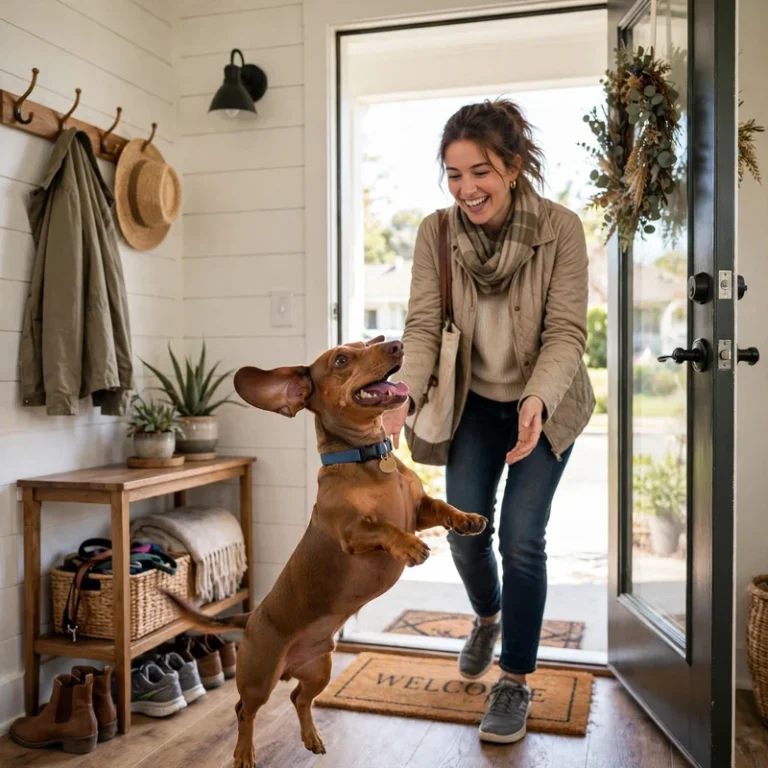
If you’re wondering how to calm a Dachshund down, you probably live with a small dog running a very large engine — the 8 p.m. zoomies, the vibrating-with-excitement greeting, the inability to simply exist on the sofa without launching at every sound.
Here’s the good news: Dachshunds aren’t actually hyperactive by nature. They’re hunters with an on/off switch, and most “wild” Dachshunds are just under-exercised in the ways that matter to a nose-driven brain. Calm isn’t trained by suppressing energy; it’s built by spending it wisely.
Key Takeaways
- Most wired Dachshunds are under-stimulated, not hyperactive, and walks alone rarely cut it for a scent hound’s brain.
- Nose work (sniffy walks, scent games) tires a Dachshund faster than pure physical exercise.
- “Settle” is a trained skill, not a personality trait: mat training teaches an off-switch.
- Calm behavior must be rewarded; if you only notice the dog when they’re wild, wild is what you’ll get.
Why Dachshunds Struggle to Settle
A hunter’s engine in a companion’s life. Dachshunds were bred to work independently underground: bold, driven, and self-employed. That engine doesn’t vanish because the badgers did. A Dachshund with nothing to hunt will hunt excitement: your sleeves, the doorbell, the cat, their own tail.
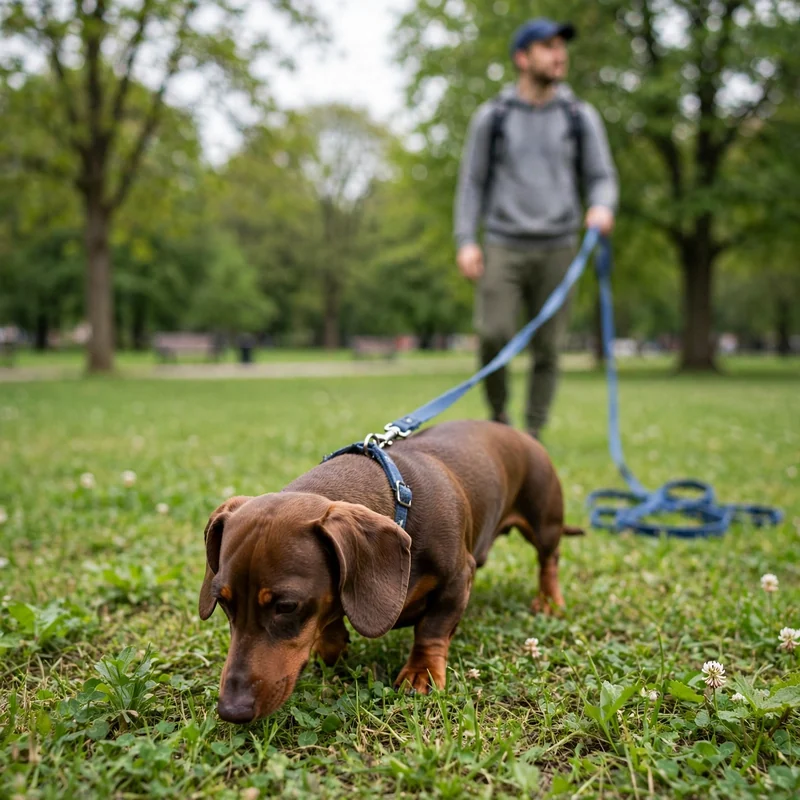
Nose-driven brains need nose work. A twenty-minute march around the block on a short leash exercises legs, not minds. For a scent hound, the mental half of the walk (the sniffing, tracking, investigating) is the part that actually tires them out. Dogs denied sniffing time come home with full batteries.
Arousal stacks. Excitement is cumulative. The visitor at 4 p.m., the exciting walk at 5, the kids’ rowdy play at 6 — each event adds arousal, and the dog never fully comes down between them. By 8 p.m. you get the witching hour: zoomies, mouthing, barking at nothing. It’s not bad behavior; it’s an overloaded system discharging.
They’re rewarded for being wild. Be honest: when the dog is lying quietly, do you notice? And when they’re bouncing off the walls, does everyone look, laugh, talk, and engage? Dogs repeat what works. Many “hyper” dogs have simply learned that calm is invisible and wild gets the party started.
How to Calm a Dachshund Down: The Daily Formula
Calm is built across the whole day, not in one training session. Think of this as the daily prescription:
1. A real walk, not a march. Aim for at least one walk where sniffing is the point. Use a long line in a safe area, follow the dog’s nose, and let them investigate. Many owners find that fifteen minutes of genuine sniffing tires their Dachshund more than a much longer heel-walk. (Keep it low-impact: this long-backed breed doesn’t need marathon running or repeated high jumping.)
2. Feed the hunter’s brain. Scatter feeding (tossing kibble in grass), snuffle mats, rolled-up towels with treats hidden in the folds, cardboard boxes with treats inside: anything that makes the dog work their nose for food. A Dachshund who “hunts” breakfast is a calmer dog all morning.
3. Short training sessions. Five minutes of trick training, twice a day. Sit, down, spin, “touch,” middle: it barely matters what. Focused thinking is exhausting for dogs, and it builds your communication at the same time.
4. Predictable routine. Dogs with predictable days are calmer dogs. Feed, walk, play, and rest at roughly the same times. Uncertainty is arousing; routine is sedating.
5. Enough sleep. Adult dogs need serious rest (often far more than owners expect), and puppies need even more. An overtired Dachshund looks exactly like a hyperactive one: bitey, zoomy, unable to settle. If the witching hour follows a day with no real nap, the fix is sleep, not discipline. A quiet crate or pen in a calm spot gives many dogs permission to finally switch off.
6. Calm greetings. If arrivals home are a screaming reunion, you’re charging the battery daily. Practice boring entrances: come in calmly, ignore the frenzy for a minute, greet when four paws are down. Ask visitors to do the same.
7. Reward the settle you want. This is the big one. Throughout the day, quietly drop a treat near your dog whenever they’re lying calmly, sighing, or resting their head: being the dog you wish they were. You’re building value for calm itself. Most owners accidentally do the opposite: the calm dog gets ignored, the wild dog gets attention.
Teach the Settle: Mat Training
Some dogs need the off-switch explicitly installed. Mat training gives your Dachshund a portable “relax here” cue.
Step 1: The mat predicts good things. Put a mat or towel on the floor. The instant your dog looks at it or steps on it, mark (“yes!”) and treat. Repeat until the dog is throwing themselves at the mat.
Step 2: Build duration. Reward for staying on the mat: first for two seconds, then five, then ten. Pay for lying down on it especially well. Keep sessions to two or three minutes.
Step 3: Add the cue. Once the dog runs to the mat eagerly, add the word “settle” or “mat” as they’re going to it. Then practice in different rooms, then with mild distractions.
Step 4: Use it in real life. Mat by the sofa during TV time. Mat in the kitchen while you cook. Mat at the café. The mat becomes the dog’s calm station — a job to do instead of spinning.

How to Calm a Dachshund Down in the Moment
For the acute episodes (the zoomies, the visitor frenzy, the post-walk crazies):
Don’t chase. Chasing a zooming dog is the best game ever invented, from the dog’s perspective. Stand still, turn boring, let the zoomie burn out.
Redirect to the nose. Toss a handful of treats into grass or a snuffle mat. Sniffing engages the seeking brain and helps most dogs downshift faster than anything else in your toolkit.
Use the mat. If you’ve trained it, cue the settle before the peak, not at it. Timing matters: redirecting a dog at arousal level 6 works; at level 10, nothing works until the wave passes.
End the fun calmly. If play with kids or other dogs is escalating, call a cheerful time-out before it tips over: “all done!” → treat scatter → calm activity. You’re teaching the dog that arousal has a ceiling.
Check the basics. A suddenly wired dog who can’t settle may be overtired, understimulated, or uncomfortable. Rule out the simple stuff before labeling the dog “hyper.”
The Calm House Setup
Environment does half the work:
- A real resting spot. A comfortable bed in a low-traffic corner, ideally where the dog can still see the family (Dachshunds hate exile). Burrow-style beds suit this breed’s nesting instinct.
- Window management. If the front window is a bark-and-launch trigger station, limit access or frost the lower panes. Fewer triggers, fewer arousal spikes.
- Background calm. Some dogs settle better with quiet background noise; sudden silence makes every small sound an event.
- Kid-dog structure. Excited kids plus excited dog is a feedback loop. Teach kids the “be a tree” game (stand still, arms folded) when the dog gets wild — it removes the fuel.
- Your own energy. Dachshunds mirror their people. If you’re tense, loud, and rushing around, expect the dog to match you. Calm is contagious too — model the energy you want.
Mistakes That Wire Them Up
- Only exercising the body. A physically tired but mentally bored Dachshund is just a fitter maniac. The nose must work.
- Accidental reward of craziness. Laughing, chasing, pushing the jumping dog (that’s play!), squealing — all of it says “do it again.”
- Punishing the zoomies. Yelling at an over-aroused dog adds your excitement to theirs. Be boring instead.
- Skipping rest. Puppies and young dogs who never learn to do nothing become adults who can’t do nothing. Enforced naps are training.
- Inconsistency. If jumping gets ignored Monday and a cuddle Tuesday, you’ve built a slot machine. Everyone in the house follows the same rules.
When “Hyper” Needs a Vet
Most high-energy Dachshunds just need a better routine. But see your vet if the restlessness is sudden, the dog can’t settle even after proper exercise and rest, or it’s paired with pacing, panting, appetite changes, or other behavior shifts. Pain, thyroid issues, and age-related changes can all masquerade as hyperactivity. In seniors, nighttime restlessness deserves a checkup, not just more walks.

Frequently Asked Questions
Are Dachshunds naturally hyper?
Not really — they’re energetic in bursts, like the hunters they are: intense activity, then deep rest. A Dachshund who never gets the “intense activity” part (especially nose work) can’t reach the “deep rest” part. Match the breed’s needs and most calm down beautifully.
Will my Dachshund calm down with age?
Generally, yes — most mellow noticeably as adults, and seniors are champion nappers. But “waiting it out” wastes years; the routine and settle training in this guide work at any age and make the wait much more pleasant.
Should I get a second dog to tire mine out?
Usually no. A second dog doubles the chaos more often than it halves the energy — and you can’t outsource training to another dog. Fix the routine first; add a dog later for companionship, not as an exercise strategy.
Do calming treats, wraps, or music work?
They can take the edge off for some dogs, but they’re garnish, not the meal. No treat replaces nose work, routine, and settle training. If you try calming treats, a compression wrap, or a pheromone diffuser, judge honestly whether your dog changes — marketing isn’t evidence. And ask your vet before starting any calming supplement or medication, especially alongside other treatments.
My Dachshund is wild only in the evenings — why?
Classic arousal stacking plus tiredness. The day’s excitement accumulates, the dog is overtired, and the evening becomes the discharge. More daytime nose work, a real afternoon rest, and a calmer evening routine usually fix it within a week or two.
—
A calm Dachshund isn’t a mythical creature — it’s just a Dachshund whose hunter’s brain got its daily work. For related challenges, see our guide to night barking (often an arousal problem too), the complete Dachshund behavior guide, and all Dachshund guides.