Shiba Inu Resource Guarding: A Complete Guide
If your Shiba Inu has ever stiffened over a chew, hovered over the food bowl, or frozen when you reached for their spot on the sofa, you've met shiba inu resource guarding firsthand.
Your dog isn't being spiteful or dominant: they're following centuries of breeding and normal canine instinct, and it's workable.
Here's why this breed guards so hard, how to read the early signals, and a humane plan that works with a Shiba's mind.
Key Takeaways
- Shiba Inus are among the most possessive companion breeds: guarding food, toys, resting spots, and even favorite people is in their wiring.
- A growl is information, not defiance. Never punish the warning: with a breed this quick to act, removing it is dangerous.
- Management comes before training: feed separately, remove high-value triggers, and stop rehearsing incidents first.
- The trade game and desensitization to your approach are the core tools: teach your Shiba that people near their stuff predict *better* things, not loss.
- Confrontation backfires with this breed. Force, intimidation, and punishment reliably make Shiba guarding worse.
Why Shiba Inus Guard: A Breed Built to Hold On
Shiba Inus were developed in Japan to hunt small game independently, making their own decisions far from the hunter.
That independence is the breed's signature trait: a Shiba has already decided what's theirs, and expects negotiation, not commands.
That self-reliance comes with a strong sense of ownership. Breed profiles consistently describe the Shiba's possessive streak: many are notably protective of food, toys, and territory.
Add the breed's famous don't-back-down attitude, and a Shiba guards with more intensity and less willingness to yield than most breeds. This intensity is exactly why shiba inu resource guarding needs a breed-specific approach.
"Dominance" isn't the explanation. Guarding is normal canine behavior: the dog believes something valuable is about to be taken, so they try to keep it.
Your job isn't to break the Shiba spirit; it's to change the prediction: people approaching your stuff means good things, not loss.
Shiba Inu Resource Guarding: Reading the Escalation Ladder
Guarding rarely starts with a bite. It starts with subtle signals most owners miss.
Early signals. Eating faster when you approach, going still over the item, angling their body to block your reach, or swallowing a chew whole.
Easy to dismiss, but this is the foundation of everything that follows.
Warnings. Freezing with a hard stare, a low growl, lip lifting to show teeth.
The Shiba version can look ferocious over a bully stick: the dog says "I'm not okay" while still choosing not to bite.
Escalation. Snapping at the air near your hand, lunging at whoever approaches, grabbing the item and running.
This usually means earlier warnings were ignored or punished.
Bites. A bite that connects is the top of the ladder.
Any bite that breaks skin needs medical attention for the person and professional help (see below).
What does a Shiba guard? Food and chews, high-value toys, and stolen contraband like socks.
But Shibas also commonly guard resting spots (a sofa cushion, their bed, your lap) and people: shadowing a favorite family member and blocking others from approaching. Those get their own section below.
Safety Rules for the Whole Household
Before any training begins, set up safety. Not optional.
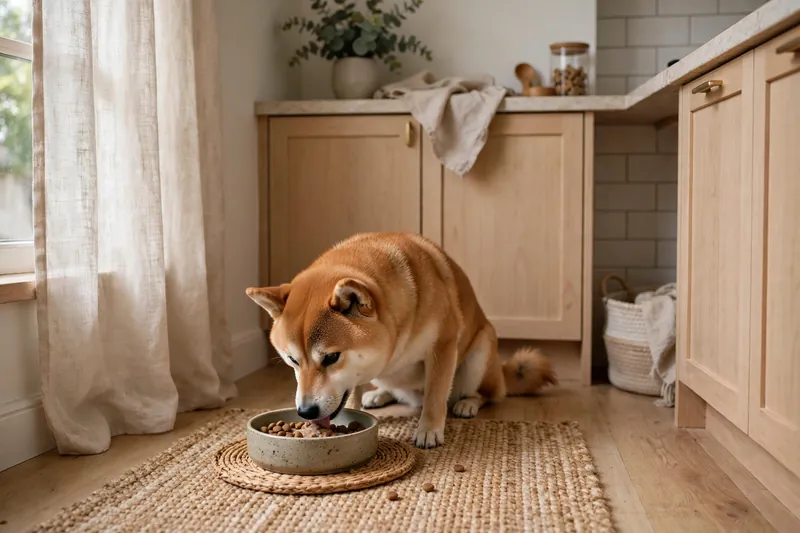
Feed separately, every time. A quiet, separate space, behind a closed door or baby gate if needed, with no one approaching.
This isn't spoiling them. It's management.
Remove high-value items from circulation. If your dog guards specific toys, bones, or chews, put them away for now.
Prevention beats confrontation; reintroduce items later through the trade game, one at a time.
Supervise kids at all times. A child reaching for a guarded item is one of the most common bite setups in this breed.
Children never approach the dog's food bowl, sleeping spot, or guarded items. No exceptions.
Never corner a guarding dog. Always give the dog an escape route.
A dog who can leave usually chooses to leave. A dog who can't, chooses teeth.
Get the whole household on the same plan. One person trading while another chases the dog and rips things from their mouth undoes everything.
Same rules, same calm responses, no freelancing.
Rule out medical causes for sudden onset. If a previously easygoing Shiba suddenly starts guarding, see your vet first.
Sudden shiba inu resource guarding paired with stiffness, yelping, reluctance to move, or appetite changes often points to pain. Pain makes guarding worse.
The Step-by-Step Plan to Reduce Shiba Inu Resource Guarding
Work through these in order. Shibas learn fast but hold grudges, so slow and consistent beats dramatic.
Step 1: Map the triggers. For one week, note every episode: what was guarded, who approached, from what distance, how the dog responded.
Patterns jump out fast: "only over chews," "only when my partner approaches." That list is your training curriculum.
Step 2: Lock down management. Every prevented incident is a deposit in the trust account.
Every confrontation is a withdrawal. Shibas keep score.
Step 3: Play the trade game. Never just take things from a guarding dog: that confirms their fear of loss.
Start with a low-value item the dog doesn't guard. Offer a genuinely high-value treat (real meat beats dry biscuits for most Shibas), say "trade," take the item, hand over the treat, and give the item *back*.
That last part matters: the dog learns your approach predicts bonuses, not loss. Repeat over many short sessions before working up to guarded items, dropping back a level whenever the dog tenses.

Step 4: Desensitize your approach. Start at whatever distance your dog notices you but stays relaxed.
Walk past at that distance, toss a high-value treat near them, and keep walking, gradually closing the distance over sessions.
The sign it's working: the dog looks up in happy anticipation when you approach, instead of stiffening.
Step 5: Teach "drop it" and "leave it" positively. Train these away from real guarding situations.
For "drop it," practice the trade game with the cue attached, always rewarding generously and returning the item often. For "leave it," start with a boring item on the floor and reward the dog for looking away.
Never shout it to pry a guarded item from your dog's mouth: that's confrontation in a training-cue costume.

Step 6: Generalize one variable at a time. Once your Shiba is relaxed with you, extend the work: different family members (one at a time), different rooms, then new situations.
Stay under threshold and keep sessions short. Rushing this step is how progress unravels.
What NOT to Do When Your Shiba Guards
The wrong moves undo every right one. These mistakes reliably make shiba inu resource guarding worse:
Never just take things from them. Snatching a guarded item confirms the dog's belief that people approaching means loss.
The old advice to regularly take food or toys to "get them used to it" routinely causes the very guarding it claims to prevent.
Never punish the warning. Yelling, hitting, alpha-rolling, or shock and prong collars on a guarding Shiba is dangerous and counterproductive.
Punishment suppresses the growl while leaving the fear untouched: how you create a dog who bites "without warning." With a breed that doesn't back down, confrontation escalates rather than resolves.
Never stare them down, hover, or pry things from their mouth. Looming reads as a threat; prying teaches the dog that hands near their mouth are the enemy, poisoning all future trade training.
Never let anyone "test" the dog. Having visitors or children approach the bowl "to see if they're better now" is how bites happen.
Measure progress by relaxed body language over time, not provocation.
Shiba Inu Resource Guarding: People and Space Specialties
Guarding people. Many Shibas bond intensely to one family member, then guard that person from pets, visitors, or even family: wedging between them, blocking, stiffening when someone approaches.
The guarded person shouldn't reward blocking: calmly stand up and walk away instead. Train a rock-solid "go to bed" cue, and desensitize the dog to the other person's approach with treats.
Don't scold it and don't laugh it off: blocking that works gets repeated.
Guarding spaces. The sofa cushion, the dog bed, a doorway, the car.
If the sofa is guarded, it's temporarily off-limits (a floor bed nearby instead); doorways get managed with gates or leashes. Teach the dog to go to their spot on cue and be paid for it, rather than physically moving them.
In multi-dog homes, separate feeding areas and picked-up toys during group time prevent most squabbles.
When to Call a Professional
This plan handles mild to moderate shiba inu resource guarding. Get qualified help promptly if a bite has broken skin, guarding is escalating despite management, or the dog bites with little or no warning.
Get help right away if guarding is spreading, children are in the home and any bite risk exists, or you feel afraid of your own dog.
Look for a qualified animal behavior professional who uses positive-reinforcement methods. Ask directly: "what happens when my dog gets it wrong?"
The answer should never involve pain, fear, or intimidation. Always start with a vet check: pain and medical issues sit behind more guarding cases than expected.
Frequently Asked Questions
Should I take my Shiba's food bowl away while they eat to get them used to it?
No. This is one of the most common pieces of bad advice in dog training, and it actively causes food guarding.
Instead, walk past at a comfortable distance and toss something delicious near the bowl, so your approach predicts bonuses.
Can shiba inu resource guarding be cured completely?
Think managed, not cured. Most dogs improve dramatically with the trade game and desensitization, but a dog with a guarding history deserves lifelong common sense: feed separately, keep strangers from reaching for their chews, revisit trade practice periodically.
My Shiba guards me from my partner. What do I do?
Stop rewarding the blocking (the guarded person calmly leaves instead of cuddling the blocker), train a solid "go to bed" cue, and desensitize the dog to your partner's approach with treats. Don't scold it and don't laugh it off.
Is my Shiba safe around my kids?
Manageable but never casual. Kids must never approach the dog's food, chews, sleeping spot, or guarded items, and all interactions stay supervised. Any doubt is exactly what a behavior professional is for.
Will a second dog fix my Shiba's possessiveness?
Almost certainly not: a second dog is a second competitor for resources. Fix the guarding first, and only consider adding a dog later with professional guidance.
Shiba inu resource guarding looks dramatic, but it follows the same rules as guarding in any dog: the dog fears losing something valuable, and your job is to change that prediction.
Trade generously, approach kindly, and manage what you can't train yet. For more on this independent breed, read our Shiba Inu recall training guide, or map your dog's triggers with the Behavior Problem Solver in our free dog tools.