Dachshund Chewing Furniture: How to Redirect It
You bought a sofa. Your Dachshund has decided it’s a chew toy with cushions. If Dachshund chewing furniture is your current reality (gnawed table legs, a de-stuffed armchair corner, skirting boards with teeth marks).
The reassuring part: this is one of the most fixable behavior problems in the breed. Dogs chew what they can reach, and furniture is simply the biggest chew available. Change what’s reachable, teach what’s appropriate, and the sofa survives.
Key Takeaways
- Furniture chewing is almost always boredom, teething, or opportunity: not spite and not a “bad dog.”
- Management (blocking access) works faster than training alone; use both together.
- The interrupt-and-trade (calmly swap the furniture for a great chew) is the core skill. Never chase or punish.
- A Dachshund with enough appropriate chewing rarely bothers furniture. The chews are the fix, not the reward for the fix.
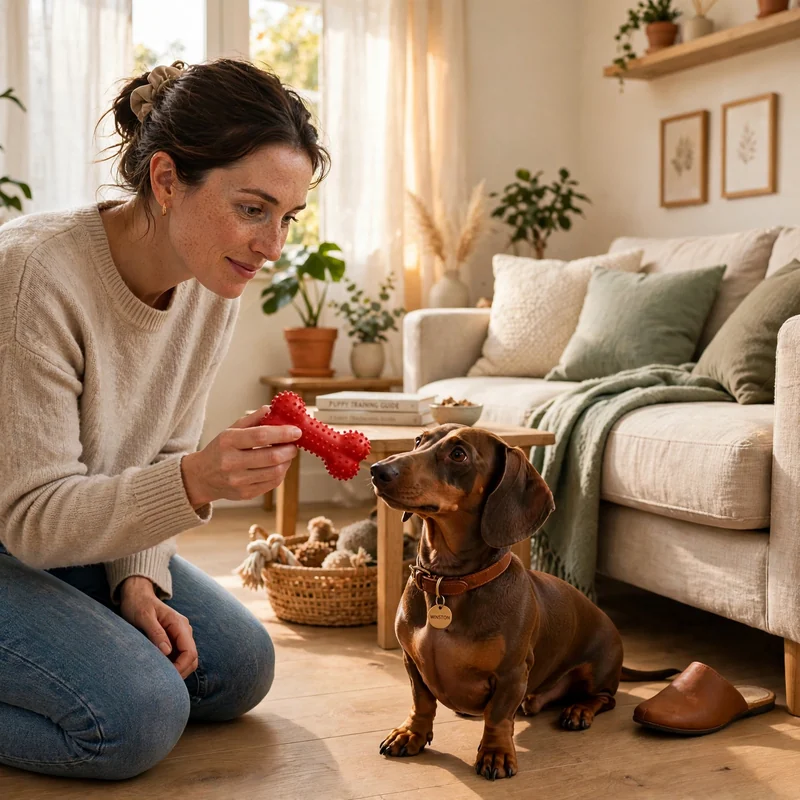
Dachshund Chewing Furniture: Why It Happens
Jaws built for the job. Dachshunds were bred to go underground and grip badgers: that takes a strong jaw and a willingness to use it. Chewing is deeply satisfying to this breed in a way it isn’t to, say, a Greyhound. Your dog isn’t broken; they’re orally employed and currently unemployed.
Teething. Puppies chew because their mouths hurt and exploring the world by mouth is their full-time job. If your chewer is under a year old, teething is likely the main driver: our puppy chewing guide covers that stage in detail.
Boredom. The classic adult cause. A Dachshund left alone all day with nothing to do will find a job, and “renovate the coffee table” is always hiring. Destructive chewing that happens when you’re out is often really a loneliness-and-boredom problem wearing a chewing costume.
Texture and taste. Wood, leather, wicker — furniture offers interesting textures and, to a dog’s nose, fascinating smells (your scent is all over it, which is part of the appeal). Once a dog has chewed a spot, the texture change makes it even more interesting. Early intervention matters.
Anxiety. Less common, but dogs with separation distress chew door frames, windowsills, and barriers — focused on exit points, not random furniture. If the chewing is frantic, happens only when you’re gone, and targets doors and windows, read that as anxiety, not mischief.
Management: Protect the Furniture First
Every piece of furniture chewed is a rehearsal that makes the habit stronger. Your first job is to make rehearsal impossible.
1. Block access. This is the single fastest win. Baby gates, closed doors, exercise pens around the good sofa: unglamorous, extremely effective. A puppy or new rescue shouldn’t have unsupervised free roam of a furnished house anyway.
2. Supervise actively. When the dog is loose, you’re watching — not scrolling your phone in the same room. The first two weeks of retraining need real supervision so you can redirect before the chew starts.
3. Cover the favorites. If the armchair corner is the current obsession, cover it temporarily (a throw, a pen panel) while you retrain. Out of sight, out of mind, and it breaks the texture habit.
4. Crate or pen when you can’t watch. A comfortable crate or playpen with a good chew isn’t a prison; it’s how you guarantee the dog practices only good habits while you’re out or busy. (For the complete approach, see our complete guide to stopping Dachshund chewing.)
5. Exercise and enrich before alone time. A dog who’s had a sniffy walk and a food puzzle is dramatically less interested in your skirting boards than a dog who’s been asleep on the sofa all day waiting for entertainment to happen.
Dachshund Chewing Furniture: How to Redirect It
This is the core skill. Practice it until it’s reflex.
Step 1: Interrupt calmly. The moment teeth touch furniture (or ideally, the moment the dog heads for it with intent), get their attention with a cheerful, low-key sound: a kissy noise, their name said happily, a clap. Not a shout. You’re redirecting, not scolding.
Step 2: Trade up. Immediately offer something better: a stuffed Kong, a bully stick, a favorite chew toy. Make the trade genuinely exciting: wiggle the toy, praise the take. The dog should feel they got the better deal.
Step 3: Reward the choice. When the dog settles with the appropriate chew, quietly praise or drop an extra treat. You’re building value for the right object.
Step 4: Repeat relentlessly. The first week takes dozens of repetitions. That’s normal — you’re rewriting a habit. Every successful redirect weakens the furniture habit and strengthens the chew-toy habit.
Bonus skill: teach “leave it.” Once the interrupt-and-trade is working, build a real “leave it” cue so you can head off chewing before it starts. Begin with a boring item on the floor, mark and reward the moment your dog disengages, and gradually work up to tempting objects. Keep sessions short and always pay well for disengaging — “leave it” only works if leaving things has a great track record.
What NOT to do: Don’t chase the dog (chase is a fantastic game and the furniture becomes the prize). Don’t yell or punish after the fact (the dog connects your anger with your arrival, not with the chew from an hour ago). Don’t just remove the furniture-chew without offering an alternative: the need to chew doesn’t vanish because you said no.
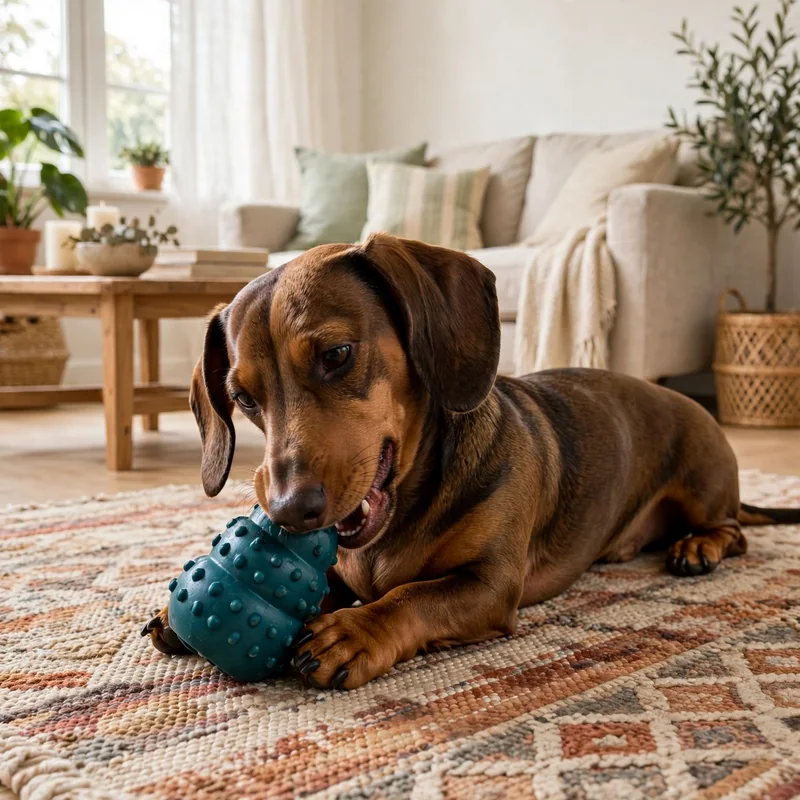
Give Them Something Better: Chews That Work
A Dachshund ignoring furniture needs legal outlets that are more appealing than the table leg. Rotate to keep novelty high.
Long-lasting edible chews. Bully sticks, yak chews, and similar long-lasting chews satisfy the grip-and-gnaw drive this breed was built for. Always supervise with edible chews, and size them so the dog can’t swallow large pieces.
Stuffed food toys. A Kong stuffed with wet food and frozen is the gold standard: it takes real work, it’s delicious, and it teaches the dog that settling with a chew is the best activity in the house. Prepare several and keep them in the freezer.
Texture variety. Rope toys, rubber toys, plush toys for dissecting (supervised): different textures for different moods. Watch what your dog prefers and stock more of that.
Chew with a job. Smear a lick mat with peanut butter (xylitol-free) or wet food. Licking is calming and keeps the mouth busy without destruction.
Match the chew to the dog. Power chewers need tougher options; gentle chewers do fine with softer toys. And remember the long back — avoid encouraging wild tug games that wrench the spine; calm chewing is the goal.
Fix the Boredom Behind It
If the chewing happens when you’re out or when the day is dull, the chews are treating the symptom. The cure is a fuller life:
- A proper sniffy walk daily — nose work tires this breed like nothing else
- Food from puzzles and scatter feeds, not just a bowl
- Short training sessions a few times a week
- A predictable routine so the dog isn’t anxiously waiting for life to happen
Dogs with rich days chew appropriately. Dogs with empty days chew furniture. It’s that simple, most of the time.
What Doesn’t Work
- Bitter sprays as the whole plan. Taste deterrents can help protect a specific spot alongside training, but alone they just move the chewing to the next unsprayed spot. They’re a fence, not a fix.
- Punishment. Rubbing noses in damage, shouting, “time-outs” delivered in anger: none of it teaches the dog what to chew, and fear-based methods can create anxiety chewing, which is worse.
- Removing all chews. Some owners, frustrated, take away toys. The chewing need doesn’t disappear — it just relocates to your belongings with renewed enthusiasm.
- Hoping they’ll grow out of it. Puppies may reduce chewing after teething, but rehearsed furniture chewing becomes a lifelong hobby without intervention.

Frequently Asked Questions
Why does my Dachshund only chew furniture when I’m not home?
That’s the key clue: it’s boredom, loneliness, or separation distress, not a furniture obsession. Increase exercise and enrichment before departures, use a pen with great chews while you’re out, and if the chewing is frantic and focused on doors/windows, consider separation anxiety rather than plain boredom.
Is it okay to use a bitter apple spray?
As a backup for one specific spot, yes — it’s harmless. But don’t mistake it for training. The real fix is management plus redirection plus better chews. Sprays protect; training solves.
My Dachshund chews the furniture even though they have toys. Why?
Because the toys are boring by comparison — same five toys, on the floor, all day, every day. Rotate toys (only a few out at a time), make chews interactive (stuffed, frozen, novel), and actively redirect to them. A toy the dog never learned to value is just decoration.
How long until the furniture chewing stops?
With consistent management and redirection, many dogs show big improvement within two to three weeks. Long-standing habits take longer. The management (blocking access) should show results immediately — if it doesn’t, there’s a gap in the setup.
Should I crate my dog to stop the chewing?
A crate or pen is excellent management for when you can’t supervise — but it’s not a substitute for training, exercise, and enrichment. A dog crated all day with nothing to do will just chew more intensely when released. Use confinement wisely, alongside the rest of the plan.
—
Furniture chewing looks like defiance and is almost always just opportunity plus an unmet need. For the bigger picture, read our complete guide to stopping Dachshund chewing, the full breed behavior guide, and browse all Dachshund guides.