Golden Retriever Biting the Leash on Walks
You clip on the leash, step outside, and within thirty seconds the walk becomes a wrestling match. Golden Retriever biting leash on walks is one of the most classically Golden behaviors there is: a dog bred to carry things in their mouth, doing exactly that with the nearest available object.
Strangers laugh. Your arm aches.
This isn't defiance, dominance, or aggression. It's a retrieving breed being a retrieving breed, usually mixed with excitement. And it's very fixable.
Key Takeaways
- Leash biting is driven by the Golden's retrieving instinct: they were bred to carry things gently in their mouths.
- Yanking the leash back turns it into a tug game, which rewards the exact behavior you want to stop.
- The best fix is giving the mouth a better job: teach your Golden to carry a toy instead of the leash.
- Puppies and adolescents do this most; with consistent training it usually fades as they mature.
Why Golden Retrievers Bite the Leash
The retrieving instinct. Golden Retrievers were developed in 19th-century Scotland to retrieve waterfowl, bred specifically for a "soft mouth" that could carry game without damaging it. That instinct didn't come with an off switch.
A leash dangling at mouth height is, to a Golden, simply something to carry. Many Goldens famously greet their owners by fetching a toy or shoe: leash-carrying is the same impulse pointed at the wrong object.
Excitement and frustration. Walks are the highlight of a Golden's day, and excitement boils over into the mouth.
Some dogs grab the leash when they're over-threshold: too excited, or frustrated at being held back from something interesting. If the leash biting happens mostly at the start of walks or near exciting triggers, arousal is the driver.
It's a great game. Here's the uncomfortable truth: leash biting is enormously self-rewarding. You pull, the dog pulls back, everybody's engaged.
From the dog's perspective, grabbing the leash reliably starts the best game on the walk. Every round of accidental tug-of-war teaches them to do it again.
Puppy teething and mouthiness. Young Goldens explore the world with their mouths more than most breeds. A puppy chewing the leash is often just a mouthy puppy being mouthy, and it typically peaks during adolescence.
Attention. If leash-grabbing reliably makes you stop, talk, laugh, or engage, the dog has learned a reliable button for your attention. Even scolding counts.
What NOT to Do
These common reactions all make golden retriever biting leash problems worse:
- Yanking the leash out of their mouth. This is tug-of-war. You cannot win tug-of-war against a retrieving breed on a long-term basis, and every pull teaches the dog that grabbing the leash starts a game.
- Leash pops or collar corrections. Jerking the leash "corrects" nothing here: the dog was already excited, and adding pain or startle to excitement creates a frustrated, aroused dog, not a calm one. Never use choke, prong, or shock collars for this.
- Scolding and chasing. Big reactions are rewarding. The dog wanted engagement and got it.
- Holding the leash high out of reach. This can work as momentary management, but standing still with your arm in the air while the dog thrashes teaches nothing and frustrates everyone.
- Punishing the mouthiness itself. The retrieving instinct isn't a behavior problem to suppress; it's a breed trait to redirect. Punishment risks damaging the trust this eager-to-please breed runs on.
How to Stop Golden Retriever Biting Leash on Walks: The Training Plan
Step 1: Burn energy before the walk. A Golden who's already had a short play or training session is far less likely to explode into leash-grabbing. Ten minutes of fetch or nose work before you clip the leash on lowers the arousal that drives the behavior.
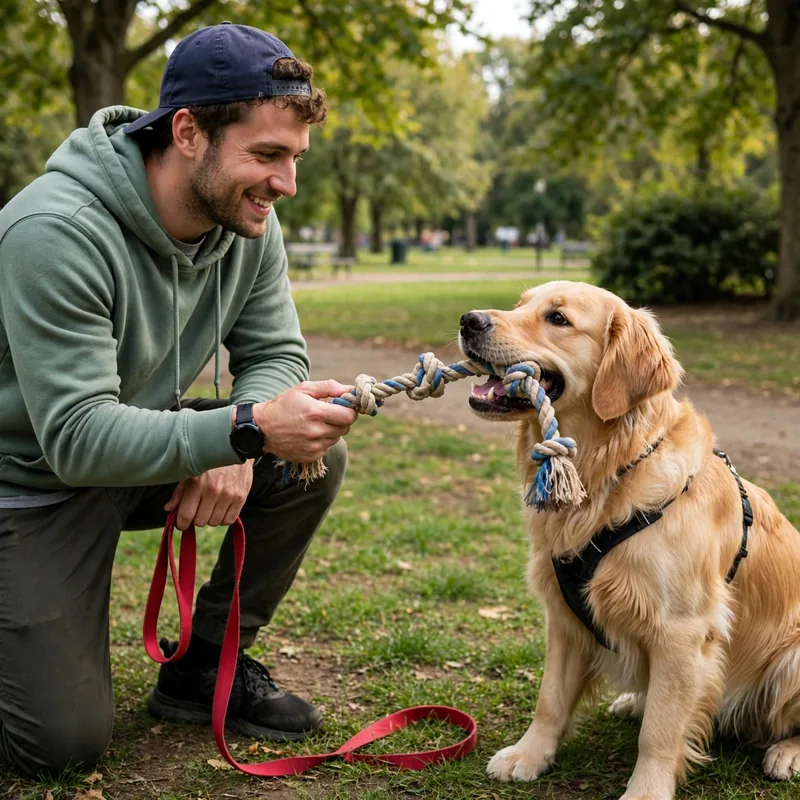
Step 2: Give the mouth a job: carry a toy. This is the golden (pun intended) solution for a retrieving breed. Teach your dog to carry a favorite toy on walks instead of the leash. Start indoors: offer the toy, reward taking it, add the cue "carry."
Then bring it on walks. A dog carrying a toy cannot simultaneously bite the leash, and you're honoring the instinct instead of fighting it. Many owners find this single change ends the problem.
Step 3: Teach "drop it" and "leave it" properly. Train these at home first with trades, never by prying the mouth open. On walks, "leave it" aimed at the leash, rewarded generously when the dog disengages, gives you a tool for the moments the toy isn't in play.
Step 4: Stop, don't pull. When teeth hit the leash: stop walking, go still and boring. Wait for the dog to release (reward the release the instant it happens), then continue.
You're teaching that leash-biting stops the walk, while a loose leash and four-on-the-floor keeps it moving. Patience matters more than speed here.
Step 5: Reward the good walking. Catch and reward every stretch of normal walking: treats for a loose leash, praise for checking in with you. Goldens are extremely handler-focused; once they learn that walking nicely earns more than leash-grabbing does, most switch voluntarily.

Practice in low-distraction settings first. Don't debut the plan on the exciting park route. Start on a boring street, build success, then add distractions gradually.
Equipment That Helps (and What to Avoid)
- A well-fitted harness gives you control without neck pressure and removes the collar-grab temptation. For a strong, enthusiastic Golden, a front-clip harness is a sensible choice.
- A slightly heavier or chain leash is less fun to chew than a soft nylon one. This is management, not training: it makes the leash boring while you teach the real skills. Don't rely on it alone.
- Avoid retractable leashes. They teach pulling, give you less control, and the thin cord is miserable to grab in a leash-biting scramble.
- Never use choke chains, prong collars, or shock collars for leash biting. They work through pain or fear, don't address the retrieving impulse, and can turn an excited mouthy dog into a fearful or reactive one.
When Golden Retriever Biting Leash on Walks Needs More Help
Most golden retriever biting leash cases are excitement plus instinct and resolve with the plan above. Get help from a qualified positive-reinforcement trainer if:
- The behavior is intense, frantic, or escalating despite weeks of consistent training
- Your dog redirects onto your hands, clothes, or the leash with real force
- Leash biting comes with lunging, barking, or reactivity toward people or dogs
- You're worried about anyone's safety on walks
A good trainer will assess whether arousal, frustration, or something else is driving it, and tailor the plan. Avoid anyone who reaches for punishment-based tools first.
Frequently Asked Questions
Is leash biting a sign of aggression?
Almost never in Goldens. True aggression involves stiff body language, hard staring, growling over resources, or intent to harm. Leash biting is bouncy, playful, excitement-driven mouthiness from a breed built to carry things.
If you're unsure, a trainer can assess in one session.
Should I just let my Golden carry the leash?
Carrying the leash itself isn't ideal (it teaches that the leash is a toy and gives you less control), but the impulse is fine. Redirect it: let them carry a toy instead. Same satisfaction, no problems.
My puppy bites the leash constantly. Will they grow out of it?
Puppies do this most, and mouthiness does decrease with maturity, but "grow out of it" only happens reliably if you also train through it. Untrained leash-grabbing rehearsed daily for a year becomes an adult habit. Our puppy nipping plan covers the mouthiness side in detail.

Does a chain leash stop leash biting?
It can reduce it, because metal is less satisfying to chew than fabric. Treat it as management while you train the carry-a-toy alternative and the "leave it" cue, not as the solution itself.
How long does it take to fix?
With the toy-carry alternative and consistent stop-don't-pull responses, many owners see major improvement within two to three weeks. Stubborn golden retriever biting leash habits in adolescent or adult dogs take longer, but they still change.
My Golden only bites the leash at the start of walks. Why?
That's arousal: the most exciting moment of the walk and a classic golden retriever biting leash trigger. Pre-walk play, a calm departure routine, and the toy-carry setup specifically target this. As the walk settles, so does the mouth.
Leash biting looks chaotic, but it's one of the most honest behaviors a Golden has: "I love carrying things, I'm excited, and this is right here." Golden retriever biting leash habits come from instinct, not disobedience: give the mouth its proper job and the walks get calm. For the mouthiness behind it, see how to stop puppy nipping and puppy chewing everything, read the complete Golden Retriever behavior guide, and explore all Golden Retriever guides.