Shiba Inu Recall: How to Train a Reliable Come
You called. Your Shiba Inu looked straight at you, weighed your offer for about half a second, and chose the squirrel. If you own this breed, you know this scene.
It is not defiance, and it is not proof that your dog is untrainable. It is a hunting dog doing what centuries of breeding designed it to do.
Shiba inu recall training has a reputation for being nearly impossible, and honesty matters more than optimism here.
A Shiba will probably never recall like a Labrador. But with a protocol built for this breed’s independence rather than against it, you can train a recall that works in real life.
Key Takeaways
- Shibas are hard to recall because they were bred to hunt independently at a distance from humans. “Selective hearing” is the breed’s design, not defiance.
- No Shiba is ever 100% reliable off-leash. Train recall anyway, but treat it as a backup plan, not a safety system.
- Use a long line outdoors. It gives your Shiba freedom while keeping a loose dog from becoming a lost dog.
- The protocol: charge the cue indoors, add distance and movement, restart in the yard, then proof on a long line with gradually harder distractions.
- Never punish a dog for coming, even slowly, and never call your Shiba to punish them.
Why Shiba Inus Are So Hard to Recall
The Shiba Inu is an ancient Japanese breed developed to flush small game from dense mountain brush, work that required ranging far from the hunter and deciding alone.
Four traits make recall the hardest skill for a Shiba owner.
Independence: bred to think, not to check in. Prey drive: hair-trigger chase instinct; a squirrel can flip a switch training never fully removes.
Aloofness: catlike and loyal but not needy, so coming to you must clearly pay better than the alternative. Escape artistry: slips collars, scales fences, digs under gates, bolts through doors. A loose Shiba does not circle back. It goes.
Your Shiba can learn, but training must be smarter: higher-value rewards, slower proofing, zero shortcuts.
The Honest Truth About Off-Leash Shibas
Make yourself one promise before training: even a well-trained Shiba can blow a recall when prey drive takes over.
Treat recall as an emergency tool, not as a reason to let your Shiba run free near roads or wildlife.
The honest standard: a Shiba is not to be trusted off-leash unless in a fully enclosed area.
Training is still worth it, because recall can save your dog’s life when a leash breaks or a gate is left open. The recall is the backup; the leash, the fence, and the closed door are the plan.
This is where the long line earns its place. A 30 to 50 foot line gives your Shiba real freedom to sniff and roam while you hold the other end, so you can practice recall at real distances without gambling your dog’s life.
Attach it to a harness, not a collar, so a sudden bolt does not jerk the neck. In unfenced areas, the long line stays on until the recall is proven, which for most Shibas means indefinitely. That quiet discipline is the unglamorous core of shiba inu recall training.
The Step-by-Step Shiba Inu Recall Training Protocol
Work the phases in order. Keep sessions to five minutes or fewer, several times a day, and always end on a success.
You will need: very high-value treats (real chicken, cheese, freeze-dried meat), a treat pouch, a 30+ foot long line, a quiet room, and a securely fenced yard.
Phase 1: Charge the Cue Indoors
Pick your recall word. If "come" is worn out, choose a fresh word like "here" or train a whistle.
For one week, only pair the word with food: say it happily, then immediately feed a treat, whether the dog moves or not. Ten to twenty reps, several sessions a day.
When the word alone produces a head turn and an expectant look, the cue is charged. That is week one of shiba inu recall training: pure association, no pressure.
Phase 2: Add Distance and Movement Indoors

Call your Shiba from across the room. Say the word once, upbeat, and reward the moment the dog starts moving toward you. Reward the turn, the first steps, and the full arrival.
Make it a game. Run backward as you call, so coming to you means chasing you.
Or play two-person recall: one person holds the dog while the other calls from across the room, then trade roles. Always pay better than whatever the dog left behind.
Phase 3: Restart in the Yard on a Long Line

New environment, new training: a living-room recall means nothing in the yard. Expect your Shiba to act like training never happened.
Clip on the long line and repeat the first two phases in the fenced yard: recharge the cue, then short recalls with big rewards.
If your Shiba ignores the call, do not repeat the word or reel the dog in. Walk calmly down the line, guide them back, and retry at an easier distance.
Add one ritual: touch the collar gently before every treat, so arriving means being handled, not just being fed.
Phase 4: Proof With Distractions, Gradually
Proofing is where Shiba recall is won or lost, and it is slow on purpose.
Build a ladder: quiet yard, yard with a family member moving around, park at a quiet hour, park with dogs at a distance. Succeed at each rung several sessions before climbing.
The golden rule of shiba inu recall training: never call when you are not fairly sure the dog will come.
Every ignored recall teaches your Shiba the word is optional. If the distraction is too tempting, close the distance first, then call. Keep the long line on as your safety net.
Train a Separate Emergency Recall
Train one emergency word you almost never use: a distinct word or whistle blast in an urgent happy tone, practiced a few times a week and always followed by a jackpot of the best treats.
Rare use plus enormous pay keeps it powerful. Reserve it for genuine danger, a snapped leash near a road. The everyday recall handles the ordinary; the emergency word is the fire alarm.
Shiba Inu Recall Training: Mistakes That Undo Your Work
Most failed recalls are owner-habit failures.
The poisoned cue: repeating "come, come, COME!" teaches the dog the word is noise. Say it once. No response means you asked for too much: fetch the dog calmly, lower the difficulty, retry. Word ruined? Retire it and charge a fresh one.
Calling to punish: the fastest recall killer.
Call your Shiba, then scold them for something from ten minutes ago, and coming to you now predicts bad things. Need to address misbehavior? Go to the dog.
Only calling to end the fun: if "come" always ends the park trip, a smart Shiba avoids you. Break the pattern: call, reward hugely, release back to play.
What About E-Collars for Shiba Recall?
Recall is the number one reason Shiba owners reach for an e-collar.
But a shock collar does not teach your Shiba to want to come to you; it teaches them to come to avoid discomfort, and in an independent breed that distinction matters enormously.
Shibas do not respond to pressure the way eager-to-please breeds do. Confrontational methods make them shut down or avoid the owner.
A dog recalling out of fear can still fail the moment fear meets prey drive at full tilt, and dogs shocked around distractions can link the pain to the wrong thing and develop new problems.
The better deal is this protocol: become the most rewarding thing in your Shiba's world.
High-value food, chase games, jackpot rewards, and a recall that always predicts good things builds a more reliable recall than any collar. It takes longer. It actually works, and it keeps your dog’s trust intact.
Management for Escape-Prone Shibas
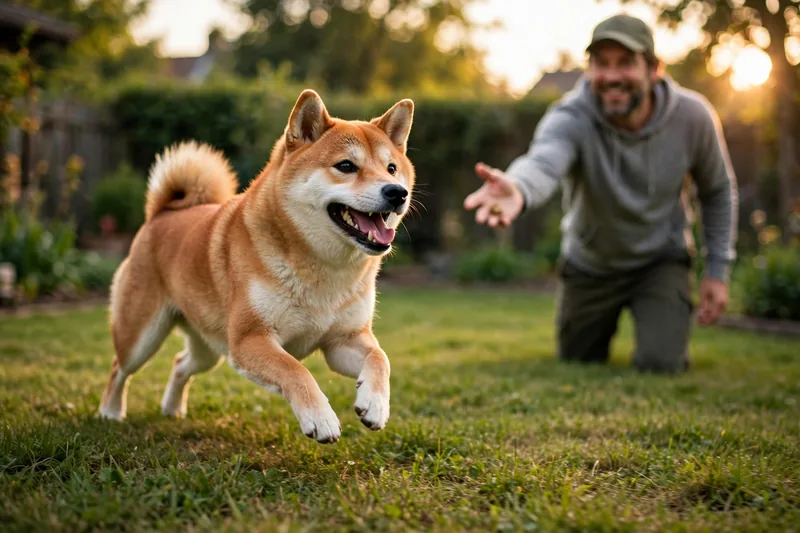
Secure the yard: check for gaps, loose boards, and dig spots. Fencing should be solid and tall with a dig guard along the base. Never leave a Shiba long unsupervised in the yard.
Double up on walks: a well-fitted harness as primary, a collar as backup for known escape artists. Martingale-style collars suit Shibas because they prevent backing out without choking.
Build door routines: most escapes happen through front doors. Use baby gates as an airlock, teach a solid wait at doors, and brief everyone in the house.
If your Shiba gets loose, do not chase. A chased Shiba runs faster; to them it is a game they are winning.
Run away calling happily, crouch, or sit down. Be interesting, not scary. If they approach, stay low and lure with food. Keep ID tags on and a microchip registered.
When to Get Professional Help
A good trainer is gold for this breed; a bad one can do real damage.
Look for a certified professional who uses positive reinforcement, and ask: "What happens when my dog gets it wrong?" Pain, fear, intimidation, or e-collars in the answer means keep looking.
Get help sooner if recall failures endanger your Shiba: bolting toward roads or repeated escapes.
Seek guidance too for aggression around collar grabs, which needs its own plan. If a decent recall suddenly collapses, see the vet first: pain, hearing changes, or thyroid issues can masquerade as stubbornness.
Frequently Asked Questions
Can a Shiba Inu ever be trusted off-leash?
Honestly, no, not in unfenced areas. That is the breed-wide consensus, and it comes from prey drive, not training failure. Train recall anyway: it is your safety net for the day the leash breaks.
My Shiba comes perfectly indoors but ignores me outside. Why?
To your dog, those are two different skills. Every new environment resets training until you proof there deliberately. Return to Phase 1 in the new spot and climb the ladder again.
Is a whistle better than saying "come"?
Often, yes. A whistle carries farther and has no emotional history. If "come" is worn out, a whistle is a clean slate. Charge it the same way: whistle, then treat, many times first.
How long does Shiba Inu recall training take?
Expect several months of practice before the recall holds up amid moderate distractions, and plan on maintaining it for life. Anyone promising a reliable Shiba recall in two weeks is selling something.
Is it too late to train recall in an adult Shiba?
No. Adults learn well but are more set in their habits, so progress may be slower. The protocol is identical; if the old cue is poisoned, pick a fresh word.
—
Shiba inu recall training asks more patience than almost any other breed skill, but it pays back daily.
Respect the breed’s limits, train the protocol honestly, and keep the long line as your silent partner.
Stick with it: steady shiba inu recall training beats intensity every time. For more guides as this category grows, browse all Shiba Inu articles.