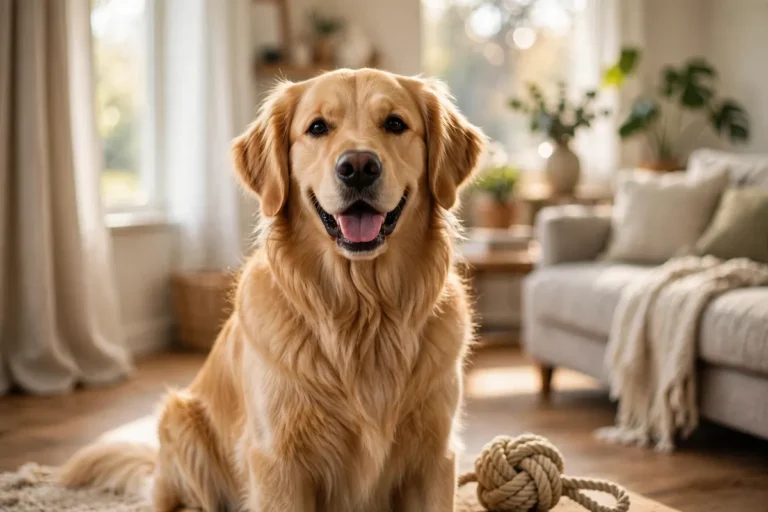
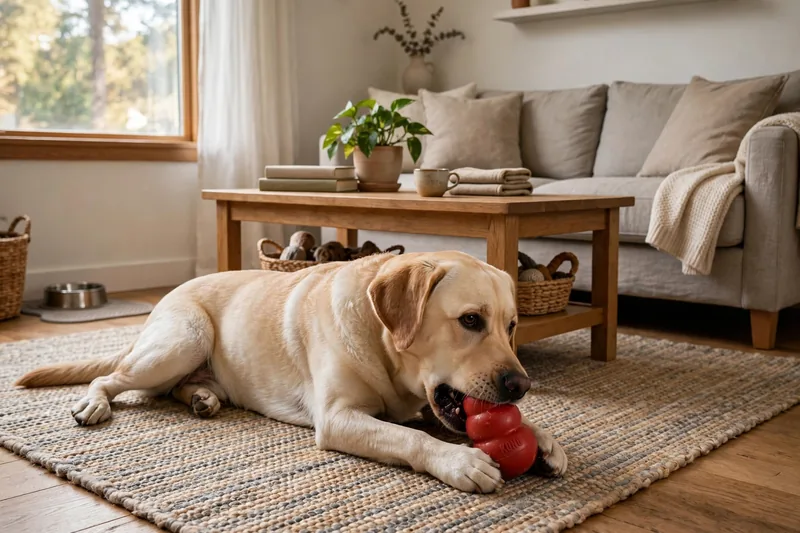
Labrador Chewing Furniture When Left Alone
You come home to a chair leg gnawed raw, the sofa cushion gutted, stuffing everywhere. A Labrador chewing furniture when left alone is one of the most common complaints in the breed.
It usually comes down to one of two very different problems: a bored, under-exercised Lab with energy to burn, or a dog in genuine distress about being alone. The fixes are almost opposites, so get the diagnosis right first.
Key Takeaways
- A Labrador chewing furniture when left alone is usually caused by boredom and under-exercise, or by separation distress. Each needs a different plan.
- A healthy adult Lab does best with roughly an hour of active exercise most days; a tired, fulfilled dog rarely remodels your sofa.
- Enrichment that lasts (frozen stuffed toys, snuffle mats, puzzle feeders) gives your dog a legal chewing job while you are out.
- Destruction around doors and windows, drooling, house soiling, and refusing food until you return point toward distress, not boredom.
- Separation distress is best handled with your vet and a qualified, force-free behaviour professional.
Labrador Chewing Furniture When Left Alone: Boredom or Distress?
Labradors were bred to work a full day alongside a handler. A modern Lab napping on your sofa still carries that engine, and when it has nowhere to go, furniture becomes the entertainment system. That is the first problem type: boredom.
The second is separation distress. This is not boredom. The dog is frightened of being alone, and chewing is a coping behaviour, a way to self-soothe or try to reach you.
Dogs may even chew items that smell strongly of their owner, such as shoes or sofa cushions, because the familiar scent is comforting.
Puppies add a third, simpler explanation: teething. A young Lab puppy will chew anything hard while the adult teeth come in. That phase passes, but it still needs managing so your furniture survives it.
The distinction matters because the bored Lab improves with exercise, enrichment, and dog-proofing, while the distressed Lab will often ignore food toys entirely, too upset to eat. Treating a distressed dog like a bored one wastes weeks and lets the problem dig in deeper.
How to Tell Which One Your Labrador Is
You cannot diagnose this from the damage alone. Set up a phone camera and record what happens after you leave. What you see in the first half hour tells you most of what you need to know.
Signs pointing to boredom and under-exercise:
- Your Lab naps or plays with toys for a while, then starts exploring the furniture out of curiosity.
- The chewing starts well into your absence, not the moment you leave.
- They happily eat the stuffed toy or puzzle feeder you left behind.
- On days they get a big morning workout, the house survives.
Signs pointing to separation distress:
- Panic behaviour starts within minutes of your departure, sometimes before you are out of the driveway.
- Destruction focuses on exit points: door frames, window sills, the crate door.
- Drooling, panting, pacing, or circling near the door you left through.
- House soiling despite being fully house-trained, or refusal to eat anything until you return.
- Your Lab shadows you and gets agitated when you touch your keys, shoes, or coat.
If the camera shows clear distress, skip to the distress plan further down. If it shows a dog that naps, wakes, and goes looking for entertainment, you are in boredom territory.
When in doubt, ask your vet; they can rule out pain or medical causes, which can also drive sudden destructive behaviour.
Your Plan for the Bored, Under-Exercised Lab
Exercise before you leave
Roughly an hour of purposeful activity most days is a good benchmark for a healthy adult Lab. Purposeful means walks at a proper pace, fetch, swimming, or training games, not a slow amble to the mailbox.
Exercise before the long absence, so your Lab naps through it instead of redecorating.
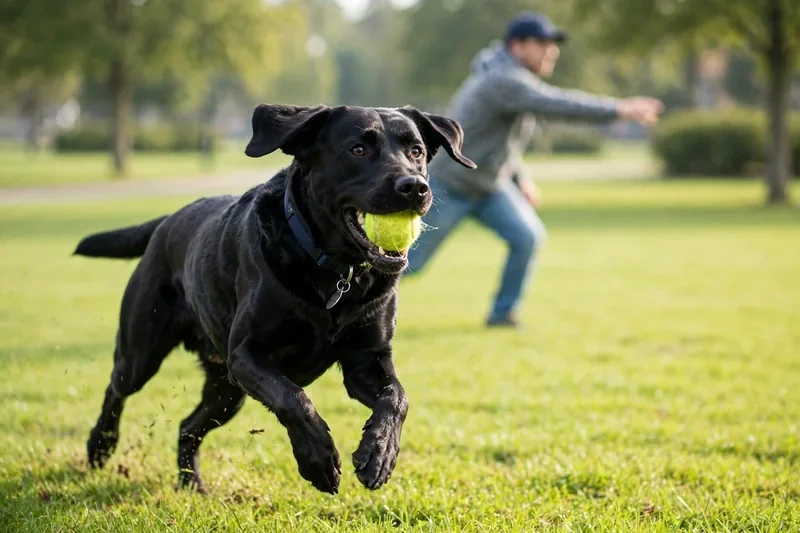
For puppies, keep formal exercise gentle. A commonly cited breed-club guideline is around five minutes of structured walking per month of age, twice a day, because young joints are still developing. Free play at the puppy’s own pace is the better filler.
Enrichment that lasts
Give your dog a legal chewing job that pays out for the whole morning. A Kong filled with peanut butter or wet food and frozen overnight takes far longer than an unfrozen one.
A snuffle mat scattered with part of their breakfast ration turns mealtime into a foraging session. Rotate a small set of durable rubber chew toys so there is always a “new” one in circulation.
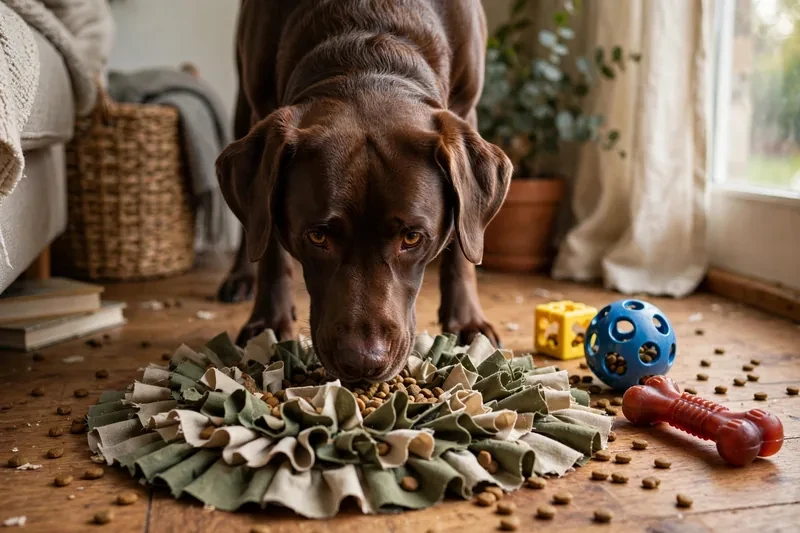
One safety note: always supervise brand-new toys first, and choose toys sized for a large, powerful chewer. Remove anything breaking into swallowable pieces.
Dog-proofing for a strong breed
A Lab is a big, determined dog, so dog-proofing needs to be robust. Restrict access to the furniture zone with a sturdy baby gate or a properly introduced crate, and give your Lab their own comfortable space instead.
Pick up shoes, remotes, and anything tempting. Bitter-apple or other taste-deterrent sprays can help protect specific items as a backup; reapply after cleaning.
How to Stop Your Labrador Chewing Furniture When Left Alone: the Anxious Lab
If your Lab shows signs of distress, be honest with yourself about the limits of DIY.
The American Kennel Club’s guidance on separation anxiety recommends partnering with your veterinarian and, after that, a certified professional behaviourist or trainer experienced in desensitisation and counter-conditioning, using positive reinforcement only.
Your vet may also discuss whether short-term medication could take the edge off while you train.
Alongside professional support, these steps also stop a mild case getting worse.
Make departures boring
Keep arrivals and departures low-key. Long emotional goodbyes and frantic hellos teach your dog that your leaving and returning are huge events. Slip out quietly, and when you return, settle in first and greet your Lab once they are calm.
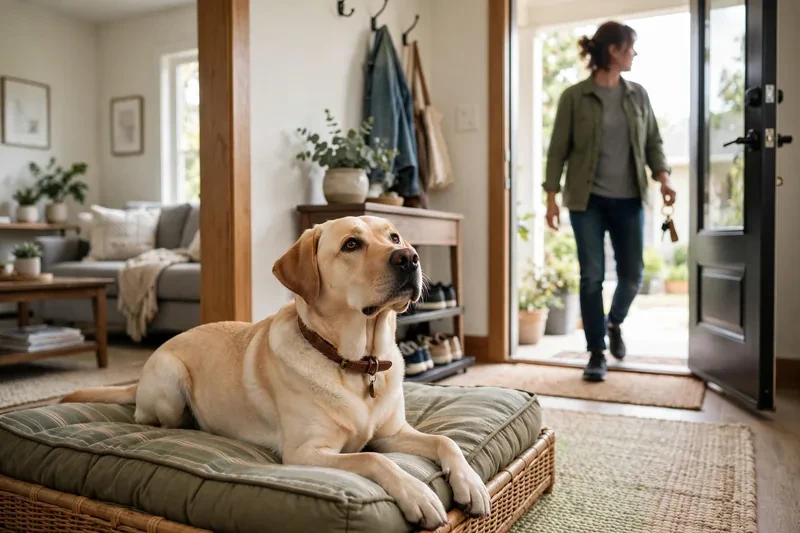
Desensitise your departure cues
If your Lab panics when you pick up your keys or put on your shoes, those cues have become triggers.
Break the association by performing them and then not leaving: pick up the keys and make a cup of tea, put on your shoes and sit down to read.
Repeat until the cues lose their charge. Then build alone time from seconds upward, rewarding calm, stretching the duration only when your dog stays relaxed.
The AKC advises a special high-value treat that appears only before you leave, so the departure predicts something good rather than something scary.
Never left alone is the training gold standard
While you work through a distress plan, avoid leaving your dog alone long enough to panic, because every panicked episode sets training back.
That might mean a dog walker, a trusted friend, or doggy daycare for the longer stretches. It is not forever, just while the new learning takes hold.
And one firm boundary, echoing the AKC’s guidance: do not punish a distressed dog. Anxious behaviour is not disobedience or spite; it is a distress response. Punishment can make the anxiety worse and destroy the trust you need for training.
What Not to Do
No matter which type of chewer you have, some approaches backfire:
- Do not scold or punish after the fact. Your dog cannot connect your anger with furniture chewed three hours ago. They just learn that your arrival is stressful, which worsens anxiety.
- Do not use shock, prong, choke, or spray collars. These suppress behaviour through pain or startle. They do not teach your dog what to do instead, and with an anxious dog they add fear on top of fear.
- Do not expect exercise alone to fix distress. A well-exercised anxious dog is simply a fit anxious dog. Exercise supports the plan; it does not replace behaviour work.
- Do not crate a panicking dog as a cure. The AKC notes that some dogs settle in a crate while others panic, and escape attempts can cause injury. A crate only works for a dog taught to love it, never as the whole solution for separation distress.
Frequently Asked Questions
Why does my Labrador chew furniture only when I am gone?
Because the trigger is your absence, not the furniture. A bored Lab chews because unsupervised hours are empty; a distressed Lab chews because your leaving starts a panic cycle. The fix has to address the alone-time experience, not the chair leg.
How long can I leave my Labrador alone?
For a healthy, well-trained adult, four to six hours is a reasonable stretch; a full working day is pushing it without a midday break. Puppies need far more frequent attention.
If your schedule keeps you out all day, a dog walker or daycare is part of responsible ownership for a breed this social.
Will a crate stop my Labrador chewing furniture?
A crate limits access to furniture, so it protects your house, but it does not fix the underlying cause.
It is useful only if your Lab has been introduced to it positively and settles inside.
If your dog claws at the crate door, drools, or tries to break out, the crate is making things worse and you need professional help.
Do bitter-apple sprays work for a Labrador chewing furniture?
They can discourage chewing on specific spots as one layer of protection for the bored chewer. Results are mixed, they need regular reapplication, and determined Labs sometimes chew straight through them. Treat sprays as a supplement to exercise, enrichment, and dog-proofing, not a standalone fix.
My Lab is well exercised and still chews. Why?
Exercise is not the whole picture. Check the mental side: does your dog get foraging, puzzle toys, and training games, or just physical walks?
Also reconsider the distress question, because a physically tired dog can still panic when left. Film an absence and look for the distress signs above.
If the chewing started suddenly in an adult dog, a vet check is sensible to rule out pain or a medical cause.
Is getting a second dog a cure for the chewing?
Not reliably. A second dog can keep a bored dog company but does not fix separation distress tied to you specifically, and it can teach the new dog the same habits. Solve the underlying cause first.
Your Furniture Can Survive Your Lab
Most Labradors that chew furniture when left alone do not need a miracle, just a plan matched to the right problem. The bored chewer needs exercise, enrichment, and dog-proofing.
The distressed chewer needs calm routines, gradual desensitisation, and a professional team behind them. Keep reading to understand the breed behind the behaviour.
Film one absence before you change anything. A Labrador chewing furniture when left alone may settle after exercise, or may panic within minutes, and the camera shows which plan fits.
Do not wait if the chewing is new, sudden, or linked to pain. A Labrador chewing furniture when left alone in that situation needs a vet check first, before training changes.
For a Labrador chewing furniture when left alone, start with the cause, not the chair leg. If mouthing is a habit, see our guide to stopping Labrador mouthing. If walks are wild before you leave, see our guide to stopping a Labrador pulling on leash.
Calm arrivals help too. Our guide to Labrador jumping up on guests covers the door routine, and our guide to stopping Lab counter surfing covers kitchen habits that often go with a busy Lab.
Other breeds face the same pattern. See our guide to Golden Retriever chewing furniture, our guide to stopping German Shepherd chewing furniture, and our guide to German Shepherd separation anxiety when left alone for a closer look at distress.
Whatever the cause, a Labrador chewing furniture when left alone needs a calm plan, not punishment. Keep the routine steady, and ask your vet or a force-free behaviour professional for help if distress, pain, or sudden change is involved.
Reference
Reference: ASPCA, Chewing and Destructive Behavior in Dogs.
Still stuck? Get a plan built for your dog.
Answer a few quick questions and get a personalized, force-free training plan in minutes.
Try the Free Dog Tools