Dachshund Pulling on Leash: Loose-Leash Training
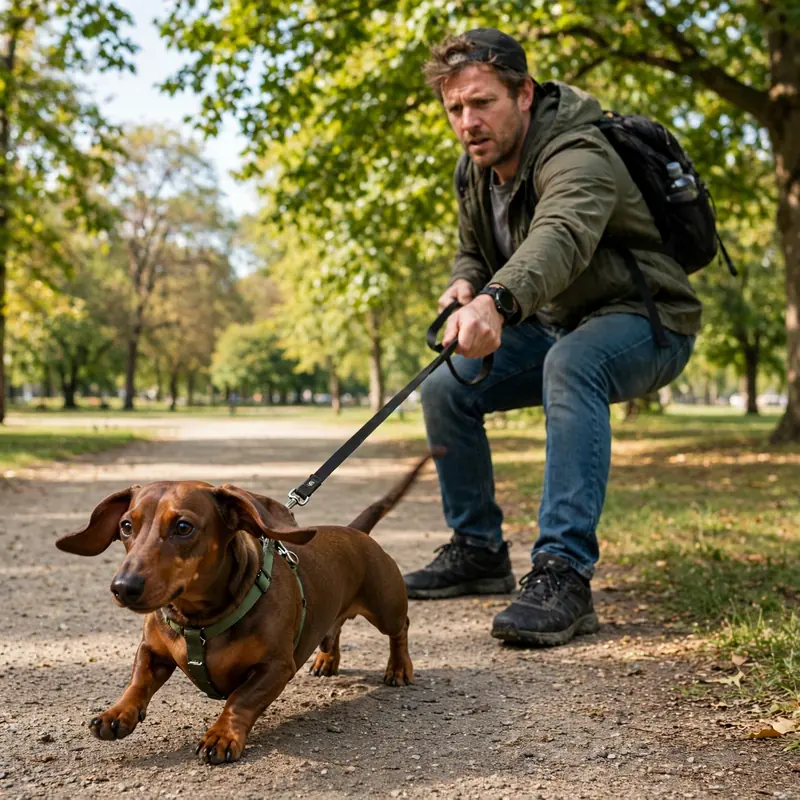
Nine kilos of determined Dachshund at the end of the leash, nose down, hauling toward a smell only they can detect. Your shoulder aches, the walk isn't fun, and under all that straining is a long, vulnerable spine taking a beating.
A dachshund pulling on leash is one of the most common and fixable problems in the breed, and the fix starts with understanding why they pull.
Dachshunds don't pull from defiance. They pull because they're scent hounds with a nose that outranks every other sense, legs built to trot for miles after a trail, and an independent streak.
Once you know that, the training is obvious: make walking with you more rewarding than dragging you along.
Key Takeaways
- Pulling is natural for a scent-driven breed: their nose leads, and the leash is just an obstacle. It's not defiance.
- For a Dachshund, pulling is a welfare issue, not just an annoyance. Every pull strains the neck and long spine, so a well-fitted harness is mandatory, not optional.
- The core technique is simple: stop moving when the leash is tight, move forward when it's loose. Pulling stops working; walking nicely starts paying.
- Never use choke chains, prong collars, or leash pops, especially on a long-backed breed. They cause pain and damage trust without teaching anything.
Dachshund Pulling on Leash: Why It Happens
The nose rules everything. Dachshunds were bred to follow scent trails, sometimes for long distances. When a scent catches them, the tracking brain switches on completely.
They aren't choosing to ignore you; the smell is simply more compelling. Expecting a scent hound not to pull toward smells without training is like expecting a retriever not to notice a thrown ball.
Pulling works. Every time your dog pulls and you follow, they've learned that pulling is how you get to the interesting thing. Dogs repeat what works.
Months or years of unintentionally rewarded pulling build a strong, durable habit.
Under-exercised body, under-stimulated nose. A Dachshund who gets a quick pavement shuffle and nothing else pours all that pent-up hunter energy into the walk. Boredom plus a leash equals pulling.
Excitement and novelty. Puppies and young dogs pull hardest because everything is new: arousal is high and self-control is still under construction.
The Equipment Fix: Harness, Not Collar
This is step zero, and for this breed it's a health decision, not a training preference. A Dachshund's long back is prone to disc problems, and every pull on a collar concentrates force on the neck and, through it, the spine.
A dachshund pulling on leash while wearing a collar faces a welfare problem on every single walk.
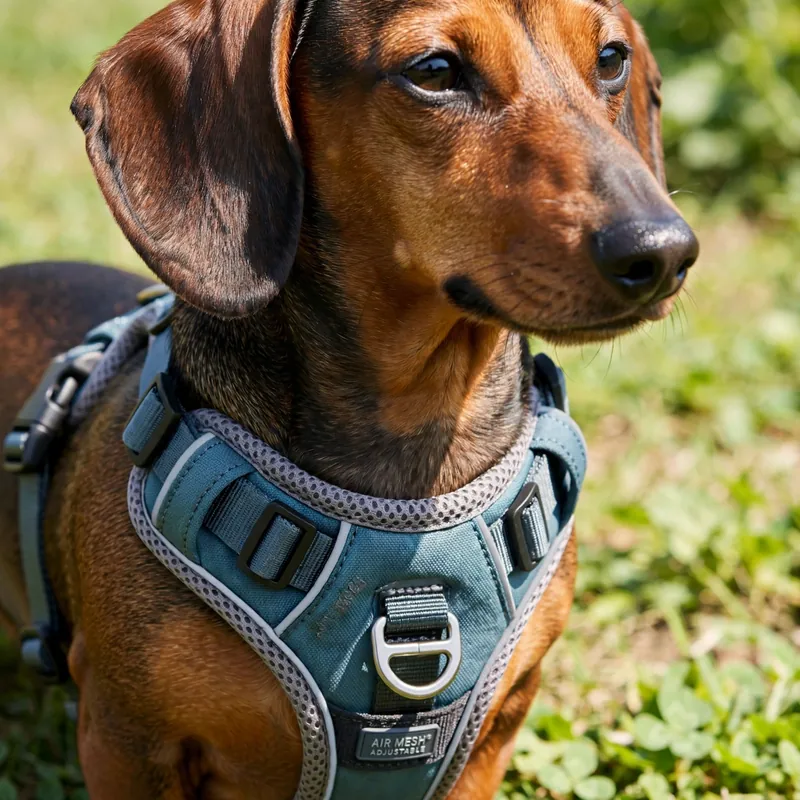
Use a well-fitted harness. A Y-shaped or H-shaped harness spreads pressure across the chest and shoulders: snug enough that your dog can't back out, loose enough for two fingers under every strap.
Dachshunds have deep chests and narrow waists, so adjust carefully and re-check fit as puppies grow.
Consider a front-clip harness for heavy pullers. A chest-attached leash gently turns the dog toward you when they surge, mechanically discouraging pulling. It's a training aid, not punishment: no pain, no tightening, just redirection.
Skip the retractable leash. Constant tension teaches the dog that pressure on the neck is normal, which is the opposite of what loose-leash walking needs. A standard fixed-length lead (around 1.8 metres) gives you control and gives the dog a clear signal about where the slack ends.
Never use choke chains, prong collars, or slip leads on a Dachshund. These work through pain or the threat of it. On a breed with a vulnerable neck and spine, that's risking real injury, and it teaches the dog that walks are scary. Same spine-protection logic as stopping jumping off the couch: your equipment should protect the back.
Stop Dachshund Pulling on Leash: The Training Plan
To stop dachshund pulling on leash for good, train in short sessions (five to ten minutes) in a low-distraction area first: your garden, a quiet street, an empty car park. Busy parks come later, once the skill is solid.
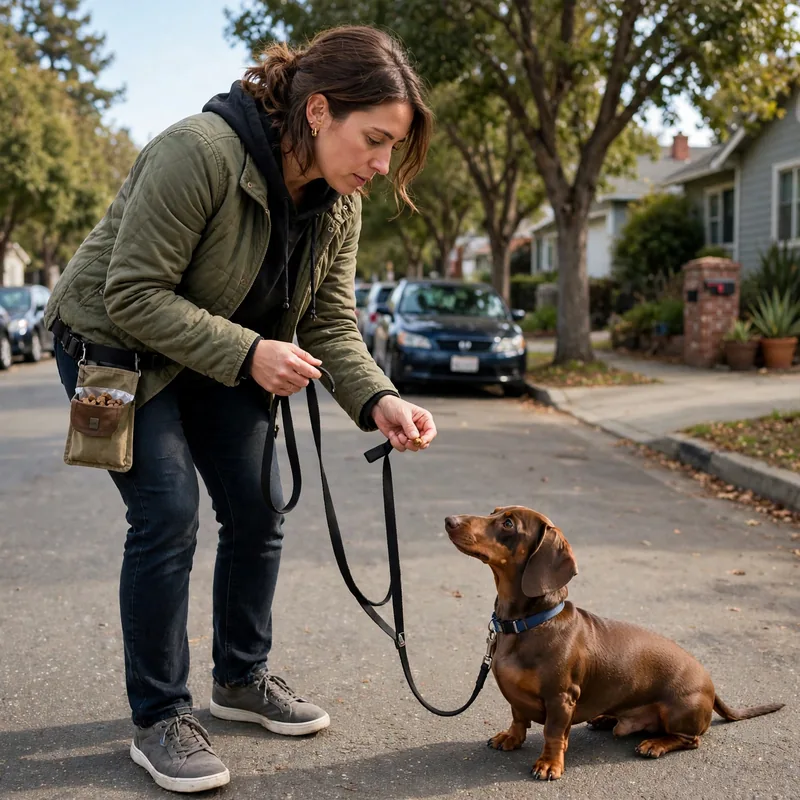
Step 1: Be a tree. The moment the leash goes tight, stop. Plant your feet, stay calm, don't yank back or reel the dog in.
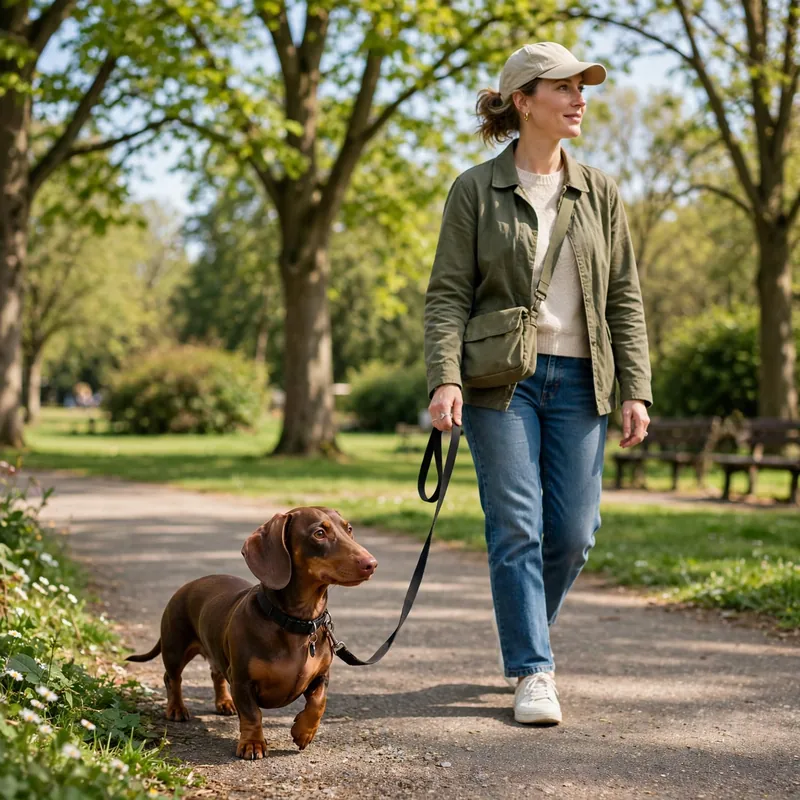
The instant there's slack, even accidental, say “yes!” and walk forward. Pulling stops the walk; slack restarts it. This only works if you're consistent every single time: consistency is what ends dachshund pulling on leash.
Step 2: Reward the position. When your Dachshund walks beside you on a loose leash, mark it (“yes!”) and treat right at your leg, where you want them.
Dachshunds are extremely food-motivated: use small, soft, high-value treats and pay generously at first. You're building value for the position itself.
Step 3: Add direction changes. When your dog surges ahead, turn and walk the other way with a cheerful “this way!” Reward when they catch up.
This teaches them to watch you, since you might turn at any moment, and it breaks the nose-locked trance.
Step 4: Add a cue word. Once your dog is offering loose-leash walking reliably, attach a calm word like “easy” or “with me” as they settle into position. Over time the word becomes a reminder.
Don't use the cue before the behavior exists: naming something the dog doesn't understand yet just teaches them to ignore the word.
Step 5: Build up distractions gradually. Garden, then quiet street, then a street with some activity, then the park at a quiet hour, then the park at a busy hour.
Each new level of distraction is a new lesson. If your dog falls apart at a new level, drop back one and rebuild.
Handling the Hard Spots
The scent lock. Your Dachshund freezes, nose glued to the ground, and no treat competes. Don't drag them off.
Wait it out, or use it: let them sniff a few seconds as a reward for walking nicely, then cue them onward. A dog whose sniffing needs are met pulls less, and meeting those needs is half the battle with dachshund pulling on leash.
Other dogs and exciting triggers. High arousal destroys loose-leash skills. Create distance, use the threshold principle from our guide to lunging at other dogs, and reward calm choices. Manage first, train second.
The puppy zigzag. Young puppies don't walk in straight lines; they explore in bursts. That's normal. Keep sessions very short, reward any nice walking generously, and accept that puppy walks are for sniffing and learning, not distance.
When the whole walk falls apart. Some days the dog is too aroused, too tired, or too over-faced to learn. That's fine.
Cut the session short, head home via the quietest route, and try again tomorrow. One bad walk doesn't undo training; pushing through frustration does more damage than quitting early.
Common Mistakes
- Yanking the leash back. Leash pops punish without teaching an alternative, and on a Dachshund they risk neck and spinal injury. Correction-based shortcuts are off the table for this breed.
- Being inconsistent. If pulling works on some walks (you're in a hurry, you let them drag you to the park), the dog learns that persistence pays. The rule has to hold on every walk, by every family member. Get everyone in the household on the same page.
- Training too long. A frustrated twenty-minute session teaches less than three focused five-minute sessions. Dachshunds check out when training drags; quit while you're ahead.
- Skipping the boring practice. Real walks are for management. The skill is built in short, deliberate practice sessions in easy environments. Dogs who only “train” on exciting real walks learn very slowly.
- Expecting heel position. Loose-leash walking isn't obedience heeling. Your dog is allowed to sniff, wander a little, and be a dog, as long as the leash stays slack. Demanding a perfect heel on every walk is unrealistic and unnecessary.
When Pulling Isn't a Training Problem
See your vet if pulling changes suddenly: a dog who pulls harder, seems restless, cries, or resists the harness may be in pain, and back discomfort can show up as altered walking in this breed.
A dog who never pulled and suddenly starts may be reacting to pain, vision changes, or anxiety. And if the pulling is really lunging and barking at triggers, that's reactivity: our guide to calming a Dachshund down and the lunging guide will help more than leash mechanics.
For the full breed picture, read the complete Dachshund behavior guide and explore all Dachshund guides.
Frequently Asked Questions
How long does it take to teach loose-leash walking?
With consistent daily practice, most dogs improve noticeably within two to three weeks, and walk reliably loose-leash within two to three months. Dogs with years of rehearsed pulling take longer.
Is a harness really better than a collar for Dachshunds?
Yes: for this breed it's a health matter, not a preference. A harness spreads force across the chest instead of the neck, which matters enormously for a spine-prone dog. Walk on a harness; keep the collar for ID tags.
My Dachshund pulls hardest at the start of the walk. Is that normal?
Completely. The first five minutes carry the most excitement and the best smells, which is why dachshund pulling on leash is worst right at the start. Let your dog sniff and decompress before asking for nice walking; results improve once the initial buzz wears off.
Should I use treats forever?
No. At first, reward every few steps of good walking. As it becomes habit, thin rewards gradually: random jackpots, then mostly praise. But keep paying occasionally for life; behaviors that stop paying eventually fade.
Will a no-pull harness train my dog by itself?
A front-clip harness reduces pulling mechanically, but it doesn't teach the dog anything on its own. Think of it as training wheels: useful while you build the skill with stop-and-go and rewards, not a replacement for training.
My Dachshund only pulls toward other dogs, not on empty streets. What then?
That's arousal around a specific trigger rather than general pulling, and it shades into reactivity. Manage distance, reward calm behavior around dogs, and read our guide to lunging at other dogs for the full reactivity plan.
—
Loose-leash walking is one of the highest-value skills you can teach a Dachshund: it makes every walk better and protects the spine they'll need for life.
If dachshund pulling on leash has made walks miserable, pair this plan with our guide to lunging at other dogs if triggers are part of the picture, read the complete Dachshund behavior guide for the full breed picture, and browse all Dachshund guides.