Dog Lunges at Joggers and Cyclists? How to Stop It
If your dog lunges at joggers, you know the exact stretch of pavement where it happens. You spot the runner coming and wonder if this is the morning your dog knocks you sideways. A quiet walk has become a tactical operation, and sooner or later someone gets hurt.
The good news: this is one of the most fixable reactivity problems, because the trigger is so predictable. Joggers appear, pass, and leave, which gives you clear, repeatable training setups. Below: the safety gear, the step-by-step training sequence, and what makes it worse.
Key Takeaways
- Fast motion triggers your dog’s chase response: notice, fixate, chase. Prey drive, fear, and leash frustration all cause it, and the training plan works for all three.
- Safety first: a well-fitted front-clip harness, with two points of contact for strong dogs, so one lunge can’t pull you over or reach a passerby.
- Train below threshold. Your dog should notice the jogger but still take treats and respond to you. If they can’t, you’re too close.
- Never punish the lunge with leash pops, yanking, or shouting. It adds fear and pain to the moment and usually makes reactivity stronger.
- Muzzle training is a responsible safety measure while you work the plan, not a sign of failure.
Why Your Dog Lunges at Joggers and Cyclists
Lunging looks like one behavior, but it’s driven by different engines. What your dog does in the seconds before the lunge tells you which one you’re dealing with.
The chase response. Dogs carry a hardwired sequence: notice movement, stare, chase, grab. A jogger or cyclist moving fast past a dog is the perfect trigger, far stronger than a person standing still. It’s the same instinct behind chasing squirrels and rabbits. Dogs in chase mode often lunge in silence, ears forward, body leaning in: chase behavior, not aggression. (See our prey drive guide at /husky-prey-drive-cats/.)
Fear. Some dogs lunge because the fast-moving person is scary. A jogger appearing silently from behind can startle a dog into a defensive explosion of barking and lunging, trying to drive the frightening thing away. These dogs often look worried first: ears back, weight shifted backward.
Frustration. The leash creates this one. Your dog sees something exciting, the leash blocks the approach, and the impulse boils over into lunging, spinning, or barking. Common in young, social dogs who would love to say hello but haven’t learned to handle disappointment.
Rehearsal. Whatever the original motivation, every unaddressed lunge is practice. Adrenaline makes it feel intense and self-rewarding, and the jogger always leaves, which can teach a fearful dog that lunging “worked.” It won’t fade on its own, but it responds well to consistent training.
Safety Gear First: Hold the Dog, Protect the Passersby

Before you change the behavior, make sure nobody gets hurt. A strong dog lunging at a cyclist can pull an owner off their feet, and a bite at a passing runner brings real legal consequences. Gear isn’t a substitute for training, but it’s the seatbelt that makes training safe.
A well-fitted front-clip harness. When the dog lunges, a front attachment point turns their chest back toward you instead of letting them lean their full weight forward. Two fingers should slide under every strap, and it shouldn’t rotate around the body. Recheck the fit every few weeks.
Two points of contact for strong dogs. If your dog can pull you over, clip the leash to both the front and back rings of the harness, or add a flat collar with a short backup connector. Never walk a lunger on a collar alone.
A fixed-length leash, no retractables. Use a 4 to 6 foot flat leash. Retractable leashes give a lunging dog a running start and put the full force of the lunge at the end of thin cord.
Treats, a pouch, and smarter routes. Bring tiny pieces of real meat or cheese, worn where you can reach them fast. Choose wider paths and quieter times while training. Crossing the street when a cyclist approaches is smart management.
The Step-by-Step Plan to Stop a Dog Lunging at Joggers
This plan uses desensitization and counterconditioning: gradual exposure to joggers at a distance where your dog stays calm, while teaching them that fast movers predict wonderful things. Everything is positive reinforcement only. Expect weeks of short sessions, not a weekend fix.
Step 1: Find your threshold distance
Find a path where joggers pass and watch your dog. The threshold is the distance where your dog notices the jogger but can still take a treat and respond to their name. For many dogs that’s 30 to 50 feet at first; for some it’s across a field. Everything in this plan happens at or beyond that distance. If your dog can’t take treats or listen, you’re too close. Move farther away. No exceptions.
Step 2: Play the engage-disengage game
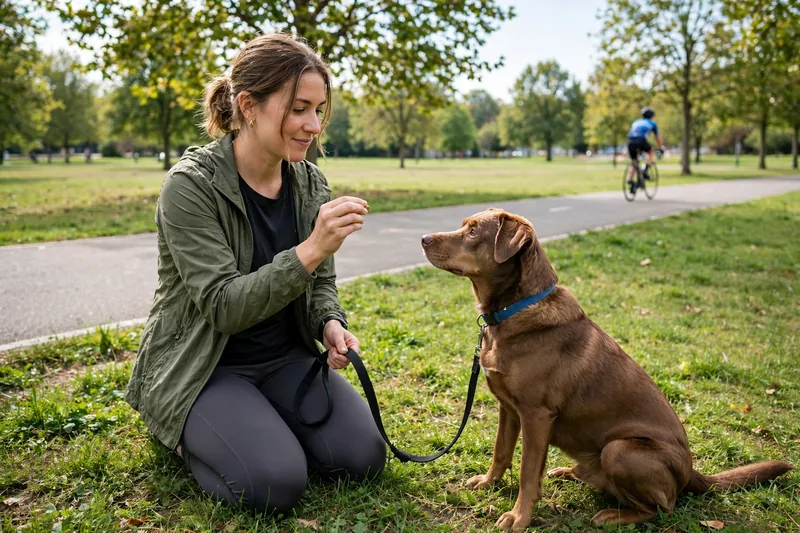
When a jogger appears at threshold distance, let your dog notice them. The moment your dog glances at the jogger, mark it (“yes!”) and feed a treat. Within a few sessions, most dogs start the second half on their own: they see the jogger and then disengage, turning back to you voluntarily. Mark that choice and jackpot it with several treats in a row.
Keep sessions to five or ten minutes, ending while your dog is still succeeding. Several short sessions a week beat one long weekend walk.
Step 3: Build an emergency U-turn
For joggers who appear suddenly on narrow paths, you need an escape maneuver. Teach this at home: say “this way!”, turn 180 degrees, and reward your dog for whipping around with you. Practice until it’s automatic, then use it on real walks. Every lunge you prevent is one your dog doesn’t practice.
Step 4: Matwork at park benches

Teach a down-stay on a small mat at home, building duration to several minutes. Then take the mat to a bench near a path, at threshold distance, and feed steadily as joggers pass. The mat becomes a portable calm station, and lying down is physically incompatible with lunging.
Step 5: Proof with staged helpers
Once your dog succeeds at their threshold, recruit a helper: a friend on a bicycle or a family member willing to jog past at a set distance. Start with the helper moving slowly and far away, reward calm responses, and over sessions decrease distance and increase speed, one variable at a time. If your dog lunges, you progressed too fast. Go back a step.
Step 6: Take it to the real world, gradually
Move sessions to busier paths at quiet times, then normal times. Keep rewarding the disengage every time in the early weeks; many owners stop treating too soon and the behavior creeps back. Pay for the choice you want until it’s the dog’s default, then fade rewards. If you plateau for more than a couple of weeks, get professional help rather than pushing harder.
What NOT to Do
No leash pops or yanking the dog back. A sharp jerk when a jogger passes teaches your dog one thing: joggers predict pain. The reactivity usually gets bigger and faster. The same applies to choke chains, prong collars, and e-collars: they suppress the visible behavior while the underlying emotion worsens, and they can produce a dog that reacts without warning because earlier signals were punished.
No shouting or punishment for reacting. Yelling “no!” mid-lunge adds your agitation to an already over-aroused dog. It teaches nothing about what to do instead, and for fear-driven dogs it confirms that scary things happen around joggers.
No flooding. Don’t take your lunging dog to a crowded riverside path “to get them used to it.” Forcing a dog to endure triggers at full intensity with no escape is how bites happen. Desensitization only works below threshold.
No off-leash testing near paths. Until the training is solid, your dog stays leashed around joggers and cyclists, or on a long line in open areas away from paths. One off-leash chase sets training back weeks and risks a bite report.
No greeting the jogger to “socialize.” Letting a frustrated dog rush up to cyclists teaches them lunging is how to reach exciting things. Politeness around fast movers means ignoring them.
Muzzle Training: A Responsible Safety Tool
A basket muzzle, conditioned properly, is one of the most responsible things an owner of a lunging dog can do. It doesn’t mean your dog is aggressive or that you’ve failed; it means a passing cyclist is protected even if a walk goes wrong.
The key word is conditioned. Spend a week or two at home: smear peanut butter inside the muzzle and let your dog push their nose in to lick it out. Repeat until your dog shoves their nose in happily, then add the straps for seconds at a time, building duration with treats. Use a basket-style muzzle that lets your dog pant, drink, and take treats, never a tight fabric sleeve muzzle for walks.
When to Call a Professional
Get help if: your dog has bitten or tried to bite a jogger, cyclist, or any person; your dog can pull you down and the gear above isn’t enough; the reactivity is escalating or spreading to other triggers; your dog can’t take treats or respond once a trigger appears, even at long distances; or you feel afraid of your own dog on walks.
Look for a certified force-free trainer (CPDT-KA or IAABC are good signs) or a veterinary behaviorist for severe cases. Avoid any trainer whose plan starts with punishment tools. If the behavior appeared suddenly in a previously fine adult dog, see your vet first; pain and sensory changes lower tolerance for surprises.
FAQs
Will my dog grow out of lunging at joggers? Almost certainly not. Lunging is self-rehearsing: adrenaline rewards it, and the jogger always leaves, which can teach a fearful dog that it “worked.” Without training, it typically gets more intense, not less.
Is a headcollar better than a front-clip harness? Headcollars suit some powerful dogs but must be introduced slowly with food, just like a muzzle. For most dogs, a well-fitted front-clip harness with two points of contact is simpler and effective.
What if my dog only lunges at cyclists, not joggers? The plan is the same, just swap the trigger. Bikes are often harder because they’re faster and quieter, so expect a larger threshold distance at first. A friend on a bicycle is the ideal staged helper for step 5.
Your dog isn’t lunging because they’re stubborn or bad. Something fast flips a switch in their brain, and nobody has shown them a better response yet. Start with the gear, find the threshold, and build the new habit one passing runner at a time.
Want the science behind the chase? If your dog lunges at joggers, Wikipedia’s overview of prey drive in dogs explains the hardwired notice-stare-chase sequence that makes fast movement so exciting for them.