

German Shepherd Barking at Strangers on Walks: How to Fix It
# German Shepherd Barking at Strangers on Walks: How to Fix It
The walk starts fine. Then a stranger appears on the path, and your 35-kilo German Shepherd erupts — barking, lunging, hackles up — while you hang onto the leash and apologize to a terrified jogger. If your German Shepherd is barking at strangers on walks, you’re dealing with leash reactivity: one of the most common, most embarrassing, and most fixable behavior problems in the breed.
First, the reframe that changes everything: this usually isn’t “aggression.” It’s big feelings — fear, frustration, guarding instinct, over-arousal — expressed through the only channel a leashed dog has. Your dog isn’t a bad dog or a dominant dog. They’re a dog having emotions too big for the situation, and emotions can be retrained.
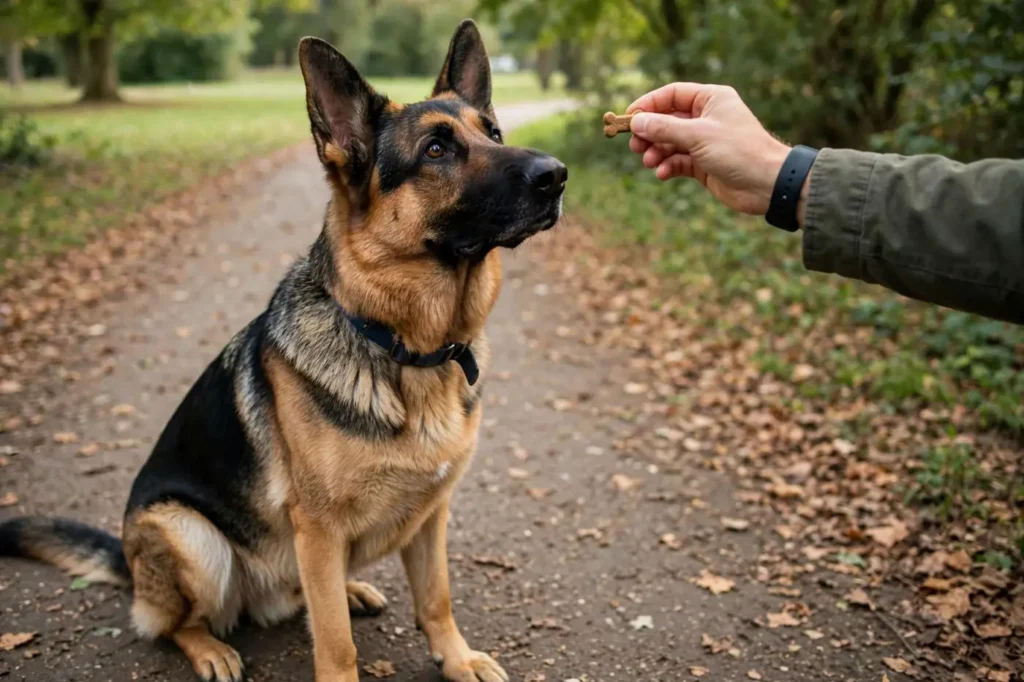
Key Takeaways
- On-leash barking at strangers is usually reactivity (fear, frustration, or guarding instinct) — not dominance and not necessarily aggression.
- Distance is your most powerful tool: train where your dog notices strangers but can still think.
- The “Look at That” game plus counter-conditioning changes how your dog *feels* about strangers, not just how they act.
- Tight leashes, forced close encounters, and scolding the bark all make reactivity worse.
What’s Really Happening
Leash reactivity, explained simply. Off leash, most dogs handle strangers with a sniff and move on — they have freedom to increase distance if unsure. On leash, that option disappears. The dog feels trapped, arousal spikes, and barking becomes the strategy: “go away!” Sometimes it works (the stranger passes), which rewards and strengthens it.
The German Shepherd factor. This breed brings extra ingredients: a guarding instinct that flags strangers as worth announcing, high arousal levels, and sheer physical presence that makes every outburst feel (and look) dramatic. A reactive Labrador gets sympathy; a reactive Shepherd gets crossed streets. The training is the same — the stakes just feel higher.
Frustration vs. fear. Some Shepherds bark because strangers are scary (fear). Others bark because they desperately want to investigate and the leash won’t let them (frustration). Many are a mix. You don’t need a perfect diagnosis to start — the training plan below works for both, because both need the same thing: a calmer emotional response at gradually decreasing distances.
One important note: I’m describing behavior patterns, not diagnosing your dog. If there’s been biting, or the intensity is escalating, skip to the professional-help section — that’s beyond DIY.
Safety and Equipment First
Before training, set yourself up:
- A secure front-clip harness or well-fitted flat collar. Front-clip harnesses give you steering without pain. Avoid choke chains, prong collars, and shock collars — they add pain and fear to an already over-aroused dog, which reliably makes reactivity worse, not better.
- A standard 6-foot leash. Not a retractable leash — you need predictable, consistent leash length and the ability to create distance quickly.
- High-value treats. We’re talking the good stuff: real chicken, cheese, hot dog bits. Kibble won’t cut it when your dog’s brain is melting. Bring more than you think you need.
- Know your dog’s threshold distance. This is the distance at which your dog notices a stranger but can still respond to you — ears up, alert, but not barking. For some dogs it’s 50 meters; for others it’s 10. Everything in the training plan happens at or beyond this distance.
Management on Every Walk (Starts Today)
Management prevents rehearsal while training builds the new response:
- Create distance proactively. See a stranger ahead? Cross the street, turn a corner, step behind a car. Distance is not avoidance-as-failure — it’s training setup.
- The U-turn. Teach a cheerful “this way!” U-turn at home with treats, then use it on walks to exit situations before they escalate.
- The “find it” game. Toss a handful of treats into the grass and say “find it!” Sniffing is naturally calming for dogs and breaks the stare-bark cycle.
- Walk at quieter times and places. Wide-open spaces with good visibility beat narrow paths with blind corners. Fewer ambushes = fewer reactions = faster progress.
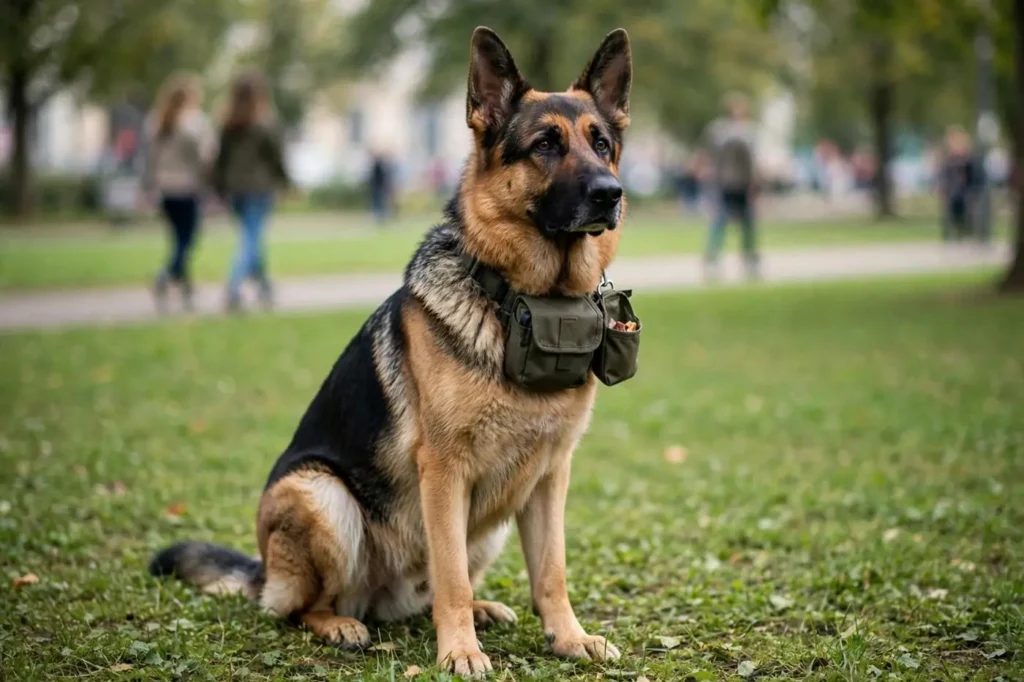
The Training Plan
This is desensitization plus counter-conditioning: gradually changing your dog’s emotional response to strangers. Expect weeks, not days — you’re rewiring feelings, not just teaching a trick.
Step 1: Find and respect threshold. For one week, just observe. Note the distance where your dog notices strangers but stays under threshold. All training happens here or farther away. If your dog is already barking, you’re too close — add distance.
Step 2: The “Look at That” game. At threshold distance, when your dog looks at a stranger, mark it the instant they look (“yes!”) and treat. Then wait. Most dogs glance back at the stranger — mark and treat again. You’re rewarding the *looking*, which sounds backwards, but it teaches the dog that noticing strangers calmly pays. Over sessions, dogs start looking at the trigger and then whipping their head back to you expectantly. That’s the breakthrough moment.
Step 3: Counter-conditioning. Stranger appears at a safe distance → treats rain from the sky. Stranger disappears → treats stop. Repeat, dozens of times, across many sessions. The dog’s brain starts rewriting the equation: stranger = chicken happens. You’re not asking for any behavior at all — just changing the feeling.
Step 4: Gradually decrease distance. Over weeks, as your dog stays relaxed, let the threshold distance shrink naturally. Never rush this. If barking returns, you moved too fast — go back to the last distance that worked.
Step 5: Add real-life skills. Once the emotional response is improving, layer in practical cues: a solid “leave it,” a “heel” past distractions, and the emergency U-turn. These are tools for the moments management isn’t enough.
Session rules: keep training sessions short (10–15 minutes of actual stranger exposure is plenty), end on a success, and never train when your dog is already over threshold. One bad flooding experience can undo a week of progress.
Common Mistakes
- Yanking the leash and scolding. The dog is already over-aroused; adding pain and shouting confirms that strangers predict terrible things. Reactivity gets worse.
- Forcing close encounters to “socialize.” Flooding a reactive dog — dragging them toward strangers so they “get used to it” — usually sensitizes them further. Desensitization must be gradual and under threshold.
- Letting strangers feed or pet the dog. Well-meaning strangers offering treats to “make friends” often lure the dog into their space and trigger a reaction at close range. Politely decline: “we’re training, please ignore him.”
- Inconsistency between handlers. If one person U-turns away and another lets the dog charge up barking, the dog learns nothing. Everyone on the same page.
- Training only when it’s already bad. The plan works through hundreds of calm repetitions. If you only practice during meltdowns, there aren’t enough calm reps.
When to Get Professional Help
Get a qualified force-free trainer or behavior professional involved if:
- Your dog has bitten, or attempts to bite, not just bark
- The intensity is escalating despite consistent training
- You can’t find any threshold distance — the dog reacts to strangers at any range
- There’s lunging with clear intent rather than noisy bluster
Look for credentials like IAABC certification or equivalent in your country, and avoid anyone whose plan centers on punishment or “correcting” the dog. Also talk to your vet: sudden reactivity changes can have medical contributors, and your vet should rule those out.

Frequently Asked Questions
Is my German Shepherd aggressive?
Barking and lunging on leash doesn’t automatically mean aggression — most cases are reactivity driven by fear, frustration, or arousal. True aggression involves intent to harm. That said, I can’t assess your individual dog from an article. If there’s been biting or the behavior is intense and escalating, get a professional assessment rather than guessing.
Will neutering/spaying fix reactivity?
There’s no reliable evidence that it fixes leash reactivity — this is a training and emotional-response issue, not a hormonal one. Focus on the training plan; discuss any medical decisions with your vet on their own merits.
Can I ever walk past strangers normally?
Yes — this is one of the most successfully rehabilitated behaviors in dog training. Most dogs improve dramatically with consistent work; many become completely non-reactive. It takes weeks to months, not days, and the timeline depends on how long the behavior’s been rehearsed and how consistent the training is.
Should strangers give my dog treats to make friends?
Generally no — at least not during the reactivity phase. Luring a reactive dog close to a stranger with food often creates conflict (want the treat, fear the person) and can trigger reactions at close range. Keep strangers at training distance and let the counter-conditioning do the work.
How long will training take?
Honestly: weeks to months. Dogs with a short history of reactivity and committed owners often show real improvement within a month. Deeply rehearsed cases take longer. The trajectory matters more than the timeline — steady improvement at your dog’s pace is success.
Reactivity feels awful in the moment, but it’s one of the behaviors most responsive to patient, positive training. For related challenges, see barking at night and barking when left alone. The full breed picture is in our complete German Shepherd behavior guide, with more in the barking archive. You can also browse all German Shepherd guides and every barking guide.