How to Stop a Dachshund Biting: Step-by-Step Plan
If you’re searching for how to stop Dachshund biting, you’ve probably had a scare — a snap when you reached for the collar, a nip at a visitor’s ankle, or a full bite that broke skin. It’s frightening, and it’s easy to assume you have an “aggressive dog.” Take a breath.
Most Dachshund biting is fear-based, pain-related, or guarding-driven — all things a small, loud, opinionated hunting breed does when they feel they have no better option. This plan gives them one.
The goal isn’t a dog who tolerates everything silently. It’s a dog who trusts that warnings work, so they never need to escalate to teeth.
Key Takeaways
- Most Dachshund bites come from fear, pain, handling sensitivity, or resource guarding — not “dominance” or spite.
- A growl is information, not defiance. Never punish the warning; you’ll just get a dog who bites without one.
- Management (avoiding rehearsal, respecting triggers) must come before training: you can’t train a dog who’s practicing biting daily.
- Any bite that breaks skin needs medical attention for the person, and sudden biting in a previously gentle dog needs a vet visit first.
What Counts as “Biting” — and Why the Distinction Matters
Not all teeth-on-skin is the same problem, and the fix depends on which one you have.
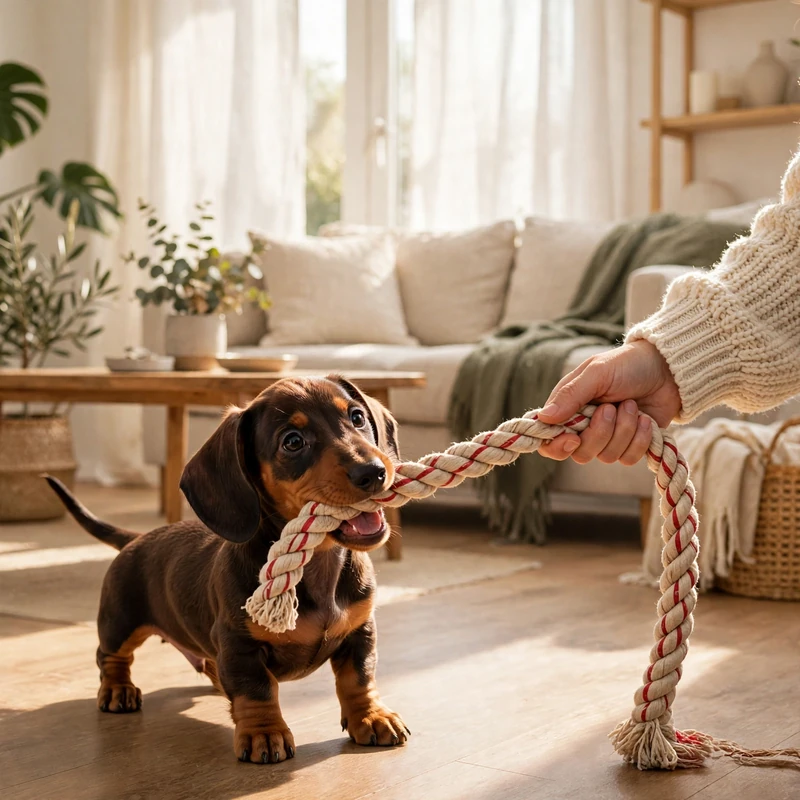
Mouthing and play nipping is common in puppies and young dogs: soft, inhibited, usually during play or excitement. It’s a manners issue, not a safety one. (If your issue is mostly with children, read our guide to Dachshund nipping at kids alongside this plan.)
Snapping and air-snapping is a warning: “back off.” It usually means the dog has learned that subtler signals (freezing, lip licking, turning away) got ignored. This is actually good news: the dog is still communicating.
Bites that connect, especially ones that break skin or bruise, mean the dog has escalated past warnings, often because warnings didn’t work in the past. This needs management immediately and, in most cases, professional guidance.
Why Dachshunds Bite
Understanding the “why” isn’t about making excuses; it’s about picking the right fix. Dachshunds bite for reasons that make perfect sense to a Dachshund.
Fear. The number one driver. Dachshunds are small dogs in a big world, and this breed’s default stress response runs hot and loud. Cornered by a stranger, startled awake, grabbed suddenly. In those moments a fearful dog bites because flight wasn’t available. Many “bit out of nowhere” stories turn out to be “we missed six earlier warnings” stories.
Handling sensitivity. This breed was built long and low, and many Dachshunds are uncomfortable being picked up, having their collar grabbed, or being restrained. If your dog bites specifically when lifted, our guide to Dachshund bites when picked up goes deeper on that exact scenario.
Pain. Backs, teeth, ears, skin. A dog in pain has a shorter fuse, full stop. Dachshunds are prone to back issues, and a dog with a sore spine may snap when touched along the back or lifted. Sudden biting in a previously tolerant adult dog is a vet visit before it’s a training project.
Resource guarding. Food, chews, stolen socks, favorite humans: Dachshunds can be enthusiastic owners of things. Guarding is a normal (if rude) canine behavior: the dog believes the good thing will be taken, so they defend it.
Over-arousal. Some bites happen mid-zoomie or during rough play. The dog’s brain is flooded and the mouth is just… involved. This is different from fear biting and usually responds to arousal management (see our guide on how to calm a Dachshund down).
Notice what’s not on this list: dominance, spite, “trying to be the boss.” Those explanations feel satisfying but they point at the wrong fixes.
Safety First: Manage Before You Train
You cannot train a dog who is still rehearsing biting every day. Management isn’t giving up: it’s what makes training possible.
1. Stop the rehearsals. Identify the top two or three bite scenarios and prevent them this week. Dog guards the sofa? Dog loses sofa privileges for now (a comfy floor bed instead). Snaps when the collar is grabbed? Use a harness and stop grabbing the collar. Every prevented incident is a win.
2. Respect the growl. A growl is your dog saying “I’m not okay” in the only language they have. If you punish the growl, you don’t remove the feeling. You remove the warning. Thank the growl by calmly increasing distance, then note what triggered it. That trigger list becomes your training plan.
3. Set up safe handling. For vet visits, grooming, and daily care, use cooperative handling: let the dog opt in, keep sessions short, and pay generously with treats. Muzzle-train positively (treats for nose-in-muzzle, no forcing) so vet visits don’t become bite setups. A muzzle-trained dog is a safer dog, not a “bad” dog.
4. Protect the humans. No face-to-face greetings with strangers for now. Kids and dogs are always supervised. No exceptions while you’re working through this. If a bite has broken skin, the person should see a doctor; dog bites can infect quickly.
5. Rule out pain. Before assuming it’s behavioral, get a vet check, especially for sudden onset, biting when touched in specific spots, or any stiffness, yelping, or reluctance to move. In this long-backed breed, spinal discomfort is always worth ruling out.
6. Get the whole household on board. The plan only works if everyone follows it. If one person still grabs the collar, chases the dog, or wrestles with hands-as-toys while everyone else redirects calmly, the dog gets mixed signals and the biting keeps paying off. Brief everyone once: same rules, same responses, no exceptions.

How to Stop Dachshund Biting: The Step-by-Step Plan
Work through these in order. Many owners see real improvement within a few weeks of consistent work, but don’t rush; each step builds on the last.
Step 1: Map the triggers. For one week, write down every growl, snap, or bite: what happened just before, where, who was involved, time of day. Patterns will jump out: “always when reached for on the sofa,” “only with unfamiliar men,” “only when the food bowl is down.” Your trigger map is your training curriculum.
Step 2: Build the dog’s overall confidence. A generally anxious dog has a shorter fuse everywhere. Daily sniffy walks (nose work is this breed’s love language), food puzzles, and short positive training sessions all lower baseline stress. A dog whose life is rich and predictable has less to defend.
Step 3: Desensitize the handling triggers. Take your top trigger and break it into tiny steps. If collar-grabs cause snapping: start by reaching toward (not touching) the collar → treat. Touch the collar for one second → treat. Hold for two seconds → treat. Build duration and pressure gradually over days. If the dog shows stress at any step, you’ve gone too far — drop back to the last easy step. Short sessions, big pay.
Step 4: Teach a “trade” for guarding. Never just take things from a guarder. That confirms their fear that things disappear. Instead, practice trades: offer a high-value treat, say “trade,” take the item, give the treat, then give the item back. The dog learns that your approach predicts better things, not loss. Practice with low-value items first.
Step 5: Train an incompatible behavior. A dog can’t lunge and hold a down-stay at the same time. Teach a rock-solid “go to bed” or “touch” (nose to hand) and use it to redirect the dog before the trigger peaks. It’s also worth teaching “leave it” as a general-purpose interrupt — start with boring items on the floor, reward disengaging, and build up slowly. And a hard rule for play: never use your hands as toys. It seems cute when they bite your fingers gently, but it teaches the dog that hands are for biting, and unlearning that is far harder than never teaching it.
Step 6: Generalize slowly. Once the dog is comfortable with family members, carefully extend the work to visitors and new situations — one variable at a time, always under threshold, always with an escape route. Rushing this step is how progress unravels.
How to Stop Dachshund Biting Without Punishment
It needs saying plainly: yelling at, hitting, alpha-rolling, or using shock or prong collars on a biting dog is dangerous. Punishment suppresses the warning signs while leaving the underlying fear or pain untouched — which is exactly how you create a dog who bites “without warning.” It also damages the trust that training depends on. For a sensitive, sharp-reacting breed like the Dachshund, aversive methods routinely make biting worse, not better. If someone tells you the dog needs to learn who’s boss, find a different someone.
When Biting Needs Professional Help
This plan handles mild to moderate cases. Bring in help promptly if:
- A bite has broken skin or required medical attention
- The biting is escalating in frequency or intensity despite management
- The dog bites with little or no warning
- There are children in the home and any bite risk exists
- You feel afraid of your own dog. That’s a valid reason on its own.
Look for a qualified behavior professional who uses positive-reinforcement methods (ask directly: “what happens when my dog gets it wrong?” — the answer should never involve pain, fear, or intimidation). And always start with a vet check: behavior professionals will tell you the same thing, because pain and medical issues are behind more biting cases than most owners expect.

Frequently Asked Questions
My Dachshund growls at me — should I correct it?
No. The growl is communication, not misbehavior. A dog who growls is telling you they’re uncomfortable while still choosing not to bite — that’s the outcome you want to preserve. Change the situation (more distance, end the interaction), then address the underlying trigger with the plan above.
Can you train the biting out of an older Dachshund?
Yes. Older dogs can absolutely learn new responses; it just takes a bit longer if the behavior has been rehearsed for years. Management matters even more with seniors, since pain often plays a role.
Should I rehome a Dachshund that bites?
Not as a first step, and not without professional assessment. Most biting is workable with management and training. That said, be honest about safety: if there are vulnerable people in the home and the risk can’t be managed, a frank conversation with your vet and a qualified behavior professional is the responsible move: before anyone gets seriously hurt, not after.
Will neutering/spaying stop the biting?
There’s no reliable evidence that desexing fixes biting, since most biting is driven by fear, pain, or guarding rather than hormones. Discuss timing with your vet as a health decision, but don’t expect it to solve a behavior problem.
My puppy bites during play — is that the same thing?
Play biting in puppies is normal developmental mouthing, not aggression. Puppies explore with their mouths and learn bite inhibition through feedback. Redirect to toys, end play briefly when teeth hit skin, and reward gentle mouths. Our puppy chewing guide covers this stage in more detail. True fear-based biting looks very different: stiff body, hard stare, growling over resources.
—
Biting is scary, but it’s also one of the most understandable dog behaviors once you see it from the dog’s side. For the full breed picture, read the complete Dachshund behavior guide, explore all Dachshund guides, and see our related guides on nipping at kids and biting when picked up.