Dog Suddenly Afraid to Go Outside? What to Do
Yesterday your dog bounded out the door for walks. Today they flatten to the floor when you reach for the leash, plant their feet at the doorway, or dart back inside shaking. It is frightening to watch a confident dog become a scared one overnight. You did not cause this, and this is not stubbornness.
A dog suddenly afraid to go outside is almost always telling you one of two things: something hurts, or something scared them badly. This guide works in a fixed order: rule out medical causes with your vet, find the trigger, then rebuild confidence in small steps at your dog’s pace. Skip step one and you risk training a dog who is actually in pain. For background on how dogs think and learn, see this overview of the domestic dog.
Key Takeaways
- A sudden fear of going outside means a vet visit comes first. Pain, illness, vision or hearing loss, and age-related cognitive decline can all make a dog refuse the outdoors. Training comes second.
- Something likely scared your dog outside: fireworks, thunder, an attack, construction noise, a sting. Finding the trigger speeds recovery.
- Never drag, carry out, punish, or flood a frightened dog. Forced exposure increases fear and breaks trust.
- Rebuild confidence with short, voluntary sessions: treats at the threshold, let the dog choose, quit while it is easy.
- If fear involves panic, biting, or zero progress after a few weeks, ask your vet for a referral to a veterinary behaviorist.
Step 1: Rule Out Medical Causes First (Vet Visit)
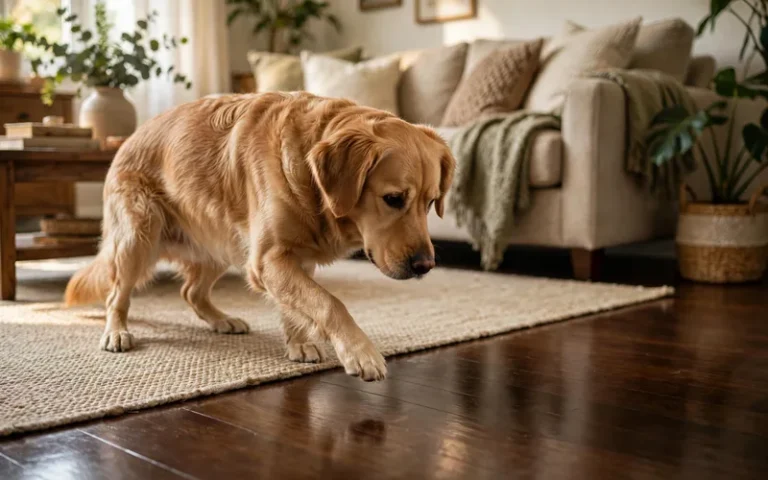
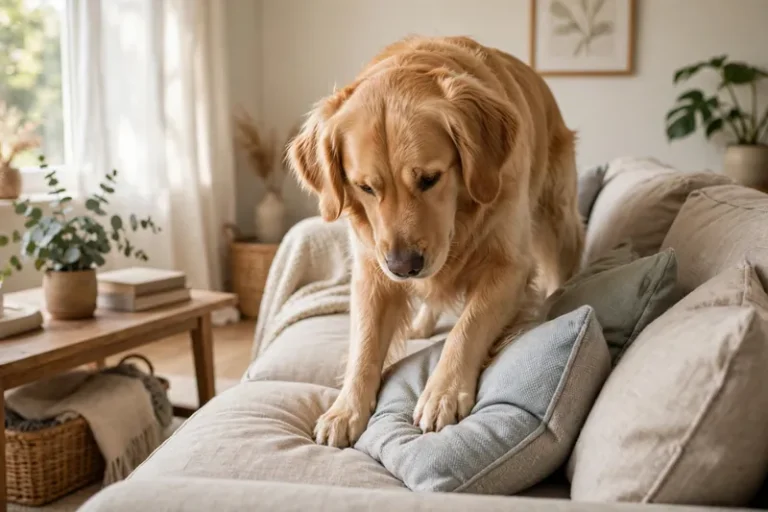
A dog who was happy outside last week and refuses to go this week is a medical case until proven otherwise. Cornell University College of Veterinary Medicine lists the pain signs owners should watch for, and many overlap with fear: reluctance to exercise, slower walking, stiffness or limping, trouble getting up, restlessness, unusual tiredness, vocalizing, withdrawal, snapping when touched, panting at rest, and a changed expression like flattened ears or a glazed look. Any of these alongside the outdoor fear points strongly toward pain.
Pain, especially back, neck, and joint pain. A dog with a sore spine or arthritic hips learns quickly that moving hurts, and the leash, the stairs, and the walk itself become things to avoid. Never dismiss this as laziness.
Vision or hearing loss. A senior dog who cannot see or hear clearly startles more easily and refuses an outdoors that now feels unpredictable.
Cognitive decline in seniors. Veterinary diagnostic guidelines organize the signs of canine cognitive dysfunction under the acronym DISHAA: disorientation, changes in social interaction, sleep-wake cycle changes, house soiling, activity changes, and new anxiety. Diagnosis is always one of exclusion, meaning pain, vision and hearing loss, thyroid problems, and infections must be ruled out first. If your older dog is also getting confused, restless at night, or clingier, ask your vet to evaluate cognitive decline rather than writing it off as old age.
Recent illness, infection, or medication changes. A urinary tract infection, an upset stomach, a bad reaction to a new drug, or recovery from illness can all make the outdoors feel wrong. If the fear started within days of a vet procedure, vaccination, boarding stay, or new prescription, mention it.
What to tell the vet. Note when the fear started, what happened that day, and any other changes: appetite, sleep, limping, indoor accidents, confusion. Ask the vet to rule out pain specifically, since chronic pain is easy to miss and a short pain-relief trial can uncover problems bloodwork alone misses. If getting to the clinic is part of the problem, our gentle plan for a dog afraid to get in the car may help.
Only once your vet has cleared your dog do you move to behavioral recovery.

Step 2: Find the Trigger That Made Your Dog Suddenly Afraid to Go Outside
With medical causes ruled out, play detective. Dogs form fear memories in a single bad moment, often something you barely noticed: fireworks or thunder, a fight with another dog, construction noise, a sting, a shock from an invisible fence collar, or a scare from a stranger. Walk back through the last few days before the fear started and ask family members what they remember.
Knowing the trigger tells you what to avoid while your dog recovers and what to rebuild toward. If you cannot find the trigger, the plan below still works: it rebuilds the outdoors itself as a safe place, piece by piece.
Step 3: Rebuild Confidence in Tiny Steps
This is systematic desensitization plus counterconditioning, the standard behavioral approach for fears. Purdue University’s Canine Welfare Center states the core principle plainly: forcing a dog toward what scares them does not help them “get used to it,” and forced exposure can actually increase fear. Instead, you work at a level so low that no fear appears, and pair it with something wonderful.
1. Set the stage. Pick your dog’s highest-value treat, something they never get otherwise: real chicken, cheese, bits of hot dog. Keep sessions to two to five minutes, a few times a day, ending before the dog gets worried.
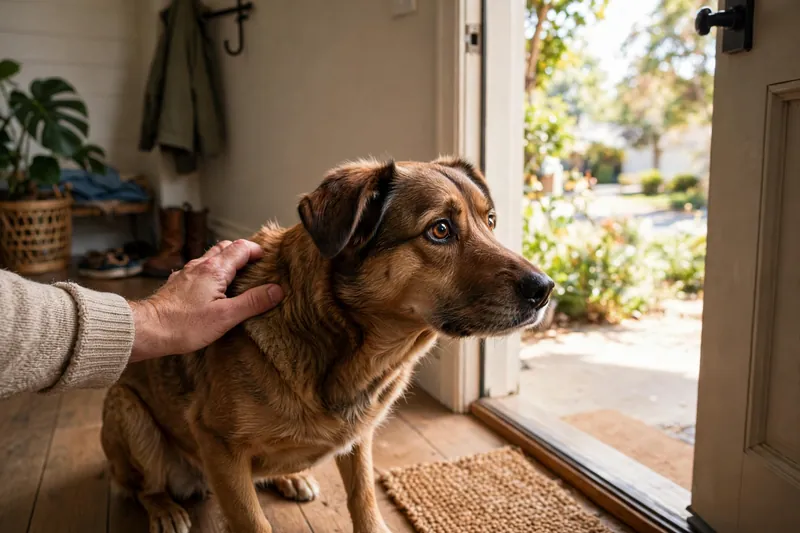
2. Start at the threshold, not past it. Open the door and reward calm behavior while your dog is still fully inside. The dog does not have to “do” anything; you are pairing the open door with good things.

3. Let the dog choose every step. When the doorway is boring, let them step onto the doormat, the porch, the first step. Each new inch gets treats and quiet praise. The moment your dog freezes, turns away, tucks their tail, or refuses treats, you have gone one step too far. Go back to where they were comfortable. Treat refusal means stress is too high: back up.
4. Keep early outings absurdly short. The first successful “walk” might be thirty seconds in the front yard. Repeat short, successful outings for several days before extending them. End every session while the dog still wants to continue.
5. Use open-bar, closed-bar for sound triggers. If noise caused the fear, play a recording of the sound indoors so quietly your dog barely notices, and feed treats continuously while it plays. Pause the recording and immediately stop the treats. Over days and weeks, raise the volume one tiny click at a time, dropping back down whenever you see stress.

6. Keep potty logistics humane. Do not withhold bathroom breaks as leverage. Walk your dog to the closest safe spot near the door and praise calmly for going outside. Clean indoor accidents with an enzyme cleaner without comment, and fill recovery time with indoor enrichment: snuffle mats, lick mats, and stuffed food puzzles. (If potty itself becomes the problem, see our guide on a dog who won’t poop on walks.)
Many dogs show visible progress within a few weeks of consistent short sessions. Deeper fears after a truly traumatic event can take months. Steady progress is the goal, not speed.
What Not to Do When Your Dog Is Suddenly Afraid to Go Outside
Do not drag, carry, or trick your dog outside. Flooding, forcing a fearful animal into the scary situation hoping they “get over it,” deepens fear and destroys trust. Calling them with a treat and then shutting the door behind them breaks the same trust.
Do not punish fear. Scolding, yelling, leash pops, spray bottles, shock collars, and prong collars have no place in fear work. A punished dog does not become brave; they become a frightened dog who is also afraid of their owner. Aversives are explicitly rejected here: they suppress behavior without changing the underlying fear, and they risk creating aggression in a panicked dog.
Stay calm, not cold. Calm, quiet company is fine; frantic reassurance (“oh no, baby, it’s okay, oh no”) signals there really is something to be upset about. Be their calm anchor.
Do not skip the vet. The biggest mistake with sudden onset fear is treating it as a training problem from day one. The vet comes before the treats.
Helping Kids Understand
Children may take a dog’s sudden fear personally or try to fix it by chasing the dog outside. Explain simply: the dog got a big scare and needs quiet time to feel brave again, like after a bad dream. Two house rules: nobody pulls the dog outside, nobody chases the dog back in. Kids can help by handing the dog a treat after a calm doorway session. Always supervise kids and dogs together during recovery.
When to Call a Veterinary Behaviorist
Most cases improve with the plan above, but ask your vet for a referral to a veterinary behaviorist (a vet with specialist training in behavior, not a regular trainer) if your dog:
- Panics to the point of injuring themselves: bolting through doors or fences.
- Snaps or bites when handled, leashed, or cornered near doors.
- Will not eat, will not play, or hides for hours.
- Shows no meaningful progress after three to four weeks of consistent, patient work.
- May need medication support. Anti-anxiety medication does not replace training, but for severe cases it can lower stress enough that learning becomes possible. Only a veterinarian can prescribe it.
Do not wait on severe cases: a panicking dog can hurt themselves, and rehearsed fear gets harder to undo.
Frequently Asked Questions
How long does it take a dog to get over a sudden fear of going outside?
There is no fixed timeline. Mild cases often improve within a few weeks of short daily sessions; deeper fears can take months. Steady progress is the goal; backsliding usually means you moved too fast.
Should I just drive my dog somewhere calmer for walks?
If the fear is tied to your yard or street rather than the outdoors itself, yes. Many dogs who will not step onto their own porch will happily walk in a quiet park. Use calmer locations to rebuild the walking habit while you work on the harder spots at home.
Will the fear come back every fireworks season?
Noise fears often resurface during fireworks season or storms, especially in senior dogs. Keep training going before the season starts, provide a safe indoor den during events, and ask your vet about situational anti-anxiety support.
My dog will go out but only at night. Is that okay?
Yes, use it. Nighttime is quieter, with fewer triggers, so it is a natural low level on your desensitization ladder. Reward night walks while you rebuild toward daytime outings in tiny increments.
A dog suddenly afraid to go outside is solvable with the right order of operations: vet first, trigger second, confidence third. Your dog is not stubborn or broken. They had a reason to be afraid, and with patience and tiny steps, they can learn that the world outside the door is safe again.