
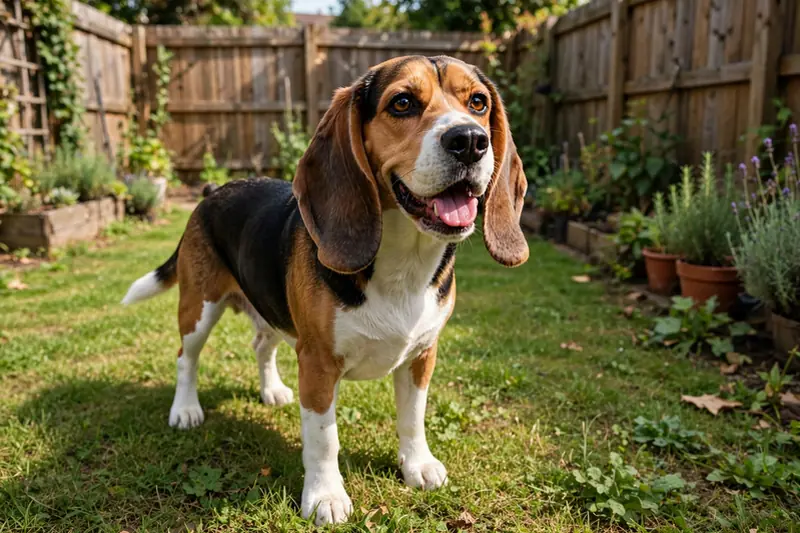
Beagle Escapes From the Yard: How to Stop It
Beagle Escapes From the Yard: The Direct Answer
When a beagle escapes from the yard, start with the route it used, not with a lecture after the fact. Walk the fence line, test every gate, and look for fresh dig spots at the base and corners.
Fix that route first, add supervision, and build recall as a backup layer. That order matters, because a Beagle will repeat a route that worked once, so closing it early stops the habit from hardening.
Key Takeaways
- Fix the exact escape route first, then add training and enrichment.
- Check fences, gates, and dig spots every week, and again after storms.
- Use a long line and supervision until barriers are tested and the habit fades.
- Never chase a loose Beagle, and always welcome a return warmly.
- Keep ID, microchip details, and a current photo ready at all times.
- Ask a vet or behavior professional about sudden escapes, pain, or aggression.
Why Beagles Escape
A beagle escapes from the yard because its nose leads first and its feet follow. Beagles were bred to follow scent trails, so a rabbit trail, a cat, or food smells can pull harder than a voice from the porch.
That pull is not spite, and it is not a sign that your dog dislikes home. It is a breed trait, and it needs management, training, and a secure yard working together.
| Driver | What you see | First fix |
|---|---|---|
| Scent trail | Head down at one fence section, nose working hard | Dig-proof and block that section first |
| Digging | Fresh soil, starter holes, paws at the base | L-shaped mesh apron and a legal dig pit |
| Jumping or climbing | Scratch marks, objects near the fence | Move launch pads, raise and smooth the fence |
| Gate or gap | Escape near a door, gate, or loose board | Self-closing hinges, strong latch, gap repair |
| Boredom or loneliness | Restless pacing, digging anywhere, vocalizing | Scent games, play, company, and routine |
| Fear or distress | Bolting during storms, panting, damage near exits | Vet check first, then a calm behavior plan |
The Yard Audit: Find the Route First
Do the audit before you buy anything. Walk inside and outside the fence, push each panel, and note every soft spot.
- Base: gaps, loose boards, soil washed away, and corners where digging starts.
- Gates: hinges, latches, gaps under the gate and beside the post.
- Height: climbable objects, low branches, bins, tables, and woodpiles.
- Triggers: neighbor animals, fallen fruit, bins, and gaps in view that invite staring.
Watch one yard session too. Most Beagles favor one spot, and that spot tells you which fix to start with.
Fence and Gate Security
Fence Height and Climbing
Aim for a solid fence about five feet high, with no gaps at the base and no horizontal rails on the inside that act as a ladder.
Move bins, tables, planters, woodpiles, and dog houses away from the fence. Shorten any run-up space, and trim low branches that offer a boost over the top.
Gate Security
Gates fail more often than fence panels. Fit self-closing hinges and a latch your dog cannot nose or lift open, and add a second clip or lock on gates visitors use.
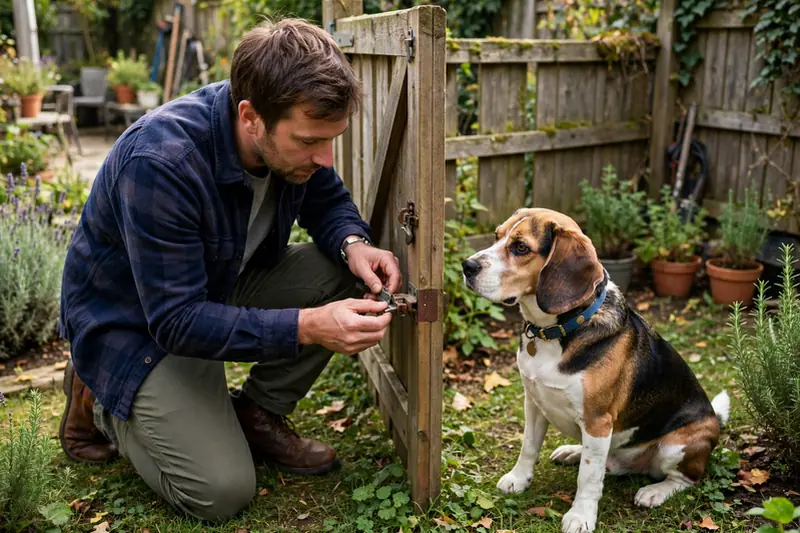
Check the gap under each gate and beside each post. Tell every household member and visitor to close the gate fully, and test it with a normal push after every change.
Digging Prevention
Digging is a common way a beagle escapes from the yard, because paws hit soil faster than a voice can stop a nose. Fit an L-shaped apron of welded wire mesh along the inside base of the fence.
Attach the mesh to the fence, lay it flat away from the fence, and cover it with soil or pavers. Cover sharp edges, check the full fence line, and use tight pavers at hot spots and gate corners.
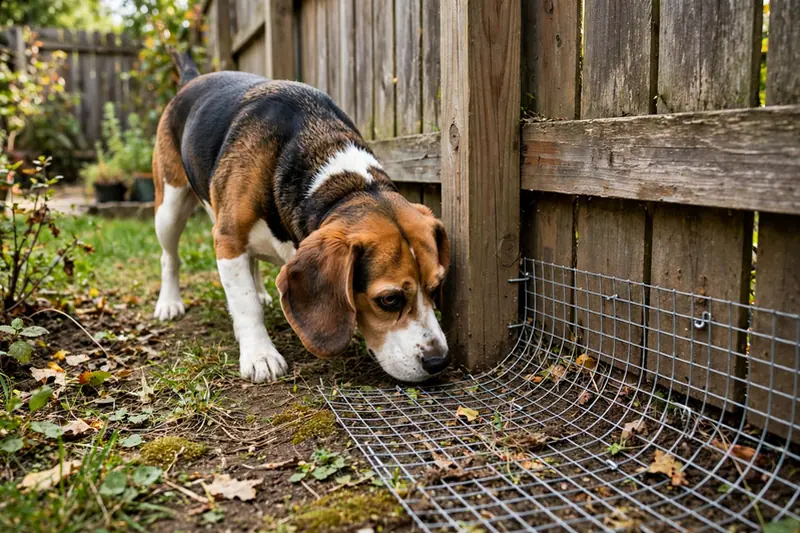
For a step-by-step dig plan, read the Beagle digging under the fence guide. Give digging a legal outlet too, with a dig pit in a quiet corner with loose soil.
Bury treats and toys in the pit so the pit beats the fence line. Keep the pit fresh by rotating buried finds, and redirect fence digging calmly to the pit.
Recall and Supervision
Recall is a backup, not a fence. Train it in stages, starting indoors, then in a quiet garden on a long line, and only then around mild distractions.
Use one cue, say it once, and reward every return with a high-value treat or a return to sniffing. For a staged plan, follow the Beagle recall guide.
Supervise yard time until barriers are in and tested. Stay outside, keep sessions shorter, and bring your dog in before digging or fence testing starts.
If your Beagle has already bolted off lead, the same calm approach helps. Read the Beagle running away off leash guide for a search and return plan.
What to Do When a Beagle Escapes
If a beagle escapes from the yard, stay calm and act fast, but do not chase. Chasing turns the escape into a game, and you will not outrun a Beagle.
- Do not chase. Crouch down, turn sideways, and use an excited, happy voice.
- Offer a high-value treat, a squeaky toy, or an open car door or garden gate.
- If your dog keeps going, follow at a distance, stay in sight, and ask neighbors to help watch.
- Tell neighbors at once with a clear photo, and contact nearby shelters and vets.
- When your dog returns, greet warmly and reward. Check paws and body for cuts, offer water, and then find the escape route.
A return must always feel safe. Scolding a dog that came back teaches it to stay away longer next time.
ID, Microchip, and GPS as Backup
No fence stays perfect forever. Posts rot, storms shift panels, and guests leave gates open, so build a backup layer before you need it.
- Flat collar with a current ID tag, worn in the yard as well as on walks.
- Microchip with current registration details, since collars can slip off.
- GPS tracker on the collar for repeat escape artists, checked and charged regularly.
- Current photos from several angles, kept on your phone for a lost-dog notice.
A tracker can help you find your dog, but it cannot stop an escape or teach recall. Use it beside a secure fence, training, ID, and a microchip.
What NOT to Do
- Do not chase, shout angrily, or grab roughly when you catch up.
- Do not scold a dog that returns, and do not use the return to end fun every time.
- Do not use shock collars, prong collars, or an invisible fence as your main barrier.
- Do not use a tie-out as a long-term fix, since tethered dogs can tangle, panic, and injure themselves.
- Do not leave your dog alone in the yard for long stretches while you wait for a fence repair.
Positive reinforcement keeps learning clear. Reward the behavior you want, manage the yard, and repeat the routine until it holds.
When to Get Professional Help
Get help early when safety is at stake. Talk to your vet first if escapes start suddenly, or if your dog shows pain, limping, hearing loss, or a sudden change in behavior.
Ask a qualified, reward-based trainer or behavior professional if escapes happen near traffic, livestock, or wildlife, or if fear, separation distress, or aggression is part of the pattern.
Do not try to train through pain, sudden change, or aggression alone. A vet or behavior professional can check for a medical cause and build a plan that fits your dog.
Frequently Asked Questions
How high should a fence be for a Beagle?
About five feet is a useful starting point, but height alone is not enough. Remove launch pads, close base gaps, and add a dig barrier, since many Beagles go under rather than over.
Why does my Beagle dig even with a dig guard?
Check the full fence line, not just the old hole, since a blocked spot often moves digging to the next weak point. Add scent games, a dig pit, and supervision, and review boredom and routine as well.
Will an invisible fence keep my Beagle in?
Not reliably. A Beagle locked onto a scent may run straight through the boundary, and an invisible fence does nothing to keep other animals or people out.
What should I do first when a beagle escapes from the yard?
Do not chase. Crouch, call happily, offer a high-value treat, and open a gate or car door if you can do so safely. Alert neighbors with a photo if your dog keeps going.
Can training alone stop escapes?
Training helps, especially recall as a backup, but management does the heavy lifting with scent hounds. Secure the fence, block the dig route, lock the gates, and then train.
Should I punish my Beagle when it comes home?
No. Greet every return warmly, even if you feel shaken. Punishing a return teaches your dog that coming home is unsafe, and the next escape may last longer.
A Calmer Yard Is Built in Layers
With fences, gates, dig barriers, recall, and ID working together, the chance a beagle escapes from the yard drops sharply. Start with the audit, fix one route at a time, and keep the routine steady.
A Beagle with a secure yard, daily scent work, and a safe return can still enjoy sniffing, playing, and exploring at home.
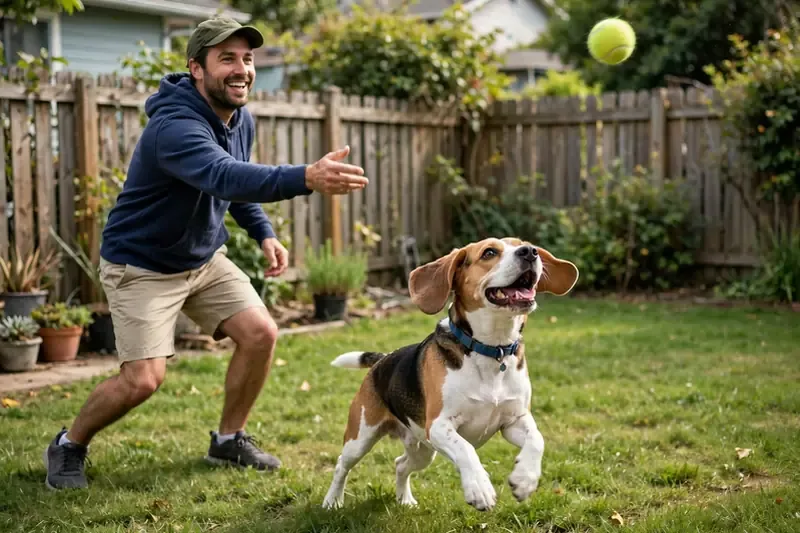
For related help, compare the Husky escaping yard guide and the Beagle baying at night guide.
Reference
American Kennel Club, Why Does My Dog Dig? Channel Your Dog’s Digging Instincts: https://www.akc.org/expert-advice/training/why-is-my-dog-digging/
Still stuck? Get a plan built for your dog.
Answer a few quick questions and get a personalized, force-free training plan in minutes.
Try the Free Dog Tools