How to Stop a Dog Barking at the Doorbell
Every delivery has become a small chaos drill. The doorbell rings, your dog erupts, you shout something you instantly regret, and the driver is already halfway down the path.
If you work from home and want to stop dog barking at doorbell, it is worse: every ring lands mid-meeting, and the apology is on your face before you unmute.
Here is the good news: you can stop dog barking at doorbell without yelling and without aversive collars.
What you need is not a louder voice. It is a plan that takes the doorbell apart and gives your dog a new job for each piece.
Key Takeaways
- The doorbell is a “perfect trigger stack”: a sudden loud sound that always predicts strangers at the boundary of the home, and the barking always appears to work.
- Management comes first: mute or change the chime, block access to the entry hall, and stop the dog from rehearsing the explosion daily.
- Desensitize the sound with recordings at low volume paired with food, then teach “go to place” as the new door routine, rehearsed with helpers before real deliveries.
- Yelling “quiet” backfires: to a barking dog, your shouting sounds like you are barking too. Never use punishment or aversive collars on door barking.
- If the barking carries on long after guests settle, or comes with pacing and panic, get a vet check and a qualified behavior professional.
Why the Doorbell Sets Dogs Off: The Perfect Trigger Stack
Most triggers are one thing. The doorbell is several, stacked.
The sound itself is sudden and loud, and dogs hear far more acutely than we do. But the real power is what it predicts: dogs are fast pattern learners, and the doorbell has never once been wrong.
It always means a stranger at the edge of the territory and the whole house about to change. Bell, footsteps, voices, the door swinging open. For many dogs this chain is the most stimulating thing that happens all day.
Then comes the emotion. Different dogs ride different feelings into the same explosion: territorial alertness, genuine excitement, or anxiety about a stranger they cannot yet see or smell.
Many feel a mix of all three. Researchers who study dog behavior describe barking as a flexible, context-driven signal, not a fixed reflex.
And it always works: the dog barks, you rush to the door, the visitor leaves or comes in, and the noise ends. A behavior rewarded several times a week for years becomes a deeply grooved habit — which is why it takes a real plan to stop dog barking at doorbell.
Finally, you are part of the pattern. If you have ever rushed to the door shouting or dragged the dog by the collar, the dog reads your agitation as proof that this really is an emergency.
You join the chorus, and the chorus gets louder. None of this is stubbornness or spite. It is a learned, rehearsed routine, and routines can be rewritten.
How to Stop Dog Barking at Doorbell: The Step-by-Step Protocol
Work through these in order.
Step 1: Take the trigger apart

You cannot stop dog barking at doorbell while the dog rehearses the explosion three times a day. Mute the chime or change the sound.
Most modern doorbells let you silence the indoor chime, lower the volume, or switch the tone. The dog cannot practice what it cannot hear, and a new tone has no history.
Use a baby gate or closed interior door to block entry-hall access while you train. Set up a station (mat or bed away from the front door) with a long-lasting chew.
Until training kicks in, every non-practice arrival means the dog goes to the station with something good. A “dog in training, please knock softly” sign by the bell is cheap and effective.
Step 2: Desensitize the sound with recordings
Rebuild the doorbell from scratch at a volume your dog can handle. Play a recording of the chime while the dog is relaxed, starting so quiet they barely notice.
The moment it plays, treats appear; when the sound stops, treats stop.
Keep sessions to two or three minutes, a few times a day, raising the volume only while the dog stays relaxed. If the dog barks or stiffens, drop back to the last easy volume.
Don’t blast the sound and flood treats to “power through”; slow wins.
Step 3: Teach “go to place” as the new door routine

Desensitization handles the sound; this handles the rushing and chaos after it. Pick a mat a few feet from the front door and lure the dog on.
Reward generously, build duration (one second, then five, then thirty), and teach a release word like “free.” A dog with a job to do is a dog who can stop dog barking at doorbell.
Once place is solid, play the low-volume recording, cue “go to place,” and reward heavily on the mat. Over sessions, fade your cue so the doorbell itself becomes the signal to go to the mat.
Then rehearse with helpers: a friend rings the actual doorbell while you run the routine (ring, place, reward, answer, release). Repeat until boring.
Everyone in the household must follow it; one person letting the dog rush the door teaches the routine is optional.
Step 4: The real-delivery practice plan
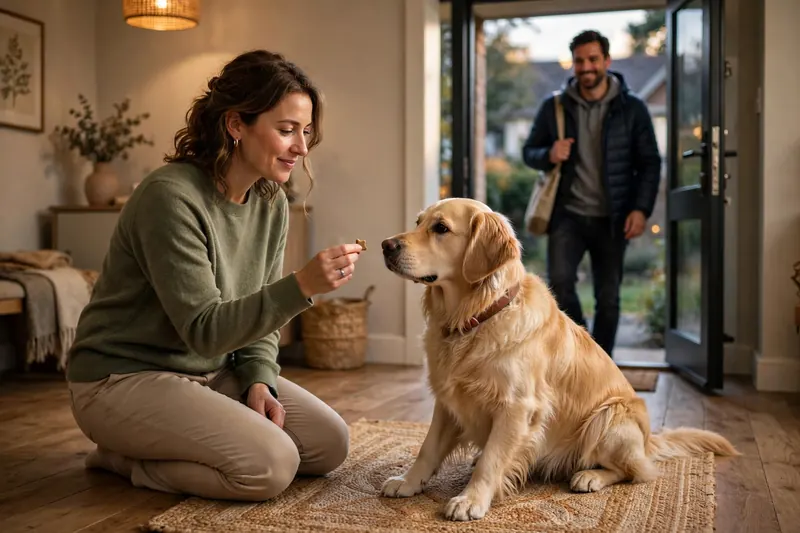
For the first week or two, treat every real arrival as management: dog to station with a chew before you open the door. Next, have a friend play delivery driver while you run the routine.
Then use real deliveries you can prepare for. You won’t nail every one, but over time the mat becomes the default — and that is how you stop dog barking at doorbell for good.
Stop Dog Barking at Doorbell in an Apartment or Shared Hallway
Apartment life changes the stakes: the dog’s doorbell routine shares a wall with neighbors, and many bells ring for someone else’s door anyway.
A white noise machine near the door and weather stripping around the doorframe cut a surprising amount of hallway sound. Desensitize the building intercom the same way as the doorbell recording work: low volume, food pairing, slow build.
Leave a note with regular couriers asking them to text instead of buzzing. A quick heads-up to close neighbors (“we are actively training, it will get quieter”) buys goodwill and time.
What NOT to Do
Do not yell “quiet” or “stop.” Say it in your head first: QUIET! QUIET! Now imagine you are a dog already barking at a threat, and your favorite human starts barking too.
That is what shouting sounds like to them: confirmation that this is a barking situation. Calm, low-energy responses only.
Do not punish the barking. Grabbing the collar, dragging the dog away, or “alpha” corrections teach the dog that arrivals are stressful and you are scary at arrivals.
They do not teach quiet. The underlying emotion has not changed, so the barking keeps coming back, often louder.
Do not use shock, spray, prong, or “ultrasonic” collars. Bark-activated collars punish the dog for arousal they were never taught to handle another way.
They suppress the sound without changing the feeling, and they can make door-related anxiety worse. This protocol is the shortcut to stop dog barking at doorbell: boring, consistent, effective.
Kids Answering the Door: A Safety Note
Build the door plan around children. Kids should never answer the door while the dog is loose, and the dog should never be allowed to rush past a small child to get to the entry.
A dog in full door-arousal mode knocks toddlers over easily, and an overexcited jump on a child is frightening even when the dog means no harm.
Keep it simple: kids do not open the front door alone. The dog is on their mat or behind a gate before the door opens. No exceptions, no “just this once.”
Teach older kids to ignore the dog at the door completely: no chasing, no restraining, no squealing. If the dog jumps on a child during arrivals, that is a management failure to fix, not a child to blame.
When Barking Signals Bigger Anxiety
Door barking is normal, fixable, and most dogs respond to this protocol. But sometimes the barking is the visible edge of something deeper.
Get a vet check and then a qualified behavior professional (ask directly what happens when the dog gets it wrong: the answer should never involve pain, fear, or intimidation) if:
- The barking carries on long after the visitor sits down, with pacing, panting, or an inability to settle
- The dog barks at family members coming through the door, not just strangers, or has become reactive toward guests who enter
- The door barking sits inside a wider pattern: destructive behavior when alone, panic at departures, refusal to eat when visitors come
- The behavior appeared suddenly in a previously calm adult dog. Sudden behavior changes always deserve a vet check first.
Frequently Asked Questions
How long does it take to stop dog barking at doorbell?
Most owners see real improvement within two to four weeks, with the door routine becoming reliable over a couple of months. It depends on how long the dog has rehearsed the old behavior and how consistent the household is.
Should I teach “quiet” or “go to place” first?
Teach them as partners: “quiet” handles the vocal part, and “go to place” gives the dog something to do instead of barking. If you only teach “quiet,” the dog sits by the door in restrained explosion. If you only teach place, the dog may run to the mat while still barking.
Will my dog still alert me if someone comes?
Probably yes, and that is fine. The goal is not a mute dog; it is a dog who gives a short alert and then goes to their station. Most owners end up with a dog who barks once or twice at the door and then trots to their mat. That is a success.
Can I just disconnect the doorbell?
Yes, at least temporarily. Removing the chime is excellent management while you train. But it does not cover knocks and other door sounds, so keep training alongside it. If muting buys you two quiet weeks, mute it.
My dog barks at the doorbell on TV. What do I do?
Run the same desensitization on TV sounds: lower the TV volume, play your doorbell recording quietly, and pair it with food. Dogs do not know the difference between a TV doorbell and a real one, so treat them as the same trigger until the training generalizes.
If you want to stop dog barking at doorbell, remember this is a rehearsal problem, not a personality problem: the same routine, practiced hundreds of times.
Replace the routine with a better one — a mat, a quiet chime, a helper at the door — and the explosion loses its job. For more on door behavior, read our guide to stopping Dachshund barking at guests, and if your dog also sounds off at people on the street, see why Dachshunds bark at strangers.