

Dog Afraid of Slippery Floors? How to Help
Direct answer
If your dog is afraid of slippery floors, fix the footing first, then rebuild confidence slowly. Lay non-slip rugs along the routes your dog already uses, keep nails short, and trim fur between the paw pads.
If the fear started suddenly, or your dog limps, stiffens, or struggles to stand, see your vet before training. Pain and weakness are common causes, especially in senior dogs, and no training plan can fix an untreated medical problem.
Why dogs fear slippery floors
A dog’s paws grip grass, dirt, and carpet well. Sealed hardwood, polished tile, laminate, and vinyl give those same paws almost nothing to hold on to.
Dogs slip most when they start, stop, turn, sit, or stand up. Their legs can splay sideways, which is frightening even when no injury happens.
One bad slip is often enough to create lasting fear. A dog that slid into a wall or did the splits in the kitchen may decide the whole room is unsafe.
That fear is not stubbornness. Your dog is avoiding a surface that has already hurt or scared them, and that avoidance makes sense to them.
Why senior dogs are affected most
Ageing joints and weaker muscles make slips harder to recover from. A younger dog may catch a sliding foot quickly, while an older dog may not.
Arthritis can make that small correction painful. The American Kennel Club lists stiffness, limping, difficulty getting up, and reluctance to run, jump, or play among the signs of osteoarthritis in dogs.
Vision changes can add to the problem. A shiny or dark floor may look confusing, and a dog that cannot judge the surface well may hesitate at the edge.
Neurological problems can also reduce stability. Weak or wobbly hind legs, dragging paws, or a foot that knuckles over all deserve a vet check, not just more practice.
Vet red flags: see your vet first
Book a vet visit before training if you notice any of these signs. They can point to pain, arthritis, a spinal problem, a neurological condition, or vision loss.
- Fear that appeared suddenly in a dog who previously walked the floors fine
- Limping, stiffness after rest, or trouble getting up or lying down
- Weak or wobbly hind legs, dragging paws, or knuckling over
- Fear that keeps getting worse even after you add traction
- Yelping, snapping when touched, or reluctance to be handled
If your dog is in pain, ask your vet about assessment and treatment options. Do not start a medication, supplement, or exercise plan on your own for a painful dog.
A certified behavior professional can help if fear stays strong after medical causes are ruled out. Look for someone who uses positive reinforcement only.
Step 1: Build a traction path
This is the single most useful step for a dog afraid of slippery floors. Rugs and runners help more than any training exercise on a bare floor.
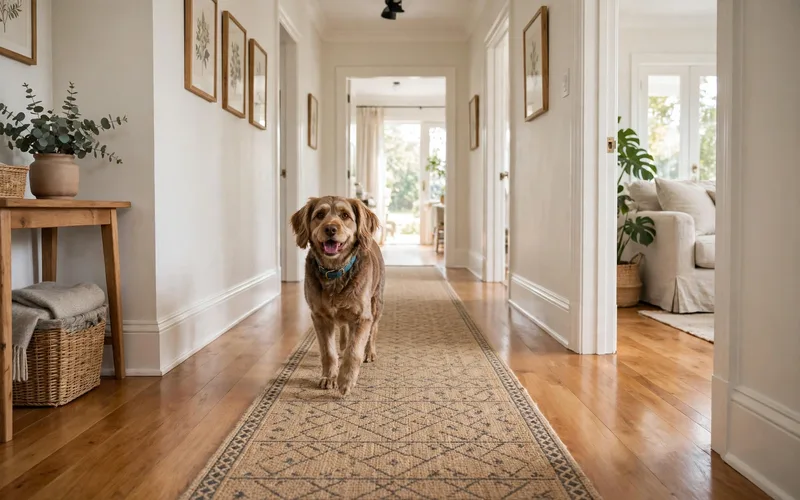
Lay runners or low-pile rugs along the paths your dog actually uses. Bed to water bowl, food bowl, and door usually matter most.
Use a non-slip pad under every rug. A rug that slides is no safer than the bare floor underneath it.
Place a mat right by the bed. Standing up from rest is one of the slipperiest moves, especially for a stiff or senior dog.
You do not need to cover the whole house. Cover the essential routes first, then add more only where your dog still hesitates.
Step 2: Fix the paws
Long nails lift the pads off the floor and reduce grip. If you hear clicking on hard floors, the nails are likely too long.
Trim a little at a time, and ask your vet or groomer for help if you are unsure. This is especially important with dark nails, where the quick is hard to see.
Trim the fur between the paw pads too. Long fur underfoot works a bit like wearing socks on a polished floor.
Check the pads weekly for cracks, dryness, cuts, or soreness. A dog-specific paw balm can help dry pads, but avoid human moisturizers unless your vet advises them.
Step 3: Compare traction options
Rugs are the backbone of the plan, but other options can fill gaps. No single option suits every dog, so try one change at a time and watch how your dog responds.
| Traction option | Best for | Note |
|---|---|---|
| Rugs and runners with non-slip backing | Most dogs, especially at home | Must not slide or bunch up |
| Toe grips (small rubber rings over the nails) | Dogs that will not wear boots | Need refitting as nails grow; not every dog tolerates them |
| Traction socks | Short trips on floors you cannot cover | Some dogs chew them off or walk oddly in them |
| Dog boots with grippy soles | All-paw coverage outdoors or on very slick floors | Many dogs dislike foot wear; introduce slowly with treats |
| Dog-specific paw balm | Dry or cracked pads | Helps grip only a little; it does not replace rugs |
Resist buying a drawer full of gadgets before the rugs are down. Start with rugs and paw care, then add one extra option only if a gap remains.
Step 4: Rebuild confidence, one small step at a time
Keep every session short, calm, and easy to leave. Your dog should always be able to step back onto a rug.
Start with a treat trail from a rug onto a tiny patch of bare floor. Reward every brave step, then let your dog return to safety.
Over days, lengthen the patch slightly. If your dog freezes, the patch was too big, so make it smaller next time.
End each session while it still feels good. A short, happy session teaches more than a long session that ends in panic.
Never lure your dog into the middle of a slick area with a treat. A frightened dog stranded mid-floor may panic, scramble, and slip again.
The same gradual, reward-based approach helps other fears too, such as a dog afraid to get in the car. Small steps and rewards beat pressure every time.

A gentle two-week confidence plan
This plan is a guide, not a deadline. Move to the next stage only when your dog is relaxed at the current one.
Week 1, days 1 to 3: rugs only. Let your dog walk the rug path calmly and reward relaxed walking, standing, and turning on the rugs.
Week 1, days 4 to 7: one small gap. Leave a gap of just a few inches between two rugs and reward each calm crossing.
Week 2, days 1 to 3: slightly longer gaps. Widen the gaps a little at a time, keeping an easy escape route back to a rug.
Week 2, days 4 to 7: short bare patches. Ask for a few calm steps on bare floor between rugs, then reward and finish.
If progress stalls, stay at the current stage for longer. Going back a stage is not failure; it is how confidence is built safely.
Help for senior and arthritic dogs
Move food, water, and bed closer together if you can. Shorter routes mean fewer chances to slip and less strain on sore joints.
Steady your dog with a hand on their harness when they stand up. Do not lift by the collar or pull them upright by force.
Gate off stairs and sharp turns on slick floors when you cannot supervise. Falls on stairs carry a higher risk than a slip on a flat floor.
Place a comfortable orthopedic bed for old dogs on the rug route. A soft, stable resting spot gives sore joints a safe place to land.
Carrying a small or painful dog over a scary stretch is fine in the short term. Keep vet checkups regular, since worsening arthritis can bring the fear back.
Keep play slow on hard floors. Avoid chase games, fast recalls, and toy throws across slick surfaces, since speed is when slips happen.

What not to do
Never drag, push, or pull a dog across a slippery floor. Forcing a frightened dog onto a surface they believe is dangerous breaks trust and deepens fear.
Never punish refusal. Scolding a dog for balking at a threshold tells them the scary floor also comes with scary people.
Do not flood your dog by removing all rugs “until they get used to it.” Living with nothing but exposed floors can turn mild hesitation into deep, lasting fear.
Do not use aversive training methods. Shock collars, prong collars, and intimidation have no place in fear work and only add panic.
Do not assume it is “just fear” without a medical check. A sudden change in an older dog is a reason to call your vet, not a reason to train harder.
Puppies and newly adopted dogs
Start with traction before a bad slip teaches the wrong lesson. Rugs down first, then rewards for calm exploring.
Play on rugs and reward calm walking on small bare patches early. Keep it fun, and let the puppy choose to step forward.
If a puppy freezes, do not coax, carry, or push them onto the floor. Wait, reward any small movement toward it, and try again another day.
Key takeaways
- Traction is the fix, not bravery: rugs, runners, and mats with non-slip backing help most
- Keep nails short and trim fur between the paw pads so the pads can grip
- Rule out pain first when fear is new, sudden, or getting worse
- Rebuild confidence with tiny, rewarded steps and an always-open escape route
- Never drag, punish, or force a fearful dog across a slippery floor
You do not need to renovate your house. A few runners, a nail trim, some patience, and belief in your dog go a long way.
Fix the footing, rule out pain, reward brave steps, and many dogs reclaim their rooms over a few weeks. If progress stalls, your vet or a positive-reinforcement behavior professional can help.
Frequently Asked Questions
Why is my dog suddenly afraid of slippery floors?
A sudden fear often follows a slip, but it can also signal pain, arthritis, weakness, or vision change. Start with a vet visit, then add rugs along daily routes.
Why is my senior dog suddenly afraid of the hardwood floor?
Ageing joints and weaker muscles make it harder to catch a sliding foot, and that correction can hurt. See your vet first, then build a rug path and keep nails and paw fur trimmed.
Are boots or toe grips better for traction?
Rugs beat both for most dogs at home. Toe grips suit dogs that will not tolerate boots, while boots suit dogs that need all-paw coverage. Try rugs and paw care first.
Can a dog injure themselves slipping on hardwood floors?
Yes, a bad slip can strain muscles and ligaments, and repeated slipping can worsen sore joints. Seniors are most at risk, which is why rugs on daily routes matter so much.
How long does it take for a dog to get used to slippery floors?
It varies, and there is no fixed timeline. Many dogs improve over a few weeks with rugs, paw care, and short rewarded sessions, but a dog with pain or deep fear may need longer and professional help.
Should I carry my dog across slippery floors?
Carrying a small or painful dog over a scary stretch is fine short term. For larger dogs, use a rug path and harness support instead, and address the underlying cause with your vet.
Reference
Reference: American Kennel Club: Osteoarthritis in Dogs: Signs, Symptoms, Treatments – https://www.akc.org/expert-advice/health/osteoarthritis-signs-treatment/
Still stuck? Get a plan built for your dog.
Answer a few quick questions and get a personalized, force-free training plan in minutes.


